
Start with the thing that should embarrass us.
A concrete highway bridge built today, with steel inside it and a century of materials science behind it, is doing well if it lasts fifty years without serious repair. Water finds a hairline crack. It freezes and pries. It reaches the steel reinforcement, rusts it, and rust swells, and swelling cracks more concrete, and the whole structure begins eating itself from the inside out. That is not a defect. That is the expected life cycle of the most widely used building material on the planet.
Now go stand on a Roman pier.
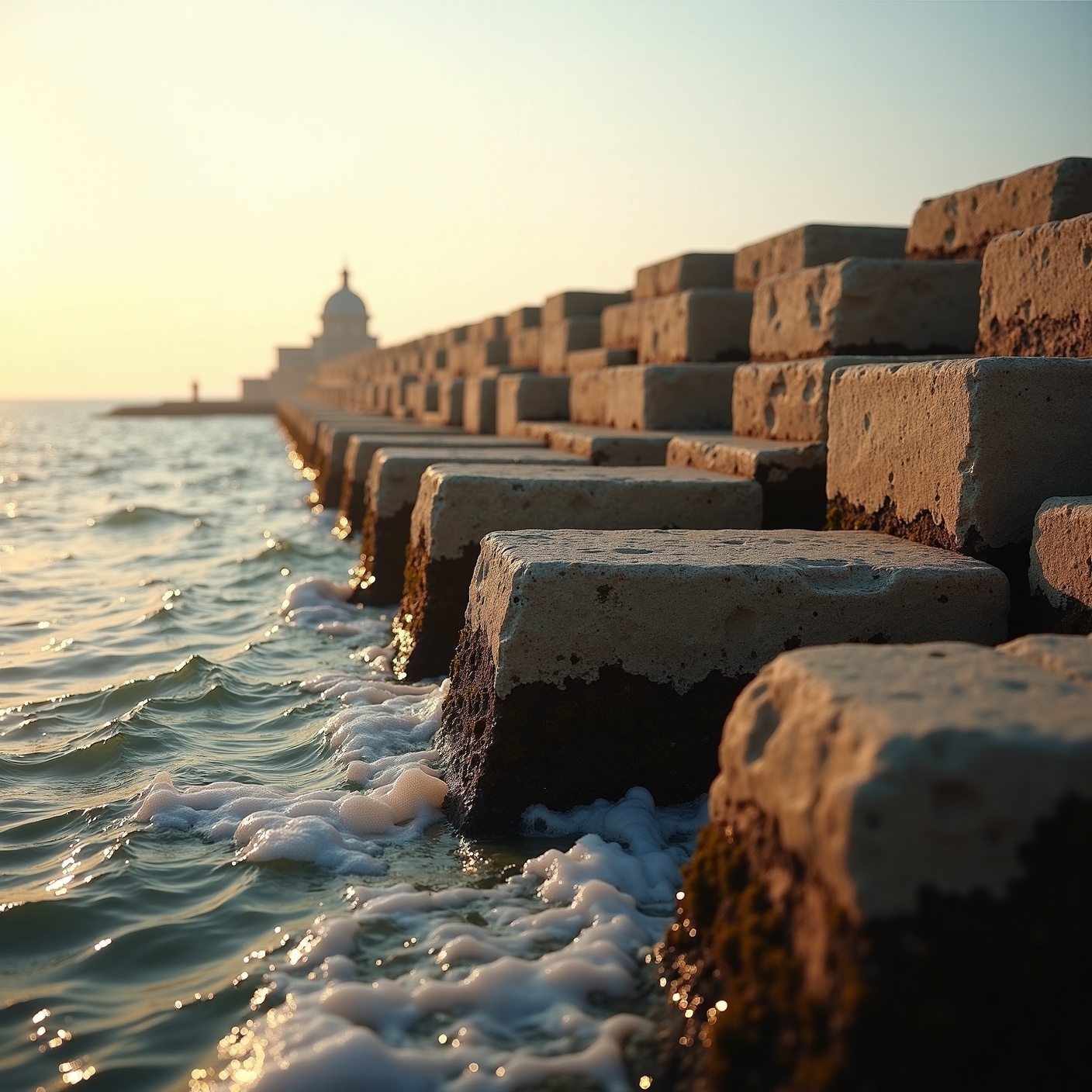
Not a reconstruction. The actual thing, poured before the birth of Christ, sitting in open salt water, taking waves in the face every single day for twenty centuries. It’s fine. Roman breakwaters and harbor works are still there. The dome of the Pantheon in Rome, unreinforced concrete, has been holding itself up since roughly the year 126, and nobody has ever had to inject it with anything.
This drove people slightly crazy for a long time.
The standard explanation was the volcanic ash. The Romans mixed pozzolanic ash from the region around Naples into their lime, and that ash reacts in a way ordinary sand does not, producing a tougher, more chemically stable material. True, as far as it goes. It just never went far enough to explain a two-thousand-year harbor wall.
And there was a loose thread nobody could pull. Scattered all through ancient Roman concrete are small white lumps, chalky, calcium-rich, big enough to see without a microscope. They are called lime clasts. For generations they were treated as evidence of incompetence: proof that the Romans mixed badly, that the lime hadn’t been properly blended, that some laborer in a hurry left lumps in the batter. An embarrassing flaw in an otherwise excellent recipe.
In 2023 a research team led out of MIT, working with colleagues at Harvard and in Italy and Switzerland, published a study in the journal Science Advances that turned that assumption completely inside out.
The lime clasts are not a mistake. They are the mechanism.
Here is what the team found when they took ancient samples apart at the microscopic scale.
The Romans, it appears, were not slaking their lime gently in water first, the way modern practice would have you do. They were using quicklime and mixing it in hot. The reaction runs violently hot on its own, and the researchers argue this “hot mixing” was deliberate. It’s fast. It sets quicker. It lets you build in ways that patient chemistry wouldn’t allow.
And it leaves behind those white lumps, which under the microscope turn out to have a very particular character. They are brittle. They are nanoparticulate, full of tiny structures and internal surfaces, a bit like a hard sponge made of calcium. They are, chemically speaking, a loaded reservoir sitting inside the concrete doing nothing at all.
Until the concrete cracks.
Because here is the elegant part. When a crack begins to travel through Roman concrete, it does not wander at random. It preferentially runs through the lime clasts, because they are the brittle bits, the path of least resistance. The crack finds the reservoir and breaks it open.
Then it rains. Or a wave comes in. Water gets into the crack, exactly the way water gets into the crack of your local overpass, and this is the moment where the two materials part ways forever. In the Roman mix, the water hits that freshly fractured clast and dissolves it into a calcium-saturated solution. That solution runs along the crack. And then it recrystallizes, growing new calcium carbonate right there in the gap, welding the two faces together.
The crack seals itself shut. In lab tests recreating the ancient recipe, cracked samples of hot-mixed Roman-style concrete closed themselves completely within two weeks of water exposure. Control samples made without the lime clasts never closed at all.
Water is the enemy of modern concrete. In Roman concrete, water is the repairman.
And in the sea, they went further still. Roman engineers building piers and harbors mixed their concrete with seawater on purpose, which sounds like sabotage to a modern contractor. Salt water is precisely what we spend fortunes keeping away from our structures. But in combination with that volcanic ash, seawater kicked off a slow chemical conversation inside the material that never really stopped. Over decades and centuries, rare minerals grew inside the concrete: aluminous tobermorite, phillipsite, interlocking crystals threading through the matrix.
The material didn’t degrade in the ocean. It kept getting stronger in it. The waves that should have destroyed those harbor walls were, in a sense, still building them.
Two thousand years later we are the ones playing catch-up. Researchers are now testing modern versions of hot-mixed, self-healing Roman-style concrete, with an eye on coastal structures along the United States shoreline, the seawalls and piers and bridge piles that currently need constant, expensive repair. A concrete that repairs its own hairline cracks would not just last longer. It would mean less demolition, less replacement, and far less new cement, which is one of the largest single sources of carbon emissions on earth.
So the summary is roughly this.
For a hundred years we looked at the white specks in Roman concrete and saw sloppy workmanship. We were looking directly at the answer and calling it a flaw. It took electron microscopes and a 2023 paper to notice that the Romans weren’t being careless.
They were building something that knew how to fix itself.