The water off Florida’s central west coast is shallow and green and busier than it looks. Seagrass flats, boat channels, mullet flashing in the shallows, and bottlenose dolphins working the whole thing like it’s their own back yard, which it is.
Biologists with the Sarasota Dolphin Research Program, run by the Chicago Zoological Society, have been watching that stretch of coast for decades. Long enough to know individual animals on sight. They can tell you which calf belongs to which mother, who’s been sick, who had a bad year. It is, if you think about it, one of the longest-running neighborhood watches on earth, and the neighbors are dolphins.
Which is how they noticed him.
February: a thin young dolphin
He was a male, about two years old. Still traveling with his mother, the way a calf that age does, still learning the flats.
And during a routine February survey, the team looked at him and saw a body that was too lean. Not catastrophic. Just wrong for a two-year-old who should have been filling out.
They logged it. They watched for him. That’s how this work goes: you notice, you record, you come back.
March: the follow-up
When they found him again in March, they had their answer, and it was the answer nobody wanted.
A length of fishing line had wrapped around the base of his tail. It had been there a long time and it had cut deep. That’s all that needs to be said about the injury.
What matters is what it meant. A dolphin’s tail is its engine. Everything else, the catching, the fleeing, the staying with his mother, runs off that one muscle. He wasn’t thin because food was scarce. He was thin because he could no longer chase it properly, and the line was still there, still working, and he was not going to get free of it by himself.
Two-year-old dolphins do not survive that. Not without help.
The morning the whole coast showed up
So the researchers made calls. And here’s the part of this story that will stay with you longer than the dolphin will.
Everybody said yes.
Mote Marine Laboratory said yes. The Florida Fish and Wildlife Conservation Commission said yes. The University of Florida’s College of Veterinary Medicine sent people. Clearwater Marine Aquarium sent people. NOAA Fisheries signed off and sent people. The Sarasota Dolphin Research Program pulled its own team together.
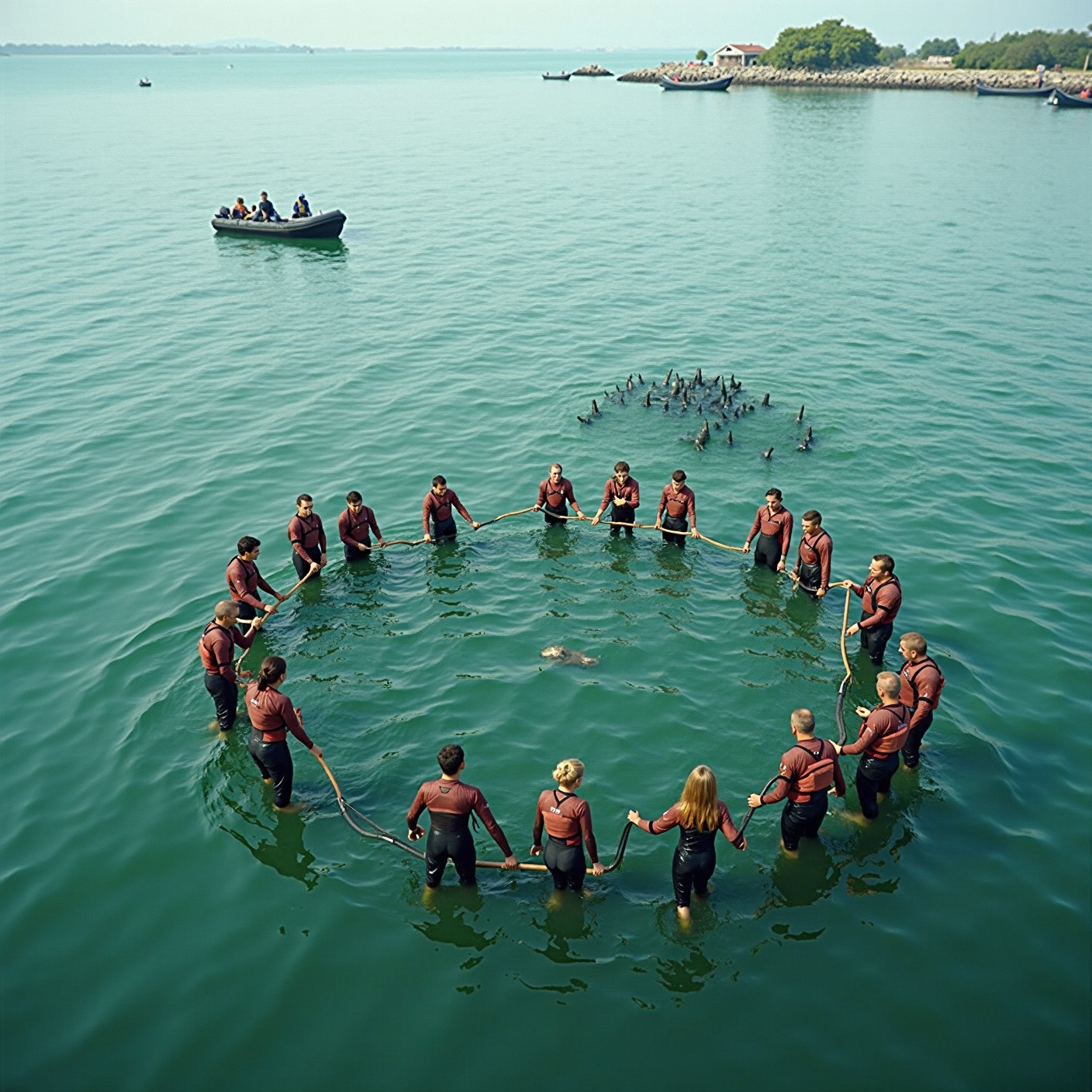
Eight boats. Forty-eight human beings on the water, most of whom had other jobs that day and did those jobs later, all of them out on the flats for a two-year-old animal with a name that was a number in a database.
Nobody was getting paid extra. There was no camera crew. There was one dolphin who was running out of time.
Twenty minutes
The plan was old and simple and it depends entirely on people not making mistakes.
They found him in shallow water, which is the one thing working in their favor, because a dolphin in open deep water is not catchable by anyone. Then the boats moved into position and paid out a net in a slow, closing circle, and this is where twenty minutes of careful work either goes right or goes very wrong.
It went right.
Inside twenty minutes he was encircled. Hands in the water, steadying him, keeping him calm and keeping his blowhole clear. A veterinary team already in position.
Then the cut. The fishing line came off. All of it.
They treated the wound. They gave him antibiotics. They checked him over the way you check over any patient you have exactly one shot at, and they did it fast, because the kindest thing you can do for a wild dolphin is finish and let him go.
And then they let him go
He went back into the water the same day.
The team’s own account is plain about it: he swam away strongly. Not staggering, not sinking. Strongly. Off into the green shallows where he’d spent his entire short life, with his tail working again.
They kept watching for him afterward, because of course they did. That’s what that program does. It has been watching that coastline for generations of dolphins, and it will be watching when this one is grown and gray-ish and traveling with a calf of his own.
(The whole operation was carried out under NOAA permit #18786-03, which is the unglamorous paperwork that makes it legal to put your hands on a wild dolphin at all.)
What it was really about
One fishing line. Somebody’s ordinary afternoon on the water, months ago, and a piece of monofilament that got away from them.
Forty-eight people to undo it.
That’s the math worth sitting with. It is spectacularly inefficient. It makes no sense on a spreadsheet. Six organizations, eight boats, an entire coordinated morning, spent on a single animal who will never know any of their names.
And every one of them would do it again tomorrow.
Source: NOAA Fisheries (fisheries.noaa.gov).