On the morning of January 24, 2017, a baby hippo was born at the Cincinnati Zoo who was not supposed to make it.
She came six weeks early. A newborn Nile hippo normally weighs somewhere between fifty-five and a hundred and twenty pounds. This one tipped the scale at just twenty-nine. She was too weak to stand. Too weak to nurse. She couldn’t push herself up onto her own legs, and she couldn’t do the one thing a newborn has to do to survive, which is feed.
Her keepers named her Fiona.
Everyone who has ever loved an animal knows the feeling in that first hour — the one where you can see how small the odds are, and you decide, quietly, that you’re going to fight for them anyway. That’s where the Cincinnati Zoo team started. Not with panic. With a plan.
They knew they were out of their depth on their own, so they did something a zoo almost never has to do: they called in a children’s hospital. The team from Cincinnati Children’s — people who spend their careers keeping premature human babies alive — came in to help keep a premature hippo alive. Around the clock. Shifts through the night. The same careful, patient, hour-by-hour work you’d give any tiny life that arrived too soon.
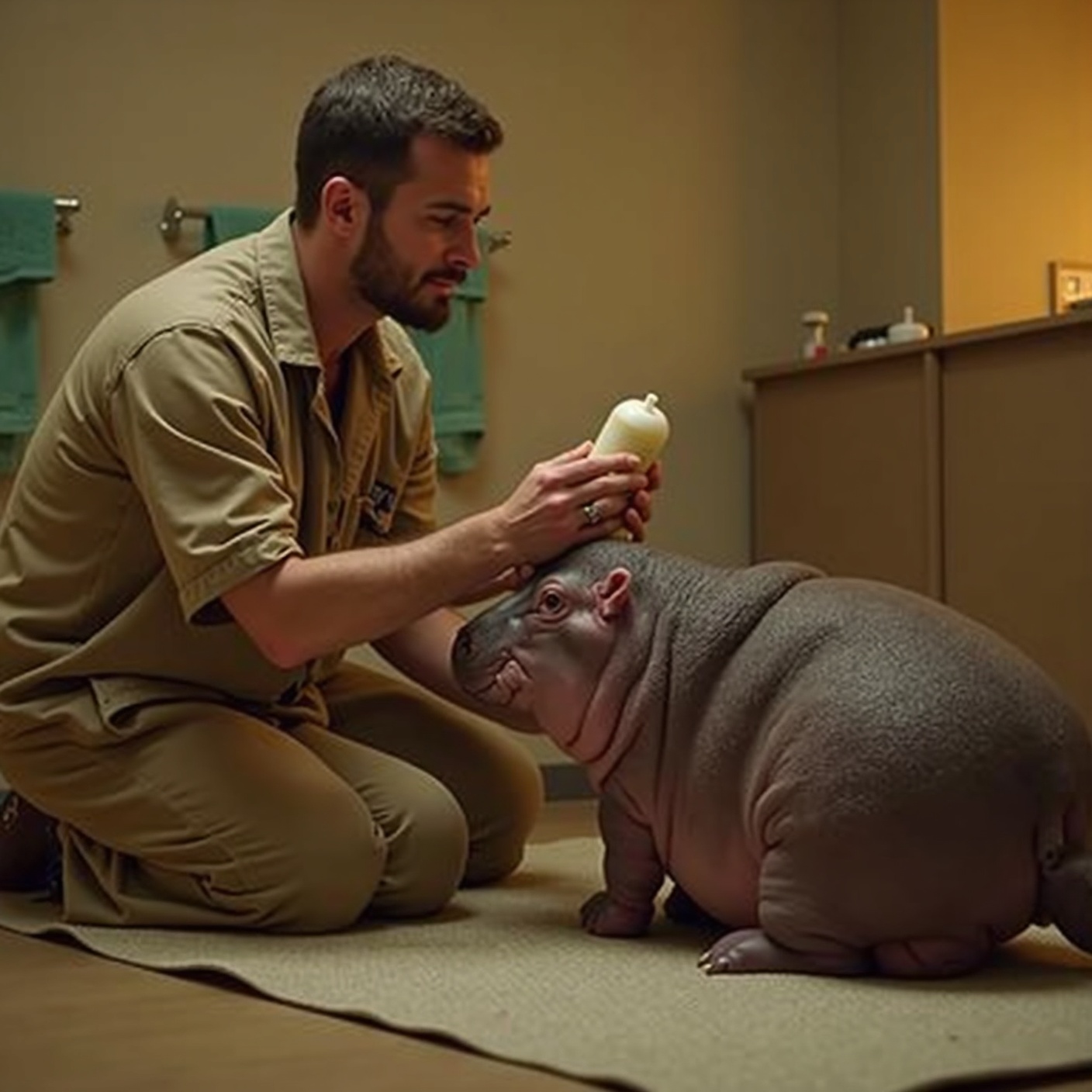
But there was a problem no hospital had a ready answer for. Fiona was too weak to nurse from her mother, Bibi — and there is no such thing as a can of baby-hippo formula sitting on a shelf. Nobody makes it. Nobody had ever needed to.
So the team invented it.
They hand-milked Bibi, the mother hippo, to get the real thing — and then used that milk to reverse-engineer a formula that matched it as closely as they possibly could. Something Fiona could actually take, that gave her body what her mother’s milk would have. It had, as far as anyone knew, never been done before.
And it worked.
Ounce by ounce, day by day, Fiona started to grow. The wobble left her legs. She figured out how to stand, then how to move, then how to be the splashing, snorting, gloriously chubby little hippo she was always meant to be. The zoo had done things with her that had never been done with any hippo — she was the first Nile hippo ever seen on a prenatal ultrasound before she was even born, and the first hippo born at the Cincinnati Zoo in fifty-three years.
Then something happened that nobody planned.
The zoo had been posting little video updates of her recovery — just short clips, a few seconds of Fiona wobbling, Fiona eating, Fiona discovering water. And people could not get enough of her. The updates kept coming, nearly every day, for close to two years. They became the most viral thing the zoo had ever made. Fiona wasn’t just surviving anymore. She was famous. People all over the world were checking in on her the way you check in on a friend, watching a hippo they’d never meet grow up from twenty-nine pounds into a happy, thriving giant.
She became such a landmark that in October 2017, a couple got engaged right at her enclosure — and the photo of Fiona in the background, seemingly watching the whole proposal happen, took off on its own and traveled around the internet all over again.
The little hippo who wasn’t supposed to live had become one of the most beloved animals on earth.
And the story kept getting happier. In August 2022, Fiona got a little half-brother named Fritz, and by then so many people were invested in her family that the zoo let the public help name him — more than two hundred and twenty thousand votes came in to pick the name Fritz.
Think back to that first morning. Twenty-nine pounds. Too weak to stand. Too weak to eat. A team that could easily have decided the odds were just too long.
Instead they called a children’s hospital, milked a mother hippo by hand, built a formula that had never existed, and stayed up through the nights until a life too small to hold itself up grew strong enough to splash.
Fiona was never supposed to make it. She grew up to be famous for it.