
Sarah had a rule about the units nobody could see into, and the rule was: bid low and expect junk.
That’s the whole business, really. She’d been flipping abandoned storage lockers for six years, buying them at the public lien auctions when somebody falls far enough behind on rent that the facility cuts the lock and sells whatever’s inside to the highest bidder, sight unseen, cash only, hauled out same day. Most of it is exactly what it sounds like — broken furniture, water-stained boxes, a treadmill somebody swore they’d use. You buy ten units to find one that pays. You learn not to hope.
This one was in a low cinderblock facility off the interstate outside Chicago, on a gray Tuesday with a wind that went right through her coat. The auctioneer rolled up the door on unit 114 and gave everyone their sixty seconds to look from the threshold — you can’t step inside, you just crane your neck and guess. Sarah saw a couch on its end, some black trash bags, a bicycle with no chain, and up on top of a dresser, by itself, a long white garment bag laid out flat and careful, the way you’d lay down something you loved.
She bid a hundred and fifty dollars and nobody fought her for it.
She waited until the lot cleared out to open the bag, because six years in she’d learned that the good moments are better alone. She unzipped it slow. Inside, wrapped in yellowed tissue and a bedsheet gone soft with age, was a wedding dress. Not a costume, not a prom dress — a real one, ivory satin gone the color of tea, with a high lace collar and small covered buttons all down the back, the kind of dress a woman is sewn into. There was a tag from a bridal shop that hadn’t existed in decades, and pinned inside the bodice, in a hand that had faded to brown, a little card that read simply: June 1964.
Next to the dress on the dresser was a shoebox. Sarah lifted the lid and there was a whole life in there — a stack of photographs, black-and-white going to color as they went down, a young couple on a church step, a baby in a christening gown, a little girl blowing out candles, a teenager scowling at the camera the way teenagers do. Somebody’s entire history, sitting in a locker off the interstate, sold for a hundred and fifty dollars because they’d fallen a few months behind on the rent.
Most flippers would’ve priced the dress for a costume shop and dumped the photos. Sarah couldn’t. She never could. That was the part of the business that had slowly become the whole point of it for her — she’d built a small following online doing exactly this, photographing the personal things she found and trying to get them home. Wedding rings. Photo albums. A Purple Heart, once, that she’d driven four hours to hand to a man’s grandson. People followed her for the reunions.
So that night she laid the 1964 dress out on her kitchen table under the good light to photograph it, and that’s when she felt it.
She was pressing the seams flat with the side of her hand, the way you smooth fabric to get a clean shot, running her palm down along the hem — and under the hem, sewn up inside the lining where the satin doubled over, there was something that wasn’t fabric. Something small and firm and rectangular. Her fingers stopped.
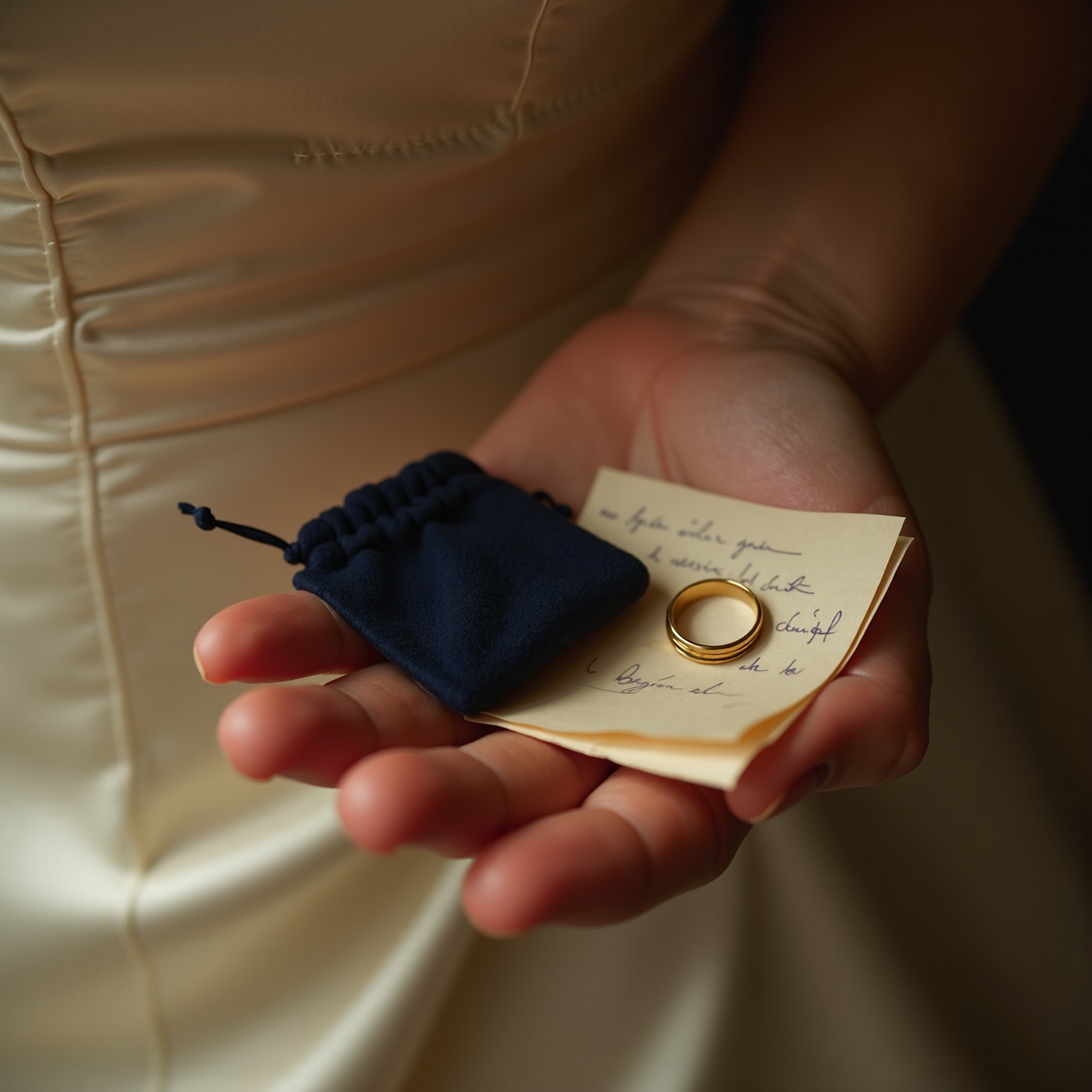
She almost didn’t open it. It felt like breaking into something. But she turned the hem inside out and found a line of stitches that didn’t match the rest of the dress — clumsier, newer, done by hand and in a hurry — and when she worked them loose with the point of her scissors, a little pouch of dark blue velvet dropped into her palm.
Inside the pouch was a ring. A thin gold wedding band, a woman’s, worn soft on the inside the way a ring gets after decades on a hand. And folded around it, no bigger than a business card, a piece of paper.
Sarah unfolded it under the kitchen light. The ink was blue ballpoint, the handwriting careful. At the top, a date: October 1994. And under it, three lines that made her set the ring down on the table very gently, because her hands had gone unsteady:
Melissa — if you are ever reading this, then I finally found the nerve, or I am gone and it found you for me. Everything I couldn’t say out loud is in this ring. I’m sorry. Come home. — Mom.
Sarah sat with that for a long time.
She’d found notes before. She’d never found one that had been hidden and sewn shut and then lost for thirty years, a letter mailed into the dark by a woman who couldn’t make herself mail it any other way.
It took her four days to find the owner. She posted three photos — the dress, the christening gown, the little girl with the candles, faces carefully cropped — and asked her followers to help her get a 1964 wedding dress back to whoever loved it. She said nothing about the ring or the note. That part wasn’t for the internet. The post traveled the way those posts do, and on the fourth day a message came from a woman two suburbs over who said the little girl in the christening gown was her aunt, and the bride in 1964 was named Diane, and Diane was eighty-two and still alive and in an assisted-living apartment across town, and yes — yes, she had lost a storage unit last winter, and she’d cried about it, and the family had assumed it was all gone.
Sarah called her that evening.
She meant to keep it simple. She meant to say I have your dress, I’d love to bring it to you, and save the rest for in person, because you don’t hand a stranger the heaviest thing you own over the phone. She got as far as her name, and I do this thing where I try to return what I find, and I have your wedding dress, the one from 1964, and a box of your photographs.
There was a silence on the line. Then a small, shaking breath.
“The dress,” Diane said. “You have the dress.”
“I do. It’s beautiful. I have it here, it’s safe — “
And Diane, crying now, not letting her finish, said the thing that made Sarah’s hand close hard around the little velvet pouch in her cardigan pocket, the ring pressing into her palm through the fabric.
“Wait,” Diane said. “Wait — is there anything sewn inside the hem? I put something in there. Before everything happened with Melissa. Please tell me it’s still — is it still in the hem?”
Sarah closed her eyes.
“It’s here,” she said. “The ring and the note. I found them. Diane, they’re right here.”
She heard the old woman make a sound she’d remember for the rest of her life — relief and grief and thirty years all coming loose at once — and then Diane just said, over and over, “Oh, thank God. Oh, thank God,” until she could breathe again.
They talked for two hours.
Diane told it slowly. She and Melissa had fallen apart in 1994, the way a mother and daughter sometimes do — not one clean break but a hundred small ones, a wedding Diane hadn’t approved of, words said in a kitchen that couldn’t be taken back, a phone that stopped getting picked up. By that October they weren’t speaking. And Diane, sixty then and certain she’d ruined the one thing that mattered, had done the only thing she knew how to do with feelings she couldn’t say. She’d taken off her own wedding ring — her marriage to Melissa’s father, who’d died young — and she’d written the note she was too proud and too frightened to send, and she’d sewn both of them into the hem of her wedding dress. The dress she’d always, always assumed Melissa would wear someday.
“I told myself I’d give it to her when she got married again, or when she had a daughter, or when we made up,” Diane said. “I told myself there’d be a right time. And I kept not being brave enough. And then the years just — went. You don’t feel them going. And I got old and I couldn’t pay the storage and I thought the last thing I had to say to my daughter was gone in a dumpster somewhere.”
“It’s not gone,” Sarah said. “It’s on my kitchen table.”
“Is she — ” Diane stopped. “Do you know if she’s — I don’t even know where she lives now. I have a phone number that’s fifteen years old.”
And here is where Sarah’s odd little second career turned out to be the exact thing this moment needed. Finding people who don’t want to be found is most of what she does. She had a name, an old number, a hometown, and four days of practice a week at exactly this.
It took her nine days.
Melissa was sixty-one, living in Ohio, a grandmother herself now. When Sarah finally reached her and explained — gently, carefully, the way you carry something breakable — that her mother was alive, and eighty-two, and had been keeping a ring and an apology sewn into a wedding dress since 1994, Melissa didn’t say anything for a long moment. Then she said, in a voice that had a whole life of its own behind it, “She kept it. She actually kept it.”
“She kept it in the hem,” Sarah said. “For thirty years. She was too scared to send it, so she hid it somewhere she thought you’d only find it when it was safe.”
Sarah drove the dress to Diane’s apartment herself, the ring back in its velvet pouch, the note refolded along its old creases. She was there, two weeks later, when Melissa came. She stood in the hallway and gave them the room, because that part wasn’t hers either, but she heard it through the door — a daughter’s voice, and an old woman’s, and then no words at all, just the particular quiet of two people holding on.
Diane put the ring back on Melissa’s finger herself, hands shaking, thirty years too late and exactly on time.
The dress hangs in Diane’s apartment now, out of the garment bag at last, where she can see it. She had the note framed. Sarah got a photo of the two of them a few months later, at Melissa’s kitchen table in Ohio, Diane’s arm around her daughter, both of them laughing at something off camera.
She still hasn’t posted the story. Some reunions are for the internet. This one, she keeps in a folder on her phone, and looks at when a Tuesday auction leaves her cold and empty-handed and wondering why she does this at all.
A hundred and fifty dollars. Sight unseen. She’d have paid every cent she had.