The line at the pharmacy on a Wednesday afternoon might be the least romantic place in the whole world.
Carol was fifty-seven, standing behind three other people with a basket of cough syrup and a birthday card, waiting for the pharmacist to call her name. Her feet hurt. She was thinking about what to make for dinner, and whether she’d remembered to move the laundry, and nothing else at all.
And then a man’s voice came from near the front of the line.
She couldn’t have told you what he said. Something ordinary, a date of birth, a thank-you to the woman behind the counter. But the sound of it went straight through her like a key turning in a lock she’d forgotten was even there.
She knew that voice. She hadn’t heard it in forty years, and she knew it in half a second.
The last time, they had both been seventeen.
His name was Danny. In the summer of 1985, in a small Ohio town where nothing much happened and everybody liked it that way, Danny and Carol were the kind of couple the whole senior class assumed would just keep going. They’d met at a church cookout in June. By July they were driving out to the reservoir every evening in his rusted-out Ford, the windows down, a cassette tape she’d made playing so many times the songs had started to warp.
He was quiet and funny in a way you had to lean in to catch. She was the one who did the leaning. He carried her books and she pretended she needed help carrying them. It was the first time either of them had ever been in love, and they had no idea yet how rare it is to have that be true for both people at once.
Then, in August, Danny’s father got transferred.
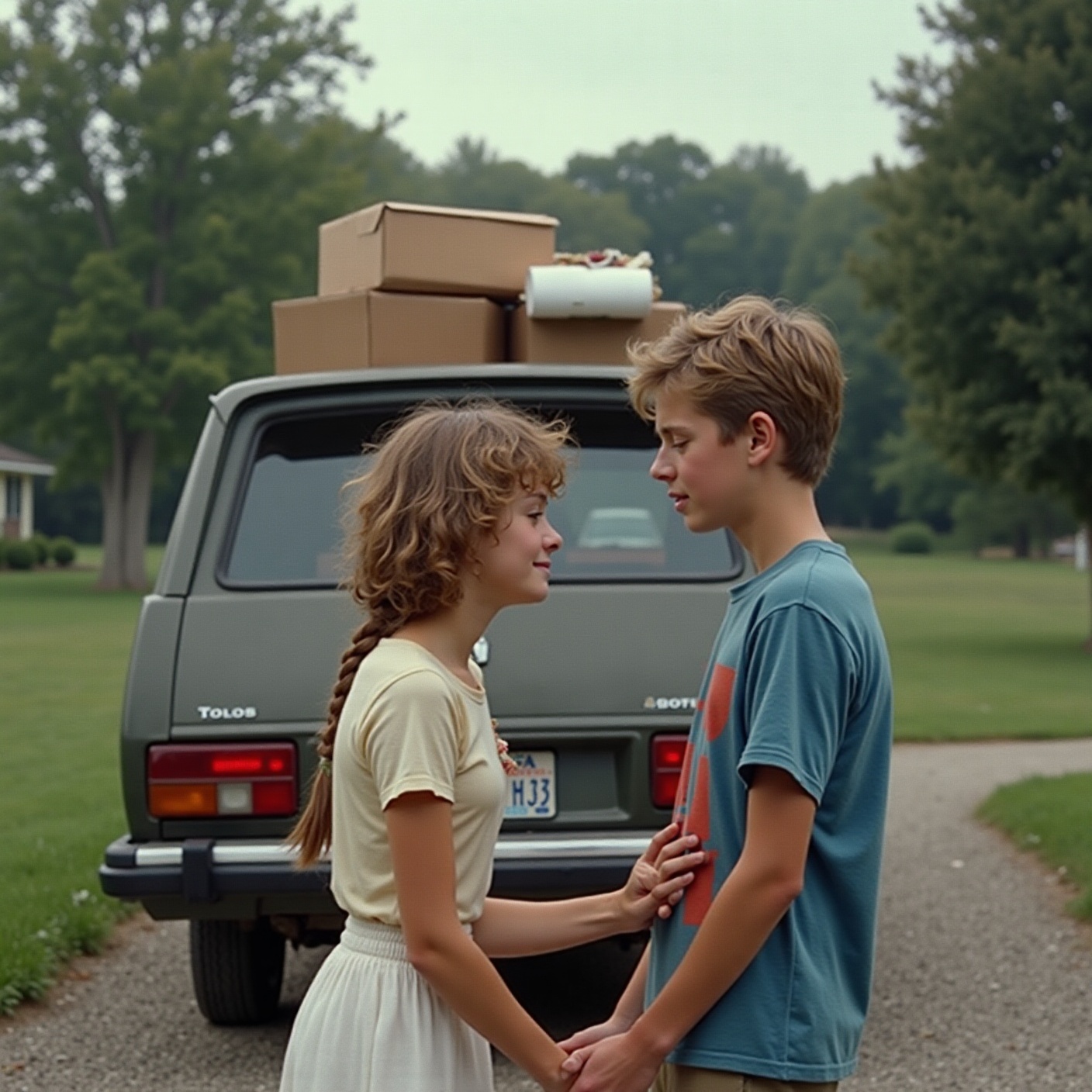
It wasn’t anybody’s fault, which was almost the worst part. There was no villain, no fight, nothing to be angry at. The plant his dad worked for was closing the Ohio line and moving operations to Arizona, and the family was going with it, all the way across the country, more than a thousand miles away. In 1985 that might as well have been the moon.
They said goodbye in Danny’s driveway on a gray morning at the end of the month, next to a car packed so full you couldn’t see out the back window. Carol had promised herself she wouldn’t cry and she cried anyway. Danny held both her hands and told her he’d write every week. He told her a thousand miles was nothing. He told her they’d figure it out.
“I mean it, Carol,” he said. “This isn’t the end of anything. It’s just Arizona.”
“Then write me the second you get there,” she said. “Don’t wait. Promise me.”
“I promise,” he said.
And for a while, he kept it.
The letters came, at first. Long ones, in his cramped handwriting, about the heat and the ugly new house and how he’d hung her school picture on his wall. She wrote back just as long. But there were no cell phones then, no email, no way to just reach out and hear a voice without a long-distance bill her parents would notice. The letters got shorter. The gaps between them got wider. Somewhere in there she started dating a boy from the next town over, mostly to have something to do on a Friday, and she mentioned it in a letter, and Danny’s next letter took a month, and then there wasn’t a next letter at all.
Neither of them ever said the actual word. It just faded, the way a photograph left in a sunny window fades, so slowly that you don’t notice until one day you look and it’s nearly gone.
Carol grew up. She married a good man named Steve, raised two kids in a house six blocks from the one she’d grown up in, buried her parents, drove her kids to college and back, and lost Steve to a heart attack the winter she turned fifty-four. A full life. A real one. She wouldn’t have traded it.
But every so often, less and less over the years but never quite never, she would think about the boy in the rusted Ford, and she would feel the old ache, and she would tell herself the truth she’d decided on a long time ago: that he had forgotten her before the first Arizona winter was out. That she had been a small-town first girlfriend, easy to leave behind. That she had spent forty years remembering someone who had almost certainly not spent forty years remembering her.
Now his voice was six feet away.
She set down her basket. Her heart was going like she was seventeen again in that driveway. And before she could talk herself out of it, she stepped out of line and walked up toward the front, and the man at the counter turned around.
Older. Gray at the temples, lines around the eyes. But it was him. It was unmistakably, impossibly him.
“Danny?” she said.
He went very still. His eyes searched her face for a second, and then something broke open in it.
“Carol,” he said. Not a question. He said it like a word he’d said to himself before. “Carol Jenkins.”
They stepped out of the line together, over by the blood-pressure machine nobody ever used, and they talked the way you talk when forty years is standing between you and you’re both trying to cross it at once. He’d moved back three months ago, he told her. His wife had passed the year before; there was nothing keeping him in Arizona, and he’d always meant to come home. Carol told him about Steve, about the kids, about the house six blocks over.
And then Danny did something that stopped her cold.
He reached into his back pocket and took out his wallet. It was worn soft at the corners, the leather cracked. He opened it, and from behind the little clear window where most men keep their driver’s license, he slid out a photograph.
It was small, and it was so faded she could barely make it out. A girl with feathered hair and a shy smile, seventeen years old, in a blue top she suddenly remembered picking out for picture day.
It was her. The school photo she’d given him the summer of 1985.
“You kept it,” she said. Her voice didn’t come out right.
“I never took it out,” Danny said. He was looking at the picture, not at her. “Not through Arizona. Not through the wedding. Not through anything. My wife knew it was there. She used to say a man’s allowed to keep one thing.” He finally looked up. “I know how that sounds. But I want you to know that wasn’t nothing to me, Carol. It was the furthest thing from nothing there ever was.”
Carol stood in the fluorescent light of a drugstore, a woman who had spent four decades certain she’d been forgotten by Christmas of 1985, and looked at the proof, soft and creased in a stranger’s-yet-not-a-stranger’s hand, that she had been carried the entire way.
They didn’t fall into each other’s arms. They were too old for movies and too honest for them. What they did was trade phone numbers on the back of her pharmacy receipt, and agree to get a cup of coffee that Saturday, and stand there a minute longer than they needed to, neither one wanting to be the first to walk toward the door.
When the pharmacist finally called Carol’s name, she almost didn’t hear it.
She’s got the receipt still. His number is on the back, and she copied it into her phone twice just to be sure. And somewhere in this town tonight there’s a man in his late fifties who finally, after forty years, has somewhere to put a photograph he was never able to throw away.