
The porch light was already on when Ellie and Ben pulled into the driveway with the first load of boxes.
It was the middle of the afternoon, bright July sun, and there it was over the front door of their new house. A plain bulb behind a little frosted-glass fixture, burning away in broad daylight like it had forgotten what time it was.
“Somebody left the light on,” Ben said, hauling a box up the steps.
“Realtor, probably,” Ellie said. She flipped the switch inside the front hall. The bulb went dark. She didn’t think about it again for three days.
They’d bought the little house on the corner from an estate. The man who’d lived there had passed that spring, an old widower named Walter, and the family had sold it quick and clean, the way families do when nobody wants to keep coming back to the sad house on the corner. Ellie and Ben were young, first place of their own, and they were too busy painting over beige walls to think much about the man who’d painted them beige.
It was Ruth who told them about the light.
Ruth lived directly across the street and had for twenty-two years. She came over on the fourth day with a foil-covered plate of lemon bars and the particular authority of a woman who has watched a street for two decades and considers it her jurisdiction.
“You’ll want to know about Walter,” she said, settling onto their porch step like she’d earned the spot, which she had. “Since it’s his house.”
“We heard he kept to himself,” Ellie said.
“Kept to himself.” Ruth repeated it slowly, turning it over. “That’s the kind thing people say. Truth is, folks around here thought he was unfriendly. Wave and that’s it. Twenty years and I never once got past the driveway with that man.”
She looked across at their front door.
“But I’ll tell you the thing about Walter,” Ruth said. “That porch light of his. Every single night, twenty-two years, that light was on till morning. Rain, snow, the big blackout in oh-three when the whole street went dark, he had a generator running just for that one bulb. Never his kitchen. Just the porch. On at dusk, off at dawn, not one night missed.”
Ben laughed, not unkindly. “Afraid of the dark?”
“That’s what people figured,” Ruth said. “Or getting forgetful, toward the end. Or just cheap habits from an old man who didn’t notice the bill. Everybody had a theory.” She stood, brushed off her slacks, and left the theories hanging there. “Nobody ever asked him. You didn’t ask Walter things.”
That night, out of nothing but curiosity, Ben flipped the porch light back on. It felt strange to leave it dark now, like breaking a rule they’d only just learned existed. But a bare bulb burning till sunrise was a waste, and by the weekend the practical part of them won out. They’d deal with the old man’s habits later. First they had a house to unpack.
Later came the following Saturday, up in the attic.
It was hot and low-ceilinged and full of the leftovers an estate sale doesn’t bother with. Ellie was sorting a corner of it into keep, toss, and donate when she found the switch.
It was an ordinary light switch on the attic wall, except somebody had run a strip of masking tape across it, holding it in the up position, and written two words on the tape in careful block letters, the hand of a man who did not write often but wanted to be understood.
LEAVE ON.
Under the switch, on the floor, was a shoebox.
She almost didn’t open it. It felt like reading someone’s mail. But the tape and the words had gotten into her, and she sat down cross-legged on the plywood and lifted the lid.
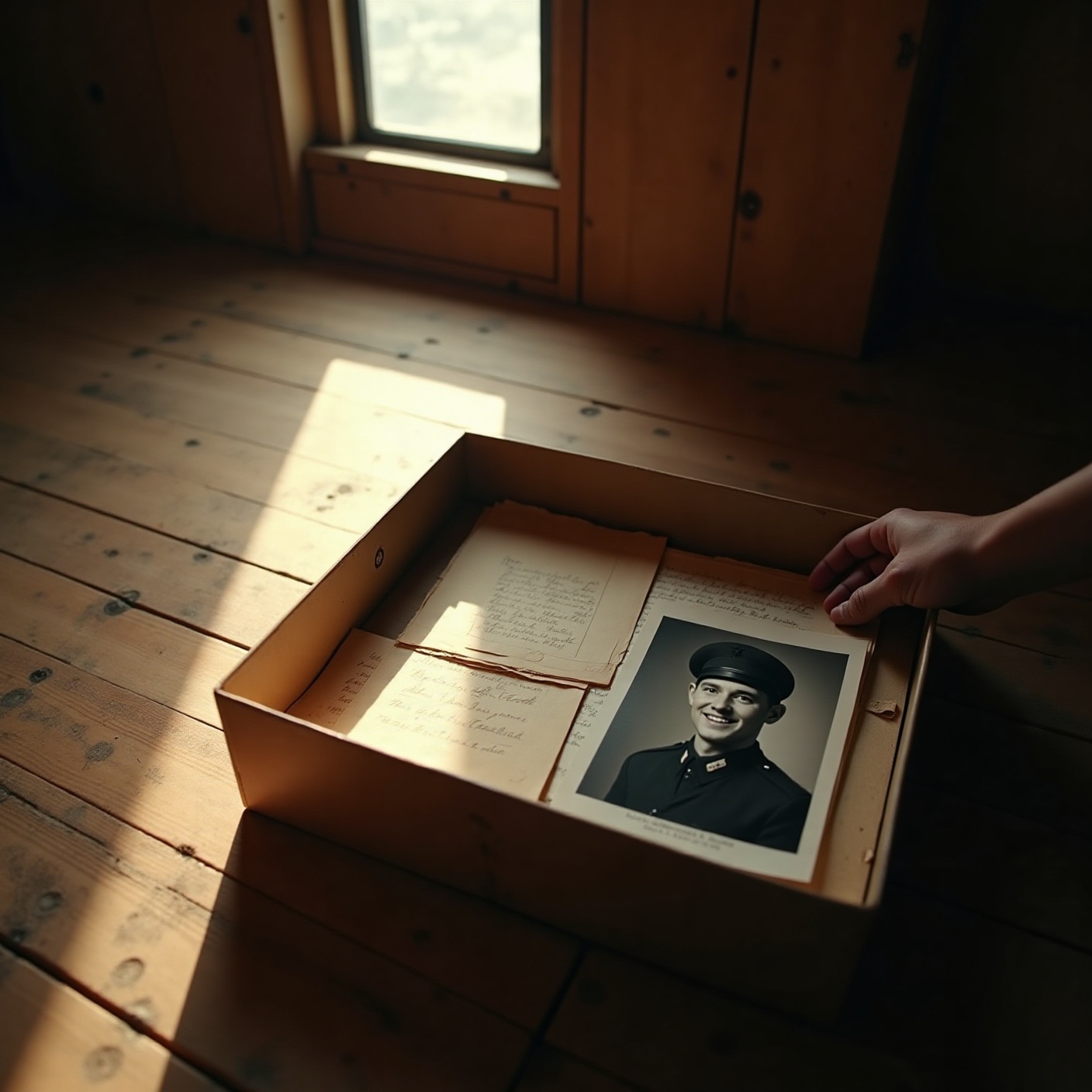
On top was a photograph. Black and white, gone soft at the corners from handling. A young man, maybe nineteen, in a plain uniform, the kind of uniform from a war so long ago it belonged to a different world. He had Walter’s jaw. He was grinning at whoever held the camera like he had somewhere exciting to be.
Under the photo was a stack of letters, and every one of them had been sent by Walter and come back. Return to sender. Unable to deliver. Addressee unknown. Years of them, dozens, the ink of the addresses fading from letter to letter as an old man kept writing to a place his son no longer was.
And under the letters was the telegram.
Ellie had only ever seen them in movies. This one was real, and yellowed, and it did not say what the movies had taught her a telegram like this said. It did not say killed. It said missing. Missing in action. It said the army was very sorry, and that they would notify him of any further news, and there was, apparently, never any further news, because it was the only telegram in the box.
That was the whole thing, then. Danny had shipped out young, to a war on the other side of the world, a long time ago. And he had not come home, and he had not been found, and no one had ever been able to tell his father the one thing that would have let him stop hoping. Missing. Not killed. Missing was a door that never quite closed.
At the bottom of the box, folded once, was a piece of lined paper. Walter’s careful block hand again.
“So he can find his way in the dark. Leave the light on. — W.”
Ellie sat in the hot attic and understood the whole street at once. The unfriendly old man who waved and never talked. The light on every night for twenty-two years, and for who knew how many years before that, in whatever house he’d lived in before this one. He hadn’t been cheap or forgetful or scared of the dark.
He’d been keeping a promise to a nineteen-year-old.
Because if Danny ever did come walking back up that road one night, out of wherever the world had swallowed him, an old man in a fading town, he would need to know which house was his. And a boy coming home in the dark, after all that time, might not remember. So every single night, without fail, Walter left a light on. So that the house would be easy to find. So that his son, if he ever came, would see the one warm window on the street and know, before he even reached the steps, that he was expected. That someone had waited. That he was home.
Ben found her still sitting there an hour later, the box open in her lap.
“I turned the porch light off last night,” he said quietly, because she’d told him about the box by then, the two of them on the phone, her voice funny in the attic heat. “I wish I hadn’t.”
“We’ll leave it on,” Ellie said. “From now on. We’ll just leave it on.”
They never did take down the tape in the attic. And if you drive past the little house on the corner tonight, late, when the whole street has gone to bed and every other porch is dark, you’ll see one light still burning over one front door.
Some porch lights you don’t turn off.
You just take the promise, and you keep it, for a boy you never met, on the chance that the dark is not as final as it looks.