She had been sleeping in her car for four months when she gave away her last meal. She had no idea the man in the next seat had been watching for six weeks.
Ruth Callahan was seventy-five years old, and by that winter her whole life fit inside a rust-colored sedan parked at the far edge of a grocery store lot, back where the light didn’t reach. A wool blanket folded on the passenger seat. A tote bag of clean clothes she rotated at the laundromat on Wednesdays. A bus pass she kept in the visor, because the bus was warm and it cost the same to ride it in a circle as it did to sit. That was the arithmetic her days had come down to. Warmth was the thing you shopped for.
It hadn’t always been like that. There had been a house once, small and paid for, and a husband named Gordon who fixed other people’s furnaces for a living and forgot to think much about his own health. When he went, he went fast, and what he left behind was love and a stack of medical bills that the love couldn’t cover. The house went to the hospital. The savings went to the house. By the time the paperwork settled, Ruth was a woman with a Social Security check that ran out on the fourteenth of every month and nowhere to be after that.
She was not the kind to ask. That was the whole trouble with Ruth, if you asked the people who’d known her. She would sooner freeze politely than knock on a door.
The one soft spot in her week was the diner out on Route 9. A low brick building with a red counter and eight stools and a pie case that hummed. Ruth walked in most days around eleven, before the lunch rush, and took the third stool from the end because it wobbled the least. She ordered the same thing every time, or close to it. The cup of soup and two crackers. The single egg and toast when the check had a little more life in it. Coffee, one cup, and she waved off the refill even when it was free, because a second cup was a thing you took when you weren’t counting, and Ruth was always counting.
The girl at the counter, Deb, had waited tables there for thirty years and could read a customer like weather. She noticed things. She noticed that Ruth ate slow, to make it last. She noticed the blanket in the back seat of the sedan through the window. She noticed that Ruth always tucked the two crackers into her coat pocket if she thought no one was looking, and Deb pretended not to look.
What Ruth did not know was that the diner had a new owner. It had changed hands quietly two years back, and the man who bought it was not the sort to hang a new sign and call it his. He kept the red counter. He kept Deb and the cook, a big quiet man named Ray who’d been at that griddle since the Carter administration. And he’d told them, on his first week, one strange thing that they’d half forgotten by now. He’d said: if you ever notice somebody who’s going without and too proud to say so, you tell me. Not the loud ones. The quiet ones.
The shaking young man came in on a Thursday.
He was maybe twenty-five, in a thin jacket that wasn’t enough for the cold, and he took the stool right next to Ruth’s and stared at the menu like it was written in a language he half remembered. His hands wouldn’t hold still. He asked Deb for a glass of water and nothing else, and when she asked if he wanted to see the specials he shook his head too quickly and said no, no thank you, just the water was fine.
Ruth knew that voice. She had used that voice herself, the first weeks in the car, before she’d learned to keep her chin up doing it. It was the voice of a person doing the math out loud in his own head and coming up empty.
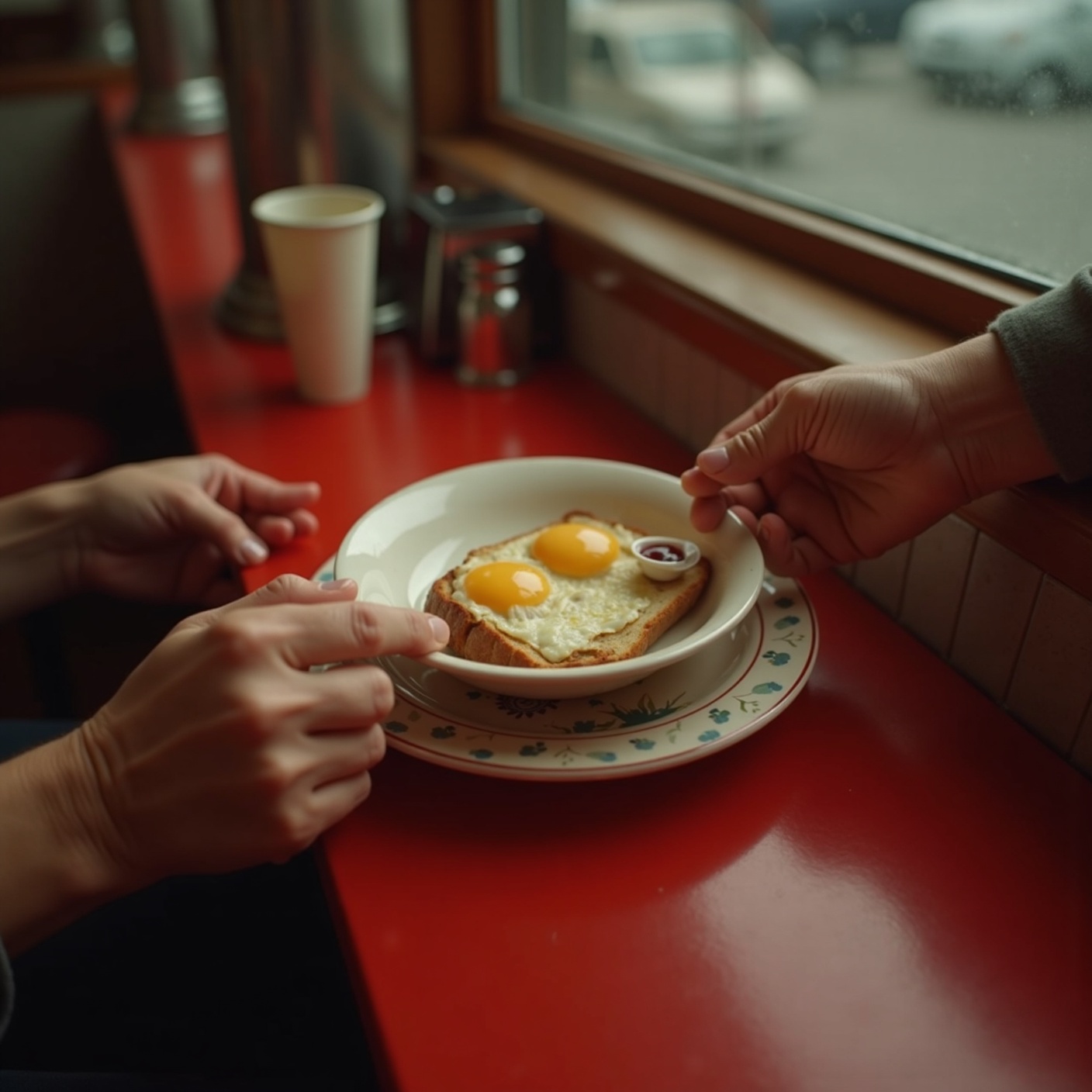
Her plate had just come. The egg, the toast, the little paper cup of jam. She’d been looking forward to it since the bus stop.
She looked at the young man’s hands shaking around the water glass, and she did the thing she did not have to do and could not really afford to do, which was the only kind of giving that ever counts for anything.
“Here,” Ruth said, and she slid the whole plate along the counter until it sat in front of him. “I ordered too much. I do that. My eyes are bigger than my stomach these days, and I already ate this morning.” She hadn’t. “You’d be doing me a favor. I hate to see food go back.”
The young man looked at the plate. Then he looked at her, and something crossed his face that she couldn’t name and didn’t try to.
“Ma’am, I can’t—”
“You can,” Ruth said, in the voice she’d once used on Gordon when he got stubborn about the doctor. “It’s egg and toast, not the crown jewels. Eat it before it’s cold on both of us.”
He ate it. He ate it like a person who had not eaten in a while and was trying not to show it, which Ruth also recognized. When he was done he wiped his mouth and said thank you about four times and left before she could say much back, out the door and gone into the gray afternoon.
Deb, drying a glass at the far end, had watched the whole thing without once seeming to.
The next day the young man was there again, at the same stool, and this time there was color in his face and steadiness in his hands. When Ruth’s check came, he leaned over and told Deb, quiet, to add it to his. He paid for Ruth’s soup and her coffee before she’d finished stirring it.
“Now that’s not necessary,” Ruth started.
“It is to me,” he said, and left it there.
The day after that, he did it again.
And this is the part that says everything about Ruth Callahan, the part her friends would have predicted if she’d had any left who knew where she was. She did not feel warm about it. She felt caught. Twice was a kindness returned. Three times was a young man who had figured out that the old lady on the third stool was broke, and was covering her out of pity, and pity was the one thing Ruth had left the house every morning determined not to collect.
So she stopped going.
She rode the bus instead, the long loop, out past the reservoir and back, and she told herself the diner was too far anyway, told herself the soup was too salty, told herself a hundred small things that a proud person tells herself to keep from admitting the real one. For a week she didn’t set foot on Route 9. She got hungry the way she’d taught herself to get hungry, quietly, on schedule, and she watched the fourteenth of the month come and go from the front seat of the Buick.
It was on the eighth day that someone tapped the glass of her car window.
She came up out of the blanket with her heart going. It was dark, it was late, and no one knew this was where she parked. No one was supposed to.
It was the young man. The shaking one, except he wasn’t shaking now. He had a paper bag in one hand and his other hand raised, palm open, the way you’d calm a spooked animal.
“Ruth,” he said through the glass, and she startled again, because she had never once told him her name. “I think you’ve got the wrong idea about all of this. Can you roll the window down? Please. There’s something you don’t know, and my father sent me to tell you.”
She rolled it down two inches, then all the way, because there was nothing in his face to be afraid of.
His name was Eli. His father was the man who had bought the diner two years ago and kept the red counter and never hung his own name on the door. And the whole business with the water and the shaking hands, Eli confessed, standing there in the cold parking lot, had not been what it looked like.
“I wasn’t broke,” he said. “I’m sorry. That part wasn’t true. My dad had me come sit at the counter because of you.”
Because for six weeks, it turned out, the staff had been keeping a quiet little record. Not out of nosiness. Ray had noticed first, then Deb, and once you notice a thing like that you can’t stop seeing it. They’d written it all down the way the new owner had asked them to, back on his first week, when he said to watch for the quiet ones. The soup and two crackers. The single cup of coffee, never the second, even free. The crackers that went into the coat pocket. The blanket in the back seat of the sedan. The way the woman on the third stool ate slow to make it last, and always, always paid to the penny and never a cent more, because she was counting.
They’d suspected. But suspecting isn’t the same as knowing, and you can’t offer a proud woman help on a suspicion, because she’ll say she’s fine and never come back. Eli’s father had wanted to be sure. So he sent his son in with empty hands and a shaking act, to sit down next to her and see.
“He said if you gave it away,” Eli told her, “then we’d know for sure. That was the whole thing. He said you don’t share your last meal with a stranger if you’ve got a second one waiting at home. Nobody does. He said only somebody with nothing gives away the plate in front of her.”
Ruth sat very still in the dark of the car.
“And you gave me the plate,” Eli said. His voice had gone thick. “You told me your eyes were bigger than your stomach. You hadn’t eaten. I could tell you hadn’t eaten. And you slid me the whole thing anyway.”
She’d read it all wrong, every bit of it. The three days of covered checks hadn’t been pity from a boy who’d noticed she was broke. They’d been the diner buying itself time, keeping her fed and keeping her close while a man she’d never met figured out what to do about a proud woman who would refuse anything offered to her face.
What he’d decided to do was not offer her a free breakfast.
Above the diner, up a narrow staircase behind the kitchen, there was an apartment. One bedroom, a small kitchen, a window that looked out over Route 9. The previous owner had lived in it, and when Eli’s father bought the place he’d never had a use for it. It had sat empty for two years, gathering dust, the heat kept just high enough to keep the pipes from freezing.
“He wants you to have it,” Eli said, and pushed the paper bag through the window into her lap. Inside was a sandwich, still warm, and a key on a plain steel ring. “There’s no catch. He’s not going to make you wait tables or thank him or any of it. He just said to tell you the room’s been empty two years, and it seems like a waste, an empty room over a full diner. He said you’d understand it better as a waste than as a gift, and he was right, wasn’t he. My dad said you’d take it if we called it a favor to us.”
Ruth Callahan, who would sooner freeze politely than knock on a door, sat in her cold car with a warm sandwich and a key in her hands, and for the first time in four months she let herself cry where somebody could see.
She moved in that weekend. The window over Route 9 looked down on the parking lot where she used to hide the sedan, and she could see the diner’s red sign from her bed. She still took the third stool most mornings, the one that wobbled least. But now Deb brought the second cup of coffee without being asked, and Ruth let it sit in front of her and go warm in her hands, and she drank it slow, the way you drink a thing when, finally, you’ve stopped counting.