There is a bench in Central Park, and a woman sitting on it, and she is covered in pigeons.
That is how most of America first met Brenda Fricker. Not in a gown, not at a podium, but in a worn coat in “Home Alone 2: Lost in New York,” feeding birds she trusted more than she trusted people. She barely spoke for her first few minutes on screen. She didn’t need to. Kids who saw that movie in 1992 have carried her face around for more than thirty years without ever learning her name.
Here is the part they didn’t know. Three years before she picked up those pigeons, that same woman had walked across a stage in Los Angeles and made history.
Brenda Fricker died on July 16 in Dublin, the city where her life started 81 years earlier. Her agent, Phil Belfield, confirmed she had died after a long period of ill health. His statement did not try to be clever about it. “We will never see her like again,” he said, “and the world is lesser for the lack of her.”
Start with the pigeons, because that is the Brenda Fricker a whole generation feels they knew personally.
The Pigeon Lady has no name in “Home Alone 2.” She lives up in the rafters of Carnegie Hall and spends her days in the park, and when young Kevin McCallister ends up alone and frightened in New York, she is the one who sits down with him. She tells him, quietly, why she stopped letting herself get close to anyone. She loved someone once. It went wrong. And after that she decided it was safer to feed birds than to risk her heart on people again.
A child talked her out of it. Kevin gives her one of a matching pair of turtledove ornaments and keeps the other, so that as long as they each hold onto theirs, neither of them will ever really be alone. It is a small scene tucked inside a loud slapstick comedy, and Brenda Fricker plays it so plainly, so without ever begging you to cry, that it became the thing people remember longest about the whole film.
Now rewind to the role that put her in the history books.
In “My Left Foot,” released in 1989, Fricker played Bridget Brown, the working-class Dublin mother of Christy Brown. Christy, a real Irish writer and painter, was born with cerebral palsy and could control only his left foot. The film, directed by Jim Sheridan, follows him from a childhood everyone else had written off to a life as a genuine artist, and at the center of it stands his mother, a woman who simply never accepted the verdict that her son was hopeless.
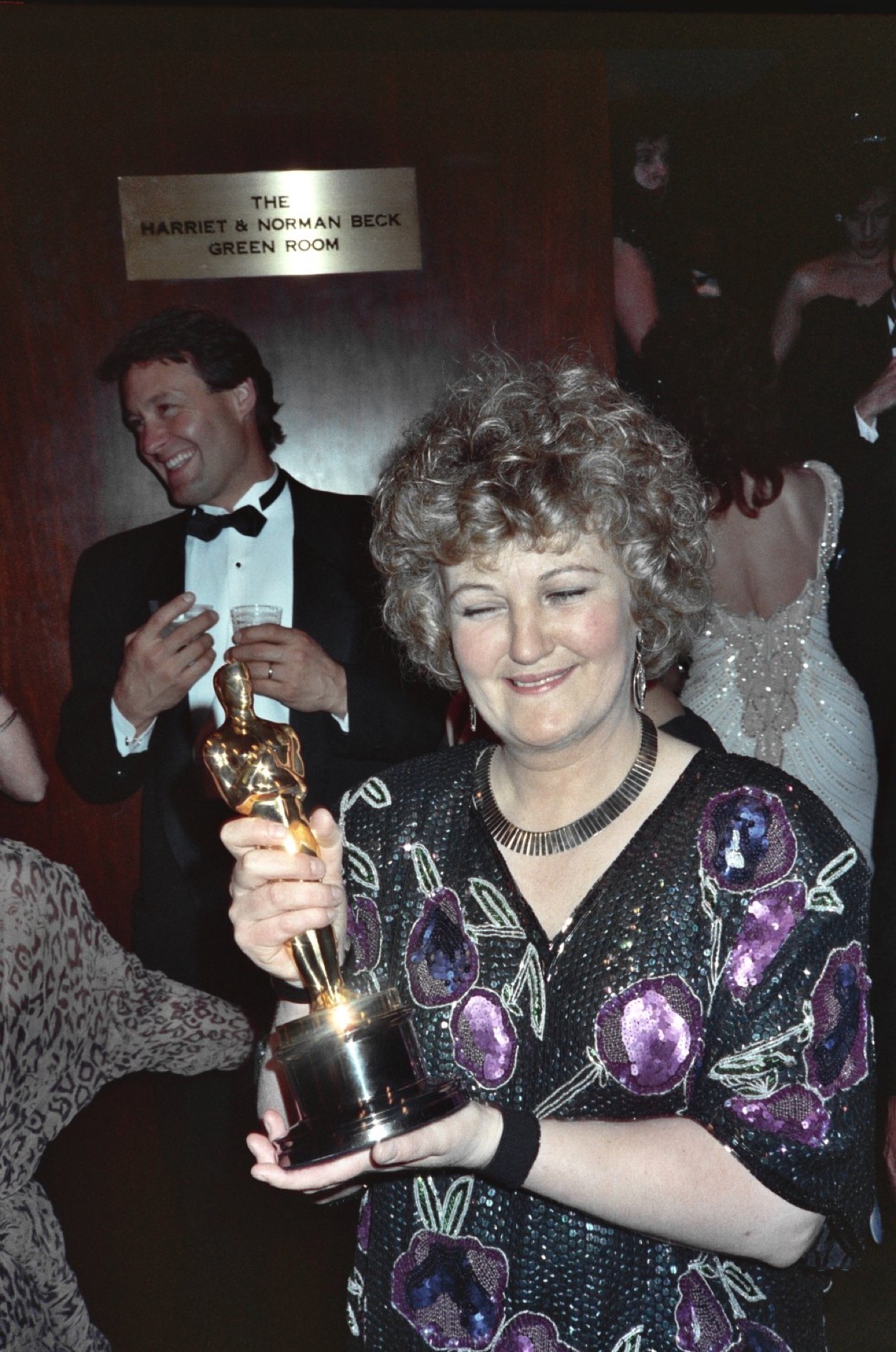
Daniel Day-Lewis played the grown Christy and won Best Actor. Fricker won Best Supporting Actress at the ceremony in the spring of 1990, and in doing so became the first Irish woman ever to win an Academy Award. She was not a Hollywood face. She was a stage and television actress from Dublin, and she stood up in front of the whole industry to accept the statue on behalf of every mother who had ever been told to give up.
She was born on February 17, 1945, in Dublin. Her father was a journalist, her mother a teacher, and Brenda came up through Irish and British theater and television long before any American had heard of her. For years, viewers in Britain and Ireland knew her best as Nurse Megan Roach on the BBC hospital drama “Casualty,” a role she played through the second half of the 1980s. By the time “My Left Foot” arrived, she had already spent decades earning it.
The Oscar did not turn her into a movie star in the usual sense, and by every account she never wanted it to. She kept choosing parts that interested her over parts that flattered her. She reunited with Jim Sheridan and stood opposite Richard Harris in “The Field” in 1990. She played Mike Myers’ mother in the comedy “So I Married an Axe Murderer” in 1993, and a warm-hearted foster mother in “Angels in the Outfield” in 1994. She worked steadily for the better part of seven decades and never seemed interested in being anything other than a working actress.
Look at the two roles side by side and you understand her. Bridget Brown, all fire and stubbornness, fighting the whole world for her son. The Pigeon Lady, all stillness and old sorrow, learning from a little boy that it is worth caring again. One woman played both, and put the same unshowy honesty into each of them.
That is why the news landed the way it did this week, on people who had no idea the fierce mother and the gentle bird lady were the same person.
The turtledoves in that movie were only props. But the idea behind them, that nobody should have to be alone, turns out to be a fair summary of what Brenda Fricker gave audiences for fifty years.