Tippi Hedren was in her very first film when Alfred Hitchcock had live birds thrown at her for five days straight.
She had never carried a movie before. She had barely acted at all. Hitchcock spotted her in a television commercial, an unknown model from New Ulm, Minnesota, and signed her to a seven-year contract on the strength of a face. “The Birds,” in 1963, was where she paid for it.
The scene everyone remembers is the one in the upstairs bedroom, where the gulls and ravens come down on her in a closed room. Hedren had been promised mechanical birds. When she arrived on set she found out there were no mechanical birds. There were real ones, and men in gloves throwing them at her, and elastic bands tying live birds to her clothes so they could not fly away from her face.
That went on for five days. On the last day a bird cut her near the eye, and she came apart. A doctor ordered her off the picture to rest for a week. She was thirty-three years old and she had learned exactly what the contract meant.
She turned 96 this January. Most of the planet still knows her only as the cool blonde in the green suit, the one running from the sky. Almost nobody knows the rest, and the rest is the part worth telling.
Her real name was Nathalie. “Tippi” was a childhood nickname from her father, and it stuck the way those things do. She grew up in Minnesota, modeled in New York, and was raising a small daughter on her own when Hitchcock’s people called. That daughter grows up later in this story. Her name is Melanie Griffith.
“Marnie” came next, in 1964, and it is a strange and beautiful film, and it was also the end of the road with Hitchcock. By her own account he had become fixated on her, made advances she refused, and when she refused them he refused to let her go. He held her to the contract and, she has said, blocked the parts that could have made her a star. For years afterward the offers that should have come did not come.
She has told that story plainly, without much bitterness in it, for a long time now. She was not the only actress Hollywood did this to. She was one of the first to say it out loud with the man’s name attached.
Here is where a lesser life would have gone quiet. Hers did the opposite.
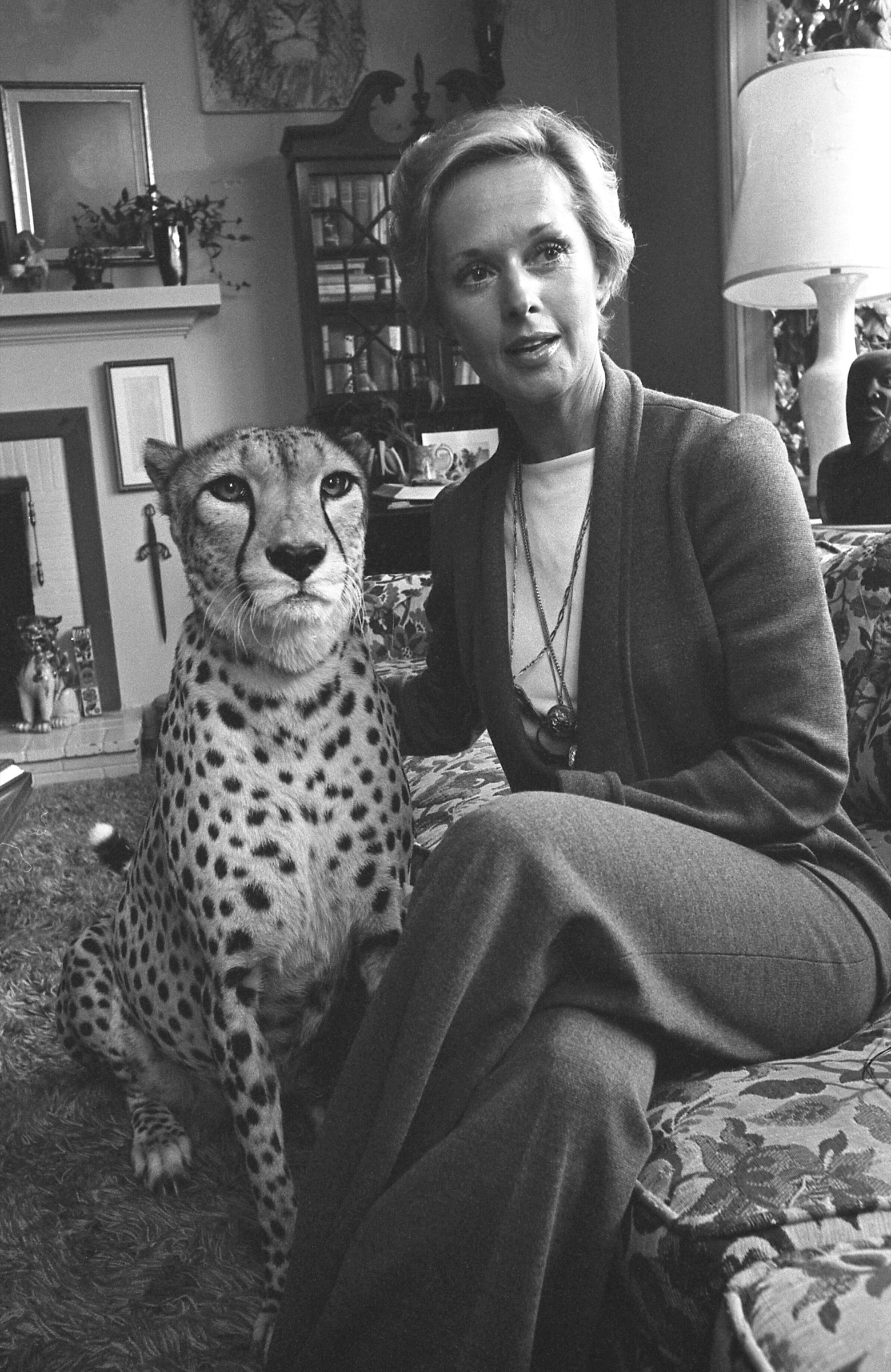
In 1969 she went to Africa for a film and saw a pride of lions moving into an abandoned house, and something in her would not let it go. She came home wanting to make a movie about big cats living alongside people. Nobody told her it was a bad idea in terms she was willing to hear.
That movie became “Roar,” and it took eleven years to make. Hedren, her then-husband, Melanie, and the crew shared the set with more than a hundred untrained lions, tigers, and other big cats. The animals did what big cats do. Melanie Griffith needed facial surgery after a lion bit her. Hedren fractured a leg and took a scalp wound. The cinematographer was scalped and needed hundreds of stitches. Seventy people were hurt over the years of shooting. When “Roar” finally came out in 1981 it barely reached theaters, and it is now remembered mostly as one of the most dangerous productions in film history.
Most people would have walked away from lions forever. Hedren kept the cats.
She could not send them back, and she would not put them down, so in 1972 she started what became the Shambala Preserve, on eighty acres of dry land near Acton, California. In 1983 she founded the Roar Foundation to pay for it. For half a century she has fed and housed lions and tigers that were seized from basements and roadside cages and failed private zoos, animals that had nowhere else on earth to go. She has said she wakes up to them and goes to sleep to them. It has never been a hobby. It has been the job.
And she was not content to rescue them one at a time. She watched people keep tigers as pets, in apartments and backyards, and she decided the law had to change. She testified. She lobbied. She told the story of the animals that came through Shambala, over and over, for the better part of thirty years.
In December 2022 the Big Cat Public Safety Act was signed into federal law, making it illegal to keep big cats as private pets across the United States. It happened because a former Hitchcock blonde would not stop asking for it.
There are three generations of women in this story, and all three of them work. Melanie Griffith, the little girl left at home when her mother went to face the birds, became a movie star in her own right. Melanie’s daughter, Hedren’s granddaughter, is Dakota Johnson. Grandmother, mother, daughter, one straight line.
In February 2024 her family let it be known that Hedren is living with dementia, and that she no longer remembers the career that made her famous. She does not recall “The Birds.” She may not recall the five days.
On January 19 this year she turned 96 at Melanie’s house, in a purple shirt and a floral blazer, in good spirits, linking arms with her grandson to manage the stairs. The year before, on her 95th, Melanie had summed her up in three words on Instagram. “She’s happy, healthy and feisty!!”
She may not remember the birds. But the law she wrote remembers her, and so do the cats.