Maren Ashworth turned thirty-four on a gray Tuesday in Alder Cove, Maine, sitting alone at her kitchen table with coffee going cold between her palms, one ear tuned to the street outside. She was listening for the mail truck the way she had every July ninth since she was six years old, and she hated a little that some part of her still did.
The envelope always came. Plain white, business-size, no return address, the stamp always slightly crooked like whoever licked it had somewhere else to be. Inside, without fail: one photograph, the same photograph, printed a little differently by whatever drugstore machine was still running film that decade. A girl, maybe fourteen months old, bundled into a yellow raincoat two sizes too big, standing on a weathered dock with the lake behind her going flat and silver. She stared straight into the lens like someone had told her, very seriously, to hold still.
Maren was not in a single family album at that age. She’d looked. There was no yellow raincoat in any closet, no dock like that one within twenty miles that anybody could point to. Her father, Walter, used to lean over her shoulder when she was small and go quiet a beat too long before he said it.
“World’s full of strange people, Mare,” he’d tell her. “Eat your eggs.”
He never gave her a real answer. Not the year she was ten and asked outright. Not the year she was twenty-two and slid the photo across the dinner table and demanded one. He’d just fold his napkin and change the subject, and something in his face would close like a door easing shut on a draft, careful, not slammed.
Walter had been dead two years now, his heart giving out on a Sunday morning while he was refilling the bird feeder. The envelope kept coming anyway, which was its own kind of unsettling, the way a habit outlives the person who taught it to you.
She still had twenty-eight of them rubber-banded by decade in a shoebox at the top of her closet. Every July she told herself this was the year she’d throw the newest one away without opening it. Every July she didn’t.
This year’s was postmarked Alder Cove. Her own town, for the first time in twenty-nine years. Every other envelope had come from somewhere else, Bangor, Providence, once as far as Tucson, as if whoever sent them moved around the country and simply never forgot the date.
She opened it standing at the counter, bracing out of habit for the same small girl in the same yellow raincoat.
The dock in this photograph was empty.
Same weathered planks, silvered and split along one board. Same slant of late light, the kind that turns water the color of a bruise just before dark. No girl this time. Just the lake going still at the edge of the frame, and fog gathering low over it like breath fogging a window.
She turned it over out of habit, the way you check the back of a photo you’ve already memorized cover to cover.
For twenty-nine years, the backs had always been blank.
Not this one. A single line, in a tight, rounded handwriting she’d never seen before and somehow still recognized, the way you’d know a voice you’d heard exactly once, as a very small child, and never again.
She never should have let go.
Maren read it four times before she trusted herself to set it down. Then she called the one person in town stubborn enough to out-argue a locked archive: her friend Priya Chandran, who ran the reference desk at the Alder Cove Public Library and still owed her one for a wedding bouquet that had wilted an hour before the ceremony.
“Bring the picture,” Priya said, before Maren had finished a sentence. “And bring the old ones too, if you’ve still got them.”
They spent that whole afternoon hunched over the library’s one working microfilm reader in the basement, the machine whining every time Priya cranked the reel forward, decades of the Alder Cove Ledger sliding past in gray and white. Town council votes. A flood in ’61. A missing dog found three towns over. Maren’s eyes had started to ache and her coffee had gone cold twice when Priya’s hand shot out and stopped the reel so hard the whole machine rattled.
TODDLER RESCUED FROM ALDER LAKE AFTER WOMAN’S DROWNING, the headline read, the ink faded to the color of weak tea. Beneath it, three short paragraphs: a young woman, unnamed pending notification of family, had drowned pulling a child from the water near the public dock on the lake’s east shore. The toddler, age approximately fourteen months, had been recovered alive by a nurse who happened to be swimming nearby. No further details available at time of press. The case, as far as the paper ever mentioned again, was never followed up.
Priya read the date out loud. Then read it again, slower, and looked up at Maren with an expression Maren didn’t like at all.
“That’s not three years before your parents’ story,” Priya said quietly. “That’s about fourteen months after your birth certificate says you were born.”
“So it’s not me,” Maren said, too fast.
“Maybe not,” Priya said. She didn’t sound like she believed it either.
It took two more days, and a favor Priya called in from a cousin who clerked at the county building, to get a certified copy of the original birth record instead of the reprint Maren had used for her passport twelve years ago. The reprint had always looked ordinary. The original had a raised seal stamped across the bottom margin, small and easy to miss: AMENDED, and a date exactly eight days after the drowning in the Ledger.
Maren sat in her car in the county parking lot for a long time after that, engine off, both hands on the wheel like she was driving somewhere.
She thought about Diane, her mother, who had died on Route 9 when Maren was nine, driving home from a school play in the rain, and who had never once in nine years of bedtime stories and skinned knees and a hundred small ordinary Tuesdays given Maren any reason to doubt a single thing about where she came from. Diane had sung off-key on purpose to make her laugh. Diane had kept a lock of her baby hair taped inside a Bible that Maren still owned. None of that made room, in Maren’s mind, for an amended seal and a stranger’s handwriting on the back of a photograph.
And yet.
The postmark this year said Alder Cove. Which meant, for the first time in twenty-nine years, whoever had been mailing these envelopes from motel rooms and rest stops across three time zones was finally close enough to walk them to the post office by hand.
Priya found the woman through the county nursing registry, a name that turned up twice in old hospital logs from the year of the drowning: Corinne Voss, once a young nurse at the county hospital, later listed for years as the seasonal caretaker of the public boat launch on Alder Lake. She was seventy-nine now, according to the property record, and still living at the same address on the edge of town, a small blue house with a wheelchair ramp built onto the porch sometime in the last decade.
Maren drove out there the same evening, the fourteen photographs from her childhood and the one new empty dock riding on the passenger seat like they were sitting up on their own. Dusk was coming down fast and blue over the tree line. She sat in the driveway with the engine ticking as it cooled, telling herself she’d just look at the house and leave, the way she’d told herself for twenty-nine years she’d finally throw one of these away.
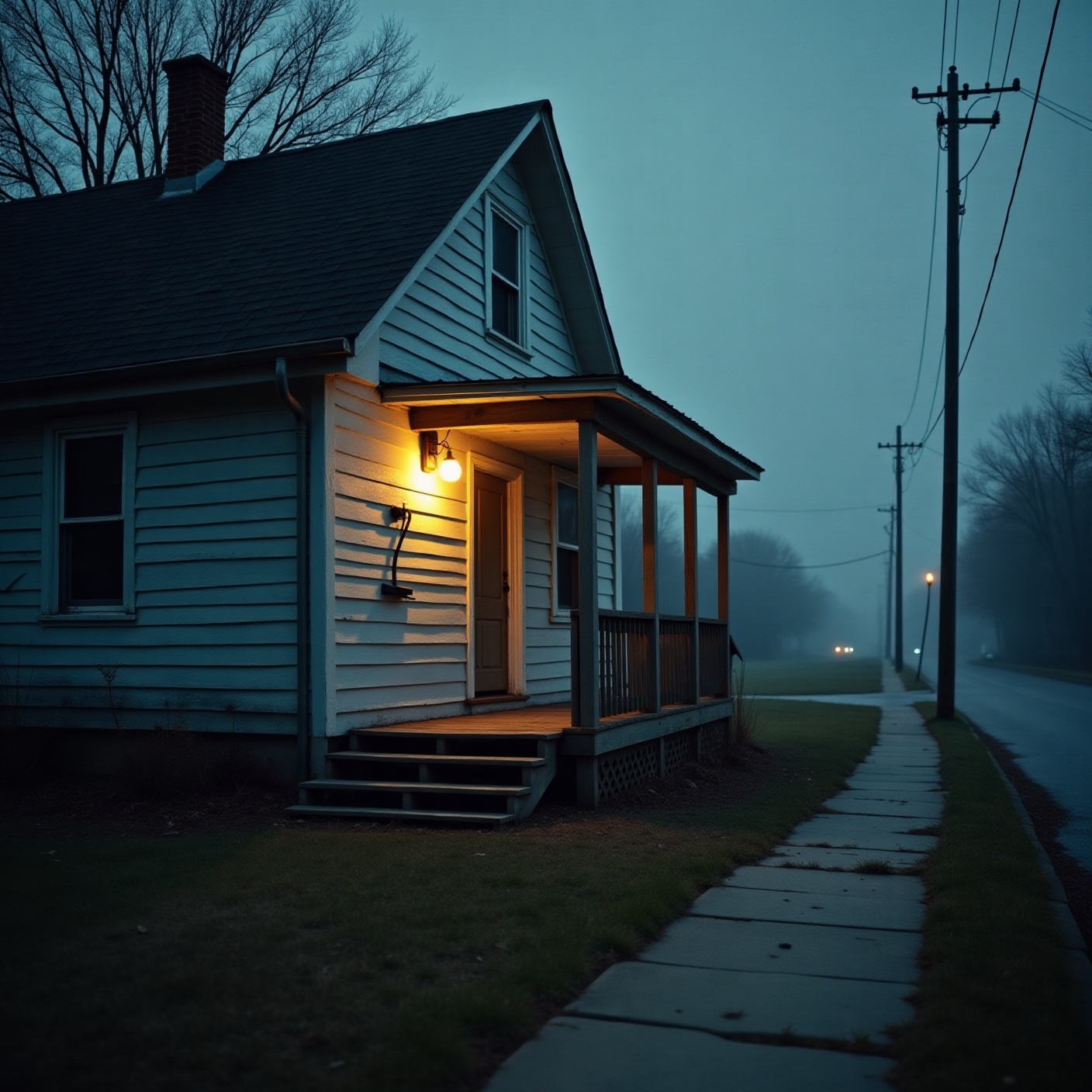
The porch light was already on when she got out of the car, though she hadn’t called ahead, though there was no reason anyone should have been expecting her at all.
The door opened before she’d made it up the second step.
An old woman stood in the frame, small and straight-backed, a cardigan pulled tight over a housedress, her white hair pinned back the way Maren’s grandmother used to wear hers. She looked at Maren for a long moment, taking in her face feature by feature, the way you’d check a photograph against the person who’d grown out of it.
“You finally came,” Corinne Voss said, and her voice cracked on the last word like it had been waiting a long time to be used for this. “I wasn’t sure I’d still be here for it.”
She stepped back and held the door open, and Maren, who had driven out only meaning to look, found her feet carrying her up onto the porch and through it.
Inside, over two cups of tea neither of them touched, Corinne told her the rest, plainly, the way you finally set down something heavy you’ve been asked to carry too long.
The young woman in the newspaper had been named Louisa Hart, a drifter with no listed next of kin, working the summer season waiting tables at a diner that no longer existed, renting a room above the hardware store with her daughter. That July evening, the toddler had wandered off the end of the public dock while Louisa’s back was turned for the length of one sentence. Louisa went in after her without a second’s hesitation, got a hand on her, and pushed her hard toward the ladder, close enough that Corinne, thirty yards off and swimming for both of them, could catch the child and haul her onto the planks.
Louisa never made it back to the ladder herself. The current along that stretch of shore ran harder than it looked, and by the time Corinne got the baby breathing and turned back around, there was nothing left on the surface to reach for.
“I’ve told myself for thirty-three years I should have gone for her first and grabbed you second,” Corinne said, her cup rattling faintly against its saucer. “I know it wouldn’t have changed anything. Doesn’t stop me thinking it every single summer.”
Walter and Diane Ashworth had been renting the cabin two doors down that year, waiting on an adoption process that had already dragged on for four years with no end in sight. Corinne, who’d delivered half the county’s babies before she ever became a nurse, made a few calls she probably shouldn’t have. Louisa had no family anyone could trace, no next of kin to claim the child, and a county judge who owed Walter’s father a favor from years back. Within a season, the paperwork had gone through quietly, the birth record had been amended, and a baby with no name anyone would keep went home to Alder Cove as Maren Diane Ashworth.
“Your father asked me for one thing before he’d let me near you again,” Corinne said. “That I never tell you, not while he was alive to see your face when you found out. He didn’t want you carrying her death around your whole life like a debt you owed her. He wanted you to just get to be happy.”
“So why the pictures,” Maren asked. Her voice came out smaller than she meant it to. “Why send them at all, if you’d promised him that?”
“Because I took that photograph of you the afternoon before it happened,” Corinne said. “Louisa asked me to. She’d just bought you that raincoat, she was so proud of it, and she wanted one picture of you in it on the dock before the summer people went home. I’ve had the negative in a drawer for thirty-three years. Seemed wrong to keep a piece of her locked away where nobody but me would ever see it. So once you were old enough that I trusted you not to go asking your father the wrong question too soon, I started sending a print, every year, from wherever I happened to be living. I told myself it wasn’t the same as telling you. I’m not sure anymore that it wasn’t a coward’s way of doing it anyway.”
She reached into the drawer of the side table beside her chair and set a small gold locket on the tea tray between them, the chain gone dull with age. Inside, when Maren’s thumb finally found the clasp, was a curl of dark hair and, engraved so small she had to tilt it to the lamp to read it, two letters: L.H.
“That’s the only thing of hers I ever kept for you,” Corinne said. “Your father didn’t know I had it. I wasn’t ready to give it up until I knew you were finally standing in front of me asking.”
Maren asked why the dock in this year’s photograph was empty, why the note had come now at all, after twenty-nine years of silence.
Corinne looked down at her own hands for a moment before she answered. “Because the doctors gave me a number of months this spring I didn’t much care for,” she said, quietly, no self-pity in it at all, just fact. “And because your father’s been gone two years, and I’d run out of reasons to keep waiting. I took that last picture myself, this spring, same spot, same time of day. Seemed like the truest way I knew how to tell you she was gone, before I had to tell you the rest of it out loud.”
Maren stayed until well past dark, past two more cups of tea gone cold, past the porch light drawing moths against the screen. She drove home with the locket in her coat pocket and the empty-dock photograph on the seat beside her, and for the first time in twenty-nine years, she didn’t put it in the shoebox when she got there.
She drove out to the lake instead, parked at the same public launch, and walked out onto the dock in the dark, the boards cool and slightly damp under her palms as she sat down at the end of it. She thought about Diane, singing off-key on purpose. She thought about Walter, closing the subject gently for thirty years so she’d never have to grow up under the weight of it. And she thought about a woman named Louisa Hart, who had one good summer and one yellow raincoat and exactly enough time to make sure her daughter reached the ladder before she didn’t.
The following July, and every July after, the envelope stopped coming. Maren didn’t need it to anymore. Instead, on the morning of her birthday, she drives out to the same dock herself, sits at the end of it with her coffee going cold the way it always had, and leaves a single flower wedged between two boards where a photograph, all those years, had been trying to tell her the rest of the story first.