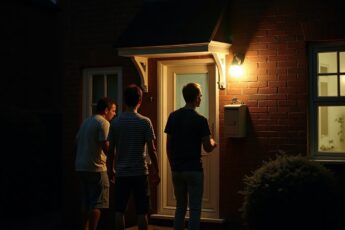
Three hours before her wedding, Claire Bennett found a box marked “DO NOT OPEN — P.B.” shoved behind a fake Christmas tree in the barn loft, and inside it were twenty birthday cards addressed to her in handwriting she hadn’t seen since she was seven.
The Sorensen family barn sat at the edge of a hayfield outside Hudson, New York, the kind of venue that photographed well specifically because someone had spent forty years making it ugly in an honest way: sagging beams, a tin roof, a loft still stacked with the previous owners’ junk. Claire had chosen it for exactly that reason. She wanted a wedding that looked lived-in, not rented.
She was twenty-eight, sitting in front of a mirror somebody had dragged up from a farmhouse basement, and her hair was half done. Mia Torres, her maid of honor since sophomore year of college, was pinning the last few curls and talking about nothing in particular: traffic on the Taconic, whether the florist had shown up yet, anything to keep Claire’s hands from shaking.
Claire had stopped expecting her mother at things like this a long time ago. She didn’t say it out loud anymore. She’d said it enough times as a teenager that it had worn smooth, like a stone you keep in your pocket until it stops meaning anything when you touch it.
“Priya needs six more folding chairs,” Mia said, checking her phone. “She’s going up to the loft.”
“Tell her to watch the third step,” Claire said. “It’s rotted through.”
Priya Anand, the wedding planner, went up anyway, and came back down twelve minutes later carrying a shoebox instead of chairs, dust down one forearm, an odd look on her face.
“This was behind the old tree decorations,” Priya said. “It’s got your name on it. I wasn’t going to open it, but — Claire, it’s heavy.”
The box was a boot box, swollen soft at the corners the way cardboard gets after years in an attic that isn’t climate-controlled. Someone had written across the lid in blue marker, the letters gone gray with age: CLAIRE — DO NOT OPEN — P.B.
P.B. Patricia Bennett. Her grandmother.
Claire’s hands went still on the edge of the mirror.
“Open it,” Mia said quietly, “or I will.”
Claire opened it.
On top was a stack of envelopes rubber-banded together, and the rubber band snapped when she touched it, brittle as a dead leaf. She picked up the first envelope. Her own name in the middle, her childhood address on East Larch Street. No return address, but she knew the handwriting anyway, the same loop on the C that she’d once tried to copy in her school notebooks because she liked it better than her own. Mom.
The postmark said it was mailed the September after Claire turned eight.
It had never been opened.
She went through the box with her wedding dress half-laced, her curls half-pinned, Mia crouched beside her not saying anything at all. Twenty envelopes. One for nearly every year since her mother left. Some had photos folded inside: a woman aging in a stranger’s kitchen, a stranger’s yard, always alone, always smiling the careful smile of someone smiling for a person who might never see it. A few of the envelopes were fatter, and when Claire opened one a small gold locket fell into her lap, tarnished, engraved on the back with her own initials.
Every single one, sealed. Every single one, postmarked, addressed, real. Every single one, hidden.
“She said Mom stopped trying,” Claire said. Her voice came out strange, flattened. “Dad said it too. Everybody said it. She just stopped trying, Claire, you have to let it go.“
Mia didn’t say anything. There wasn’t anything to say that wouldn’t sound small next to twenty years of a woman’s handwriting sitting in a box behind a fake Christmas tree.
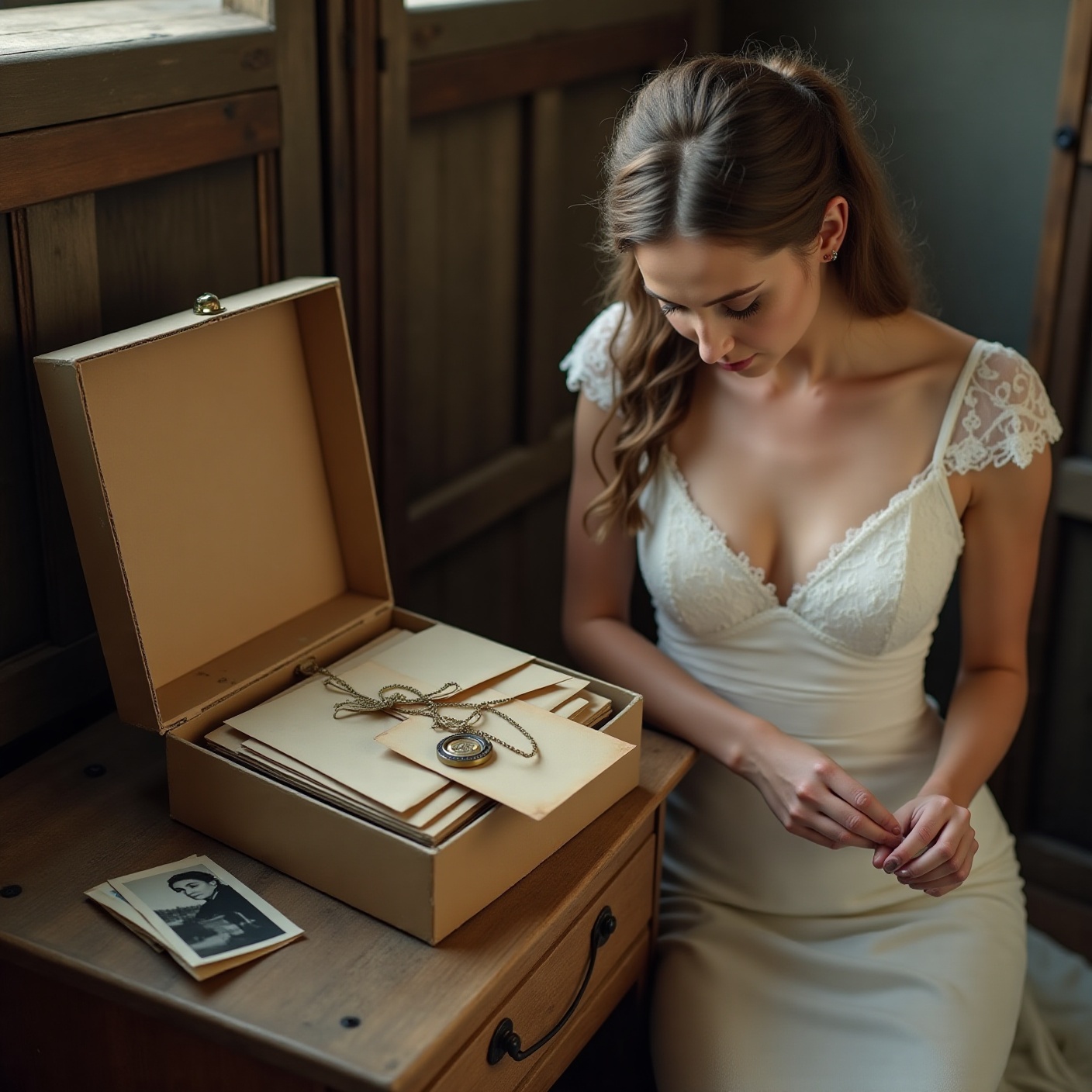
That was when they heard the shouting start outside. A man’s voice, one of the parking attendants, raised and official, and under it a woman’s voice, tight and pleading, getting louder instead of backing down.
Claire went to the loft window, dress still unlaced down the back, and looked down at the gravel lot.
A woman stood at the edge of it, silver-haired now, in a green dress that looked like she’d bought it for exactly this and then stood outside three department store mirrors deciding if she was allowed to. The parking attendant had a hand half-raised, not touching her, just blocking. Two of the Sorensen groomsmen had drifted over to see what the trouble was.
“I’m not asking to come to the ceremony,” the woman was saying. “I’m asking someone to just tell her I’m here. Please. That’s all I’m asking.”
Claire hadn’t seen her mother’s face in twenty years except in the one photograph she’d kept in a drawer, and even from the loft window, through old glass gone slightly wavy, she knew her immediately, the way you know your own house in the dark, by shape alone, not detail.
Behind her, in the doorway of the dressing room, Patricia Bennett had gone the color of the whitewashed wall, staring down into the open shoebox in her granddaughter’s lap.
“Claire,” Patricia said. “Where did you—”
She didn’t finish the sentence. She didn’t need to. Claire was already looking past her, out the window, down at the woman in the green dress who had just been told, one more time in her life, to stand back and wait.
“Tell them to let her through,” Claire said. Her voice didn’t shake, which surprised her. “Mia. Go. Right now.”
Mia went. Patricia stayed in the doorway, one hand flat against the frame like the barn itself might tip if she let go.
“You don’t understand what she put this family through,” Patricia said.
“I don’t,” Claire agreed. “I understand what’s in this box, though. Twenty letters, Grandma. A locket. Every year since I was eight. You want to tell me what I don’t understand?”
Patricia’s mouth opened and closed. For a woman who had run every holiday, every hospital visit, every school pickup for two decades with the crisp authority of somebody balancing a ledger, she looked, for the first time Claire could remember, like she didn’t know what came next.
“She left you at a park,” Patricia finally said, quieter now. “When you were six. Forty minutes, Claire. A stranger called the police. Your father was building his firm from nothing and I was not going to watch that woman’s bad year cost you a stable home. I did what I thought was right.”
“Forty minutes because she was having a breakdown nobody helped her get treatment for,” Claire said. “I read the custody file two years ago, Grandma. I know about the park. I also know Dad’s lawyer used her therapy records against her in the hearing. I know the judge only gave you full custody because you and Dad could afford three lawyers and she couldn’t afford one. None of that made her stop being my mother. You did that. You, standing at a mailbox, deciding what I was allowed to know.”
Downstairs, a door swung, and boots came fast up the barn stairs. Her father’s. She knew that stride from a hundred hallways. Richard Bennett stopped in the loft doorway beside his mother, still in his tuxedo shirt, tie loose around his neck, and took in the scene: his daughter half-dressed with a box of letters in her lap, his mother backed against the frame, and through the window behind them both, a woman in green being walked toward the barn by Mia Torres like an honor guard of one.
“Dad,” Claire said. “Did you know?”
Richard’s eyes went to the box, then to the letters spread across the vanity, and something in his face gave way the way old wood gives, slow and then all at once.
“I knew the first one came,” he said. “The year after the divorce. Mom told me she’d sent it back unopened, that Diane needed to respect the custody order and stop confusing you. I believed her. I wanted to believe her, Claire, because believing anything else meant admitting what we’d let happen to her in that courtroom.” He rubbed a hand over his jaw. “I didn’t know there were nineteen more.”
“There are nineteen more,” Claire said, “because she never stopped. Twenty years, Dad. Twenty birthdays. You told me she gave up.”
“I told you what I’d been told,” Richard said, and for once he didn’t sound like a man defending himself. He sounded tired, and old, and sorry in a way Claire had never once heard from him.
Footsteps on the stairs again, lighter ones, unsure of their welcome, and then Diane Whitaker stood in the loft doorway in a green dress she had clearly agonized over, twenty years older than the photograph in Claire’s drawer, her hands twisted together in front of her like she didn’t trust them not to reach out uninvited.
“I saw the engagement announcement in the Hudson paper,” Diane said. Her voice cracked on the second word and she pushed through it anyway. “It had the venue. I know I wasn’t invited, and I know I have no right to be here, I just — I couldn’t let you get married thinking I never once looked for you. I sent something every year. I don’t know where it went. I always hoped —” She stopped. Her eyes had found the open box on the vanity, the loose stack of envelopes, the locket catching the light. Her hand went to her mouth.
“You kept them,” Diane said. “Somebody kept them.”
“I found them an hour ago,” Claire said. “In the attic. Behind the Christmas tree.”
Nobody spoke for a moment that felt much longer than it was. Rain had started somewhere out past the hayfield, a soft percussion on the tin roof, and downstairs Claire could hear the string quartet tuning up, oblivious, running through the first few bars of something that was supposed to play in ninety minutes for an entrance that suddenly needed rewriting.
Claire stood up. She still had her dress half-laced down the back, her curls half-pinned, mascara she hadn’t finished on one eye. She crossed the loft and picked up the gold locket from where it had fallen against the envelopes, and she held it out, not to her mother but to herself, fastening the clasp at the back of her own neck with fingers that had finally stopped shaking.
“I’m not doing this without you,” she told Diane. “Twenty years too late isn’t the same as too late.”
Diane made a sound that wasn’t quite a laugh and wasn’t quite a sob, and crossed the loft in three steps, and Claire let herself be held by a woman whose handwriting she’d known for twenty years without ever once being allowed to touch the hand that made it.
Patricia stood by the doorway with the box lid still in her hand, the marker letters gone gray with age, DO NOT OPEN, and for the first time in longer than anyone in that family could remember, she looked like she wished someone had ignored her a long time ago.
She set the lid down on the vanity. “I’ll go tell Priya we need one more chair up front,” she said quietly, and left the two women standing in the loft together, the rain picking up on the tin roof above them, the quartet downstairs finally finding the right key.
Forty minutes later, Claire Bennett walked down a hayfield aisle between her father on one side and her mother on the other, wearing a locket that had waited twenty years in a shoebox to be worn, and when the officiant asked if anyone wished to say a word before the vows, Diane Whitaker stood up in the second row, in her green dress, and said only: “I never stopped writing. I’m just glad she finally got the mail.”
The barn laughed, and cried, in the particular order that happens at good weddings, and outside the tin roof kept its soft rain going through the whole ceremony, the kind of weather people would later swear was lucky.