Willow is eleven years old, which for a working farm collie is well past the last bend in the road. Cataracts took her sight two winters ago, first as a milky haze and then, within a season, all the way to nothing. Not long after, her hearing started going too — not gone, but muffled, like the world had been wrapped in a blanket.
For most of her life she’d earned her keep on a hillside two towns over, moving sheep with nothing but a look and a low whistle. When the family who owned that hillside finally sold the flock and the land, the man who bought it took one look at an old dog who couldn’t run a slope anymore and decided the arithmetic didn’t work in her favor. On the morning the moving trucks pulled in, Willow was left tied to the gatepost with a bowl of water and nothing else.
A neighbor found her there an hour later, shivering, and made a call to Sparrow Hill — the eleven-acre sanctuary Maya Bennett runs outside Randolph, Vermont, mostly on savings and stubbornness. Maya had a fenced yard, a woodstove that never quite heats the back room, and exactly zero expectations for what a blind, half-deaf dog could still do with the rest of her life.
“She’ll get a warm bed and a soft retirement,” Maya told Dr. Okafor, her vet, the week Willow arrived. He’d just finished checking her over — heart fine, hips achy but manageable, eyes gone for good. “That’s the whole job description now. Rest. She’s earned it.”
Dr. Okafor snapped his bag shut and glanced at the dog, who had already found the one warm patch of floor by the stove without being shown it. “Try telling her that,” he said. “Something tells me she’s going to disagree.”
Three weeks earlier, Sparrow Hill had taken in someone else whose job description needed rewriting. A lamb, four days old, bottle-fed around the clock after a lambing that went wrong in the barn down the road and the ewe didn’t survive it. Maya named her Clover, for the little white patch on her forehead that looked, if you squinted, almost like the shape of one.
Clover ate well. Clover grew. But Clover cried at night — a thin, rising bleat that carried clean across the whole dark property — because a lamb without a flock is an animal without a language, and nobody at Sparrow Hill spoke it well enough to answer her.
The first time Willow lifted her head at that sound, Maya figured it for coincidence. Old dogs startle at all sorts of things — a floorboard, a truck two roads over, nothing at all.
Then it happened the second night. And the third.
By the end of that week, Willow had stopped sleeping in her dog bed by the stove. She was sleeping outside Clover’s stall instead, nose pressed to the gap under the door, and Maya could not explain how a dog who could barely hear had learned to pick one small lamb’s cry out of an entire Vermont night — only that, somehow, she had.
“I don’t think she can even see her,” said Jenna Ruiz, the college student who volunteers weekends and has a soft spot for anything with four legs and a hard-luck story. She was watching Willow press her head, slow and deliberate, against Clover’s side — the exact motion she used to use to press a whole flock into a tidy line. “I think she just decided this one’s hers now. Sight or no sight.”
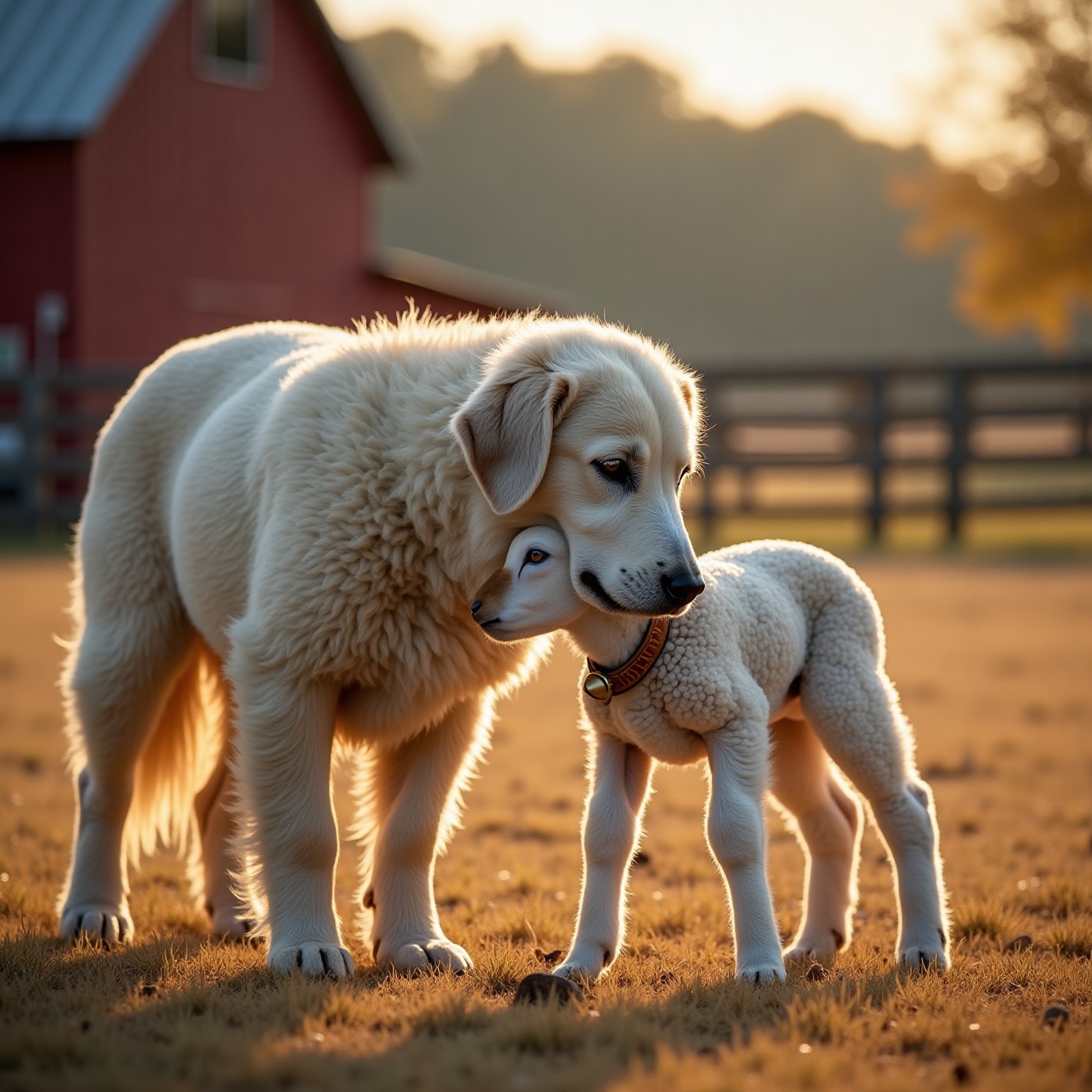
It held, that arrangement, through the rest of the fall. Willow, blind and half-deaf, always seemed to know within a few feet where Clover was standing in the yard — by smell, maybe, or by some private accounting of her own that nobody else could check. Clover, for her part, stopped crying at night almost entirely. She took to walking pressed against Willow’s flank on their evening rounds of the paddock, the old dog’s shoulder as good as a hand on a fence rail.
“It’s not that she forgot she’s blind,” Maya said one evening, watching the two of them cross the yard together in the last of the light, the dog’s steps slow and certain, the lamb’s quick and bouncing beside her. “It’s that Clover doesn’t need her to see. She just needs her to be there.”
Vermont winter came in hard that year and didn’t let up, and the ice storm arrived in the second week of January — the one that knocked the power out for six hours and made the barn doors rattle on their hinges like something was trying to get in. Nobody at Sparrow Hill slept well that night. Nobody expected the latch on the paddock gate to be the thing that failed, sometime after midnight, while the whole house lay dark and the sleet came down sideways.
Maya woke to barking.
Not the occasional bark at a passing car. The other kind — the kind that doesn’t stop, that comes from somewhere out past the fence line, out toward the pond at the edge of the property that never fully freezes even in the coldest weeks, not at the near edge, not where the spring feeds in underneath.
She was down the stairs and into her boots, unlaced, before she’d finished waking up. She grabbed her coat and the big flashlight by the door and ran out into sleet that stung sideways, shouting Willow’s name into wind that took the sound and scattered it before it had gone ten feet.
The beam swung wild across the yard — the barn, the empty paddock, the gate hanging open on one hinge — and for three or four seconds that felt like three or four minutes, Maya couldn’t find either of them at all.
Then the light caught two shapes at the edge of the water, right where the ice gives way to open black, and Maya’s whole chest went cold in a way that had nothing to do with the weather.
Willow was standing between Clover and the water. Not near it — between. Blind, deaf in one ear, soaked through and shaking with cold, the old dog had planted herself sideways across the last few feet of frozen ground, barking at nothing Maya could see, refusing to move, while a small trembling lamb pressed into her side as far from the black water as the dog’s body would let her get.
“Willow!” Maya’s voice cracked on the name. She half ran, half slid down the bank, snow filling her unlaced boots, and dropped to her knees between them. Willow turned toward the sound of her voice — she couldn’t see her, but she knew it — and for just a second, stopped barking.
Maya got an arm around Clover first, hauling her back from the edge, then reached for Willow’s collar with a hand that wouldn’t quite stop shaking. “Okay,” she kept saying, to both of them, to herself, to the storm. “Okay. I’ve got you. I’ve got you both. You did so good. You did so good, you old thing.”
Dr. Okafor drove out at first light, once the roads had been sanded, and looked them both over by the woodstove while Jenna held mugs of coffee nobody was drinking. Clover was cold but fine — a scare, not an injury. Willow had a torn pad on one paw from the ice and a chill that took two blankets and half a day to shake, but nothing worse. She slept curled around the lamb for most of that day and refused, twice, to be moved off the good rug to somewhere more sensible.
“However she found her way out there in the pitch dark, in that wind, half-deaf,” Dr. Okafor said, crouched beside them both, “she wasn’t guessing. She knew exactly where that lamb was the whole time.”
Nobody at Sparrow Hill has ever fully worked out how. Maya’s best guess is the little brass bell she’d clipped to Clover’s collar back in the fall, mostly so she could find her in tall grass — a small, ordinary thing that turned out, on the worst night of that winter, to be exactly the thread an old blind dog needed to follow through the dark.
These days, visitors to Sparrow Hill find the two of them together most mornings, out past the barn — Willow with her nose lifted into the wind, reading the yard the only way she has left; Clover a few feet off, bell chiming softly with every step, never straying far enough that the sound fades. Somewhere along the way the two of them worked out a trade that neither Maya nor Dr. Okafor ever taught them: Clover lends Willow a sound to steer by, and Willow, when anything in that yard is worth worrying about, is always the first one barking.
“People ask me what job an old blind dog can still do on a farm,” Maya said, watching them cross the paddock together, the lamb’s bell ringing bright against the snow. “I used to think the honest answer was none. Now I just point at those two and let them answer for themselves.”