He was the one nobody stopped for.
Three puppies had been dumped behind a shuttered auto shop on the edge of town, in the gap between a dumpster and a stack of old tires, where oil and rainwater pooled black on the concrete. Nobody knew where they’d come from. Someone guessed a litter no one wanted, left in the one corner of town where people already looked away out of habit.
Two of them didn’t stay long. They were pale and soft, still round in the belly the way very young puppies are, and a woman driving past on her way to work spotted them tumbling in the gravel. She pulled over, sat on the curb until they came to her, and had both of them wrapped in a beach towel on her passenger seat before her lunch break was over. That’s how it usually goes for the cute ones.
The third puppy, people walked right past.
He sat a little apart from where his littermates had been, small and dark and matted, so thoroughly coated in grease and road grime that his coat had gone the flat, dull black of the puddle he’d been sleeping in. Motor oil had worked its way down to the skin. Dust had caked over that. Whatever color he’d been born, the street had painted over it completely.
He didn’t look sick, exactly. He looked like something the town had already filed under lost cause.
For almost two weeks, that’s where he stayed. He lived off dropped french fries and the mercy of one gas-station attendant, a man in his sixties who started leaving a chipped cereal bowl by the back door every morning and pretending to himself he wasn’t getting attached. The puppy would wait until the man went back inside, then creep out to eat. He never let anyone close. Two weeks is a long time to learn that hands aren’t safe.
Word travels slowly for a plain black stray. But it does travel. Eventually a photo — grainy, taken from a phone at a distance — reached a small foster-based rescue two counties over, with a message underneath it: black pup living behind the old auto shop, been out here a while, nobody’s claimed him.
A volunteer named Dana read it on a Thursday night and drove out on her day off.
When she finally found him, tucked in the shadow of the dumpster, she almost talked herself out of it. He shrank from her outstretched hand. His ribs stood out sharp under all that filth, and his tail was tucked so tight against his belly it seemed to vanish. Everything about him said don’t.
So she didn’t. She stopped reaching. She lowered herself down onto the cold concrete, folded her hands in her lap, and simply waited — the way you wait for something that has no reason left to trust you.
It took a while. Then the puppy inched forward, one careful paw at a time, and leaned the entire weight of his small body against her ankle. He let out a breath. And that was the whole conversation.
“Okay,” Dana whispered, barely moving. “Okay. You’re coming with me.”
She carried him to the car like he might break, drove him home with the heater on, and carried him straight to the utility sink in her laundry room. She ran the water until it was warm on the inside of her wrist, then eased him in. He trembled hard enough that she could feel it through her palms, but he didn’t fight her. He just looked up at her, waiting to find out what this was going to cost him.
She worked the first handful of soap into the fur along his back.
And her hands went still.
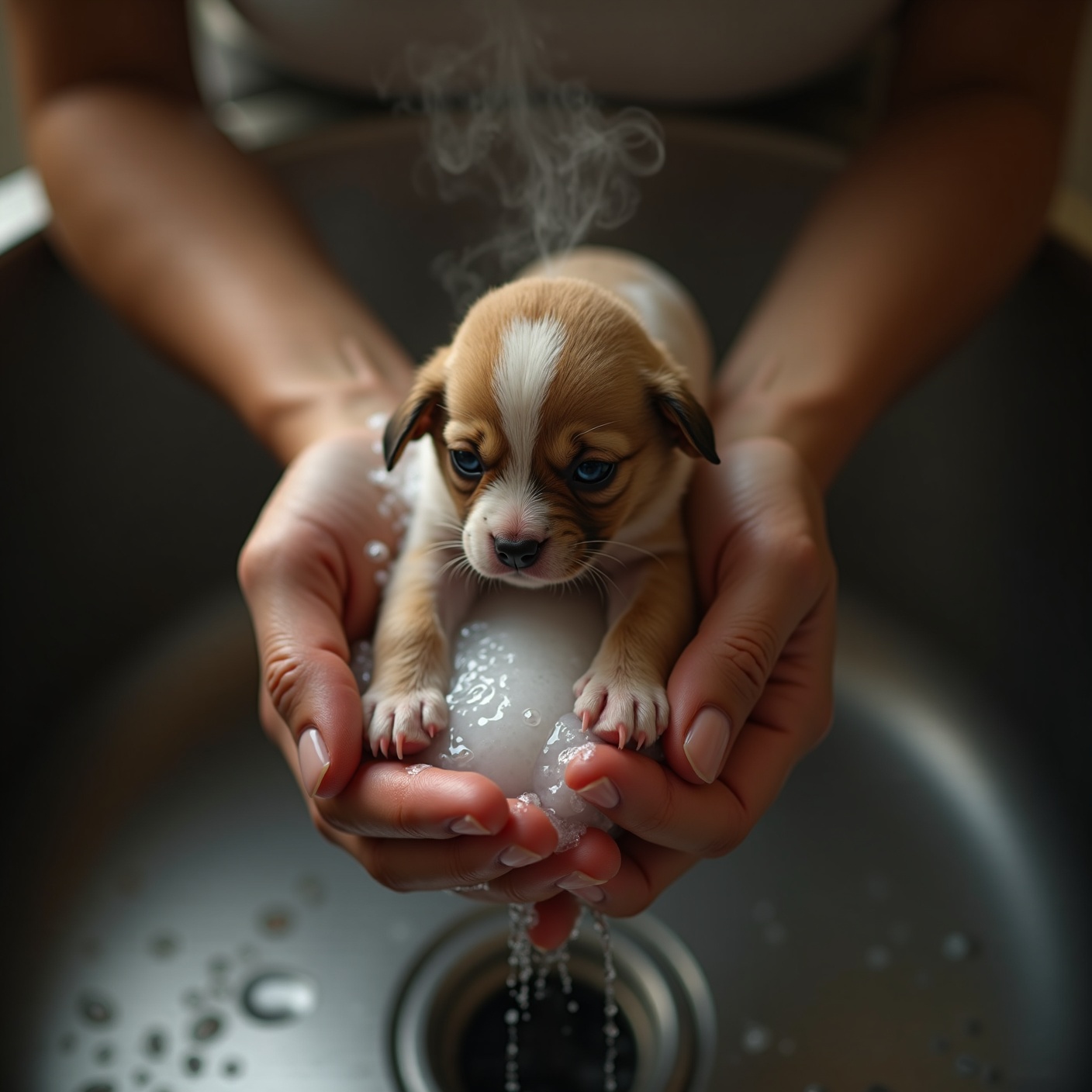
Because the water sliding off him and swirling toward the drain wasn’t running grey. It was running white.
Not dirty-white. Not cream. Under two weeks of oil and dust and street, under the color everyone in town had assumed was simply his, was fur the clean, impossible white of fresh snow.
Dana rinsed and lathered and rinsed again, and with every pass more of him appeared — a white chest, white paws, a white face with a black button of a nose and two dark eyes blinking up at her through the suds. By the time the water finally ran clear, the grimy black stray nobody had wanted for two weeks was gone. In her hands sat a snow-white puppy, so bright against the steel sink that she actually laughed out loud, alone in her laundry room at eleven at night.
“Well,” she said, wrapping him in a towel. “Look at you.“
She named him Polar. It wasn’t even a decision. It was just the only thing his name could possibly be.
Clean, warm, and fed, Polar turned out to be a completely different animal than the one who’d flinched behind the dumpster — or maybe the same one, finally allowed to be himself. He discovered squeaky toys and lost his mind over them. He learned that a hand coming toward him usually meant a scratch behind the ear, and he started meeting it halfway. He slept, for the first time in his short life, on something soft, in a room where nothing could get to him.
But Dana couldn’t stop thinking about the other two.
The pale puppies the woman had scooped up that first morning — Polar’s littermates, the ones who got rescued while he sat in the dark being overlooked. She made some calls, followed the story back through the neighborhood grapevine, and found them: safe, healthy, being fostered a few miles away by the very woman who’d pulled over that day. Between Dana’s rescue and that one foster home, all three siblings from that oily corner behind the auto shop were accounted for. All three would go up for adoption. All three would get the thing none of them had been born with — a door that opened, a bowl that was theirs, a person who stayed.
Polar was the last to find his. And, in the way these things sometimes work out, the wait turned out to be worth it. The family that finally took him home — a couple with a fenced yard and a older, patient dog who took one sniff of the little white puppy and decided he’d do — hadn’t come looking for a white dog at all. They’d come looking for the one who needed them most.
They got both.
There’s a photo Dana keeps on her phone from the day he left: Polar, gleaming white in the afternoon sun, ears up, tail going like a windshield wiper, front paws on the new dog’s back. You would never, ever guess that for two weeks the whole world had looked at him and seen nothing worth stopping for.
Sometimes the thing everyone walks past isn’t broken. It’s just waiting for one person to run the water warm and look a little closer.