
For three weeks, the only part of Axel I ever touched was the towel I used to cover his crate at night.
He came to us off a loading dock behind a grocery store, one of those big grey tabbies with a torn left ear and a body built like he’d argued with the whole world and mostly won. A trapper caught him meaning to neuter and release him, standard practice, back to the alley he knew. But the vet found an old wound gone bad under all that muscle, and releasing him would have been a death sentence. So he came to me instead. I foster the ones who need a few weeks of quiet before they’re ready for anything else.
I’ve fostered a lot of scared cats. I had never met one like Axel.
Scared cats hide. Axel didn’t hide. He sat in the middle of the spare room with his back to the wall and watched me the way you watch a storm coming across a field, calm and completely unwilling to look away. When I set his food down, he didn’t move until I’d backed all the way out and shut the door. When I came back, the bowl was clean and he was in the exact same spot, watching.
“It’s okay, buddy,” I’d tell him, low, from the doorway. “Nobody here is going to hurt you.”
He’d blink, slow, and say nothing, the way cats say nothing so loudly.
The first week I didn’t push. You don’t push a cat like that. I sat on the floor by the door with a book and read out loud so he’d learn my voice, and I moved like I had nowhere to be. By the end of the week he’d eat while I was still in the room, as long as I stayed against the far wall. That was the whole victory. That was it.
The second week I tried to close the distance. Six feet. Then four. At four feet Axel did the thing I’ll never forget: he didn’t hiss, didn’t swat, didn’t run. He just went still. Every muscle locked, his eyes flat and enormous, and he waited to find out what I was going to do to him. Whatever had happened to him out there had taught him that when a hand comes, you brace. I sat back to the wall and my throat hurt.
“Okay,” I said. “Okay. Not today.”
I called our rescue’s founder that night, half in tears, and told her I didn’t think I was getting through. She’s been doing this thirty years. She said something I keep taped over my kitchen sink now. “Some of them can’t learn it from us, hon. We’re the thing that scared them. Sometimes they have to learn it from something smaller than they are.”
I didn’t know what she meant. Not yet.
Three days later she called back. A litter had come in — four kittens, maybe three weeks old, found in a storm drain after their mother didn’t come back. Bottle babies. They needed warmth, round-the-clock feeding, and something I couldn’t give four squirming kittens in a house that already had a foster: a body to pile against. Every foster we had was full. Did I have room?
I looked at Axel’s closed door and thought, absolutely not. A traumatized feral tom and four newborns is not a plan. It’s a headline.
But we were out of options, and kittens die without heat. So I set the kittens up in a carrier in the far corner of Axel’s room, a heating pad under half of it, the door of the carrier open to the warm air but a folded towel across the front so nobody was going anywhere. I figured he’d ignore them at best. I set my alarm for the two a.m. feeding and I did not sleep, listening for a sound I was afraid I’d hear.
The sound never came.
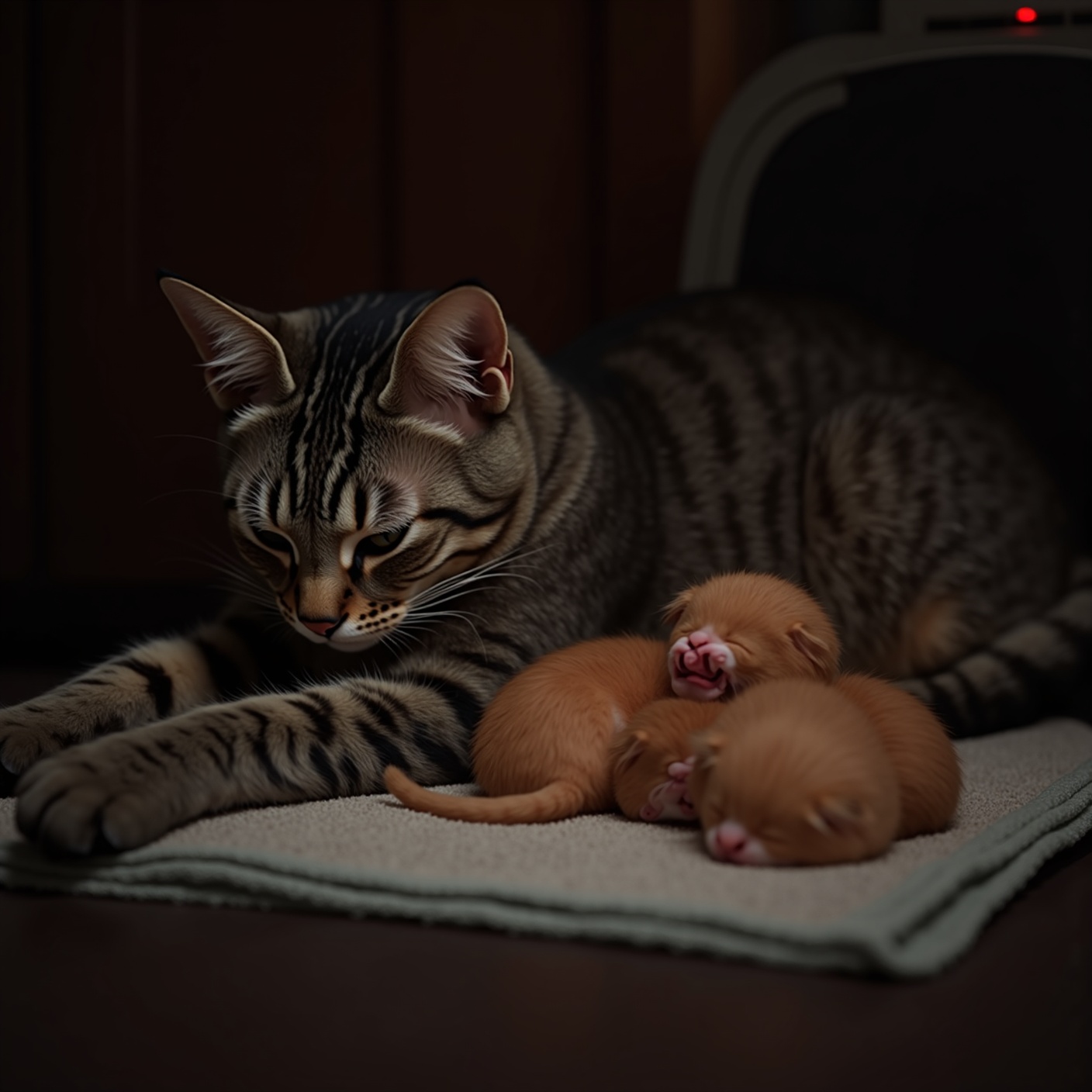
At two a.m. I cracked the door with my heart in my mouth. The heating pad glowed faint red in the dark. And there, stretched along the front of the carrier — not inside it, not touching them, just close, a wall of grey between four kittens and the whole rest of the room — was Axel. His torn ear was up. He was listening to them breathe.
He looked at me. I looked at him. Neither of us moved.
Then one of the kittens started that thin, awful newborn crying, the sound that means cold or hungry or lost, and I watched a feral cat who would not let a human within four feet lean down and press his big scarred head against that kitten until it stopped.
I fed them and left. I did not try to touch him. Some things you don’t interrupt.
It went like that for two weeks. I’d come in for feedings and Axel would be there, sentry-still, and slowly he stopped bracing when I reached past him for the kittens. The kittens didn’t know he was supposed to be dangerous. They climbed him. They fell asleep in the curve of him. One of them, a runty orange girl we called Marmalade, decided Axel’s torn ear was a personal enemy and batted it every chance she got, and Axel — Axel who flinched at a human hand — let her.
The morning it finally happened, I wasn’t even trying.
I’d sat down against the wall with the bottle and Marmalade, who was too impatient to wait her turn, and I felt something touch my knee. I looked down. Axel had crossed the room. He was sitting pressed against my leg, watching me feed the kitten, close enough that I could feel the rumble start up in his chest.
I didn’t move. I barely breathed. Very slowly, I let my hand come down, palm up, the way you offer instead of take.
And Axel, the storm on the loading dock, the cat who braced for the worst from every human he’d ever met, pushed his big head up into my open hand.
He purred like a truck. He purred like he’d been saving it for years.
I sat on the floor of that spare room and cried into a kitten while a feral tomcat headbutted my wrist and I understood, finally, exactly what the old woman meant. We couldn’t teach Axel that hands were safe, because to him we were the danger. But four kittens who needed him taught him he was safe — and a cat who knows he’s safe can afford, at last, to be soft.
The kittens all found homes. Marmalade went to a family with a little boy who thinks she hung the moon, which is fair, because she thinks so too.
Axel didn’t go anywhere. He lives with me now. He sleeps on the pillow next to my head with his torn ear against my cheek, and every time a new foster comes through scared and bracing and sure the world is out to get them, I put them in the room with Axel.
He sits with them. Back to the wall, ear up, that same steady patience. Teaching the thing he learned the hard way.
That the hand, when it comes, isn’t always there to hurt you.