The bird weighed almost nothing when they found him.
Somebody spotted him in a field near Hucknall, Nottinghamshire, in the first days of July. A small dark shape that should have been up in a tree, or at least hopping after a parent with its mouth open. Instead he was sitting on the ground. Barely feathered. Not moving much.
He was a jackdaw, which makes him a member of the crow family, and he was about six weeks old. That number matters more than it sounds. At six weeks a jackdaw is out of the nest but nowhere near independent. He still follows his parents around, still begs, still gets fed by them for weeks afterward. On his own he simply does not know how to eat.
His parents were gone. Nobody knows why, and nobody ever will.
He ended up at Brinsley Animal Rescue in Nottingham, and the staff there had seen enough young birds to know exactly what they were looking at.
“At this stage of his growth, Frank would still be reliant on his parents for food,” said Jon Beresford, the rescue’s co-founder.
The blue eye
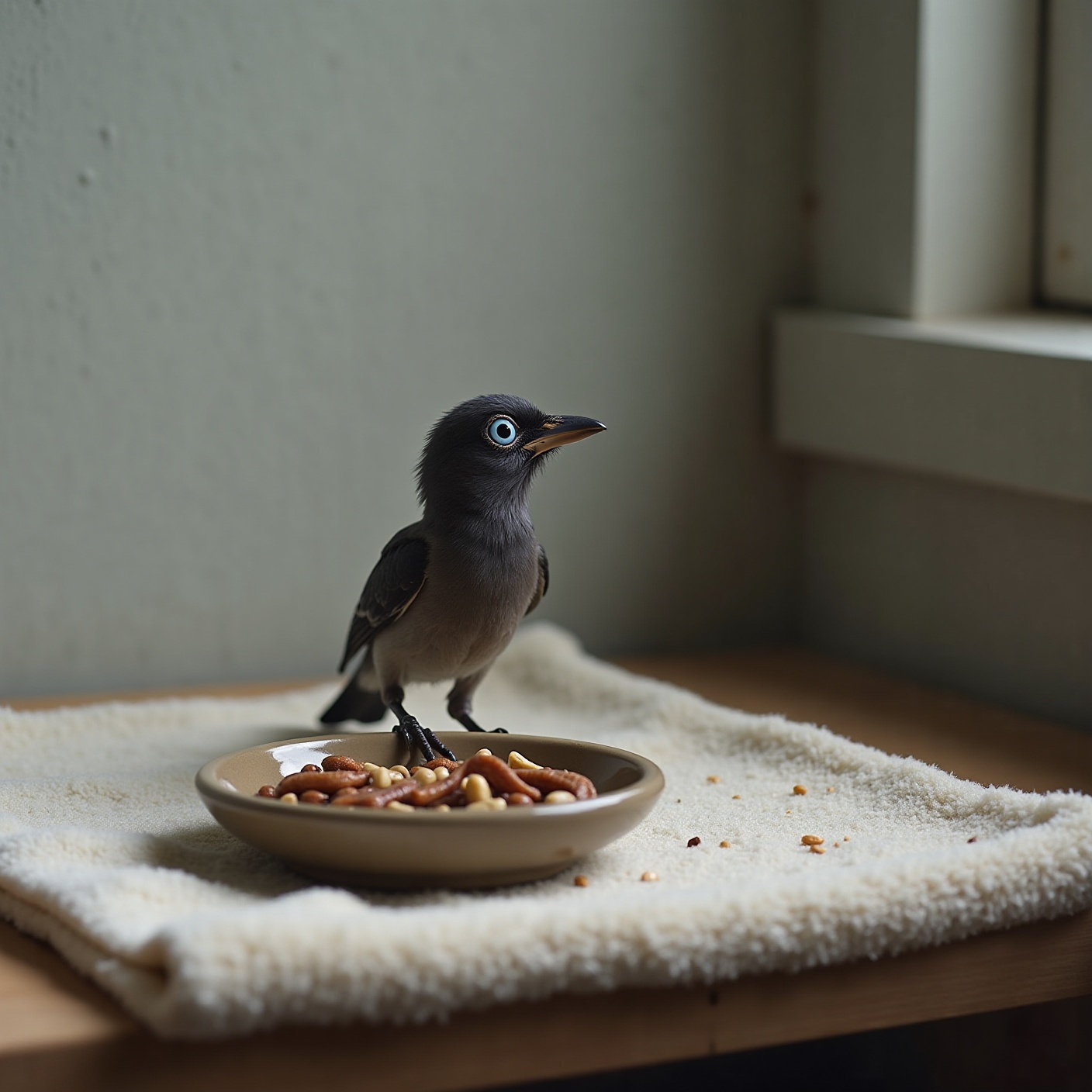
They named him Frank. Not for anything sad, and not for anything clever. He had one startling pale blue eye that seemed to follow people around the room, and somebody said Sinatra, and that was that. Ol’ Blue Eyes. Six weeks old, the size of a fist, and already saddled with the name of a man who filled concert halls.
The name stuck for the same reason names always stick at rescues. Once a bird has a name, everyone in the building has decided he is going to make it.
“As soon as he arrived with us he stole all our hearts,” Beresford said.
Frank went into quarantine, which is standard. Food, medical treatment, warmth, quiet. But food is only useful if the animal knows what to do with it, and Frank did not. He had never been taught. Everything about eating that his parents were supposed to show him over those long weeks of following and begging and copying, he had missed.
The bird in the next space
There was another young bird at Brinsley at the time. A crow, a fledgling like Frank, just a bit further along.
Not much further. This one had only recently figured out how to feed himself. Days, not weeks. He was still new to the whole business of picking things up and getting them down without help, still at the stage where eating takes concentration.
Staff put the two of them together.
It was a practical decision more than a poetic one. Young corvids do badly alone. They are social to the bone, they learn by watching, and a lone chick in a quiet box tends to fade. Company was worth trying.
Then the crow did something nobody asked him to do.
He started feeding Frank.
Beak to beak
Worms and seeds, brought over and passed directly, beak to beak, the way a parent bird does it. Every day. A teenager who had barely worked out how to get food into his own mouth turned around and started putting it into somebody else’s.
Nobody trained him. Nobody could have. Whatever made him do it came from somewhere inside a bird that had never raised anything in his life and was, by any honest measure, still a baby himself.
“It’s amazing to watch them interact,” Beresford said. “Frank watches the older one’s every move and copies him.”
That last part is the piece that actually saves Frank’s life. The feeding kept him alive in the short term, but the copying is what gives him a future. That is how corvids learn. Watch, imitate, repeat, until the thing your parent does becomes a thing you do. Frank lost his teachers in a field somewhere. He got a replacement who was about three weeks ahead of him in the curriculum and teaching it anyway.
Ask people what a crow is and you get a graveyard, a bad omen, a horror-movie silhouette on a fence. Centuries of that. Then an actual crow, given a chance to do nothing at all, walks over and feeds a smaller bird he has no reason to care about.
Scientists have spent decades documenting how sharp these birds are. Tool use, face recognition, grudges held for years, gifts left for children who fed them. Kindness rarely makes the headline. This time it did, and the clip of it went around the world through SWNS and Talker News, picked up by outlet after outlet, because apparently people still want to see this sort of thing.
What happens next
Frank is putting on weight. He is eating. He is, according to the people watching him every day, copying his roommate’s every move.
The plan from here is the plan for any healthy young wild bird at a rescue. He moves to an aviary. He learns to fly properly, in real space, with real distance to cross. And when he is strong enough and fast enough and knows what he is doing, the door opens and he goes back to the sky over Nottinghamshire, where he was supposed to be all along.
He will not remember any of this. That is the deal with wild birds, and it is the whole point of the work. You do not get thanked. You get an empty aviary and a bird somewhere out there who has no idea he was ever nearly dead in a field.
Somewhere in that county there is going to be a jackdaw with one pale blue eye who was fed, in the worst week of his life, by a crow who had only just learned to feed himself.