By two o’clock, Carol had shaken about sixty hands.
Doug’s coworkers from the plant. Doug’s bowling league, all six of them in matching windbreakers, which he would have thought was hilarious. Neighbors she barely knew, holding casseroles out in front of them like small offerings, saying the same four sentences in the same soft funeral voice.
She was running on autopilot. Nod. Thank you. He’d have loved that you came.
Her son Ethan stood at her left elbow, twenty-six and hollow-eyed, wearing a tie he’d borrowed from a friend. Her daughter Lindsay was on her right, doing the thing she’d done since she was nine, which was to stand very close and slightly in front, as if she could block something.
Then a woman came up the center aisle that nobody moved aside for. Not out of rudeness. Nobody knew her either.
Sixties. Navy dress, no black. Silver hair cut sharp at the jaw. She had the kind of posture that makes a room straighten up without knowing why.
She walked to the casket and stopped.
And she stood there longer than a stranger stands. Long enough that the murmuring behind Carol thinned out. Long enough that Lindsay’s hand closed around Carol’s arm.
The woman reached out and touched the edge of the casket, just once, with two fingers.
Then she turned and came straight to Carol, and she took Carol’s hand in both of hers.
That’s when Carol looked down.
The woman’s wedding band was the same as her own. Not similar. The same. That braided rope pattern cut into the gold, the one the jeweler at the mall had called “unusual, we don’t get asked for that,” the one Doug had picked out himself, twenty-two years ago, because he said it looked like something that wouldn’t come undone.
Carol felt the sound go out of the room.
“I’m sorry,” she said. “I don’t think we’ve met.”
“No,” the woman said. Her voice was steady and low. “I don’t think we have. I’m Peggy.”
She held Carol’s hand a beat longer, and she looked at her with something that was not cruelty. It was closer to pity, and it was aimed in both directions at once.
“I’m Doug’s wife,” she said.
Here is what Carol knew about her husband on the morning of his funeral.
Twenty-two years of marriage. Two kids. A mortgage with both their names on it, hers on the top line because his handwriting was so bad. A man who fixed other people’s mowers on Saturdays and wouldn’t take money for it. A man who cried at graduations.
Three weeks a month, he was home. One week a month, he was on what he had always called the work rotation. A contract site three states away, in a town Carol had never once visited, because, he said, there was nothing there to see, and it was a long drive, and he’d rather spend the gas coming home.
Twenty-two years, and she had never once picked up the phone and checked.
Here is what Peggy knew.
Twenty-five years of marriage. One son, grown. A man who was gone three weeks a month for work and came home for one, and who was so good at coming home that she used to tell her friends the separations kept it fresh.
Same braided rope band. Same jeweler, probably. Same man standing at the counter picking it out, three years apart, saying the same line about how it wouldn’t come undone.
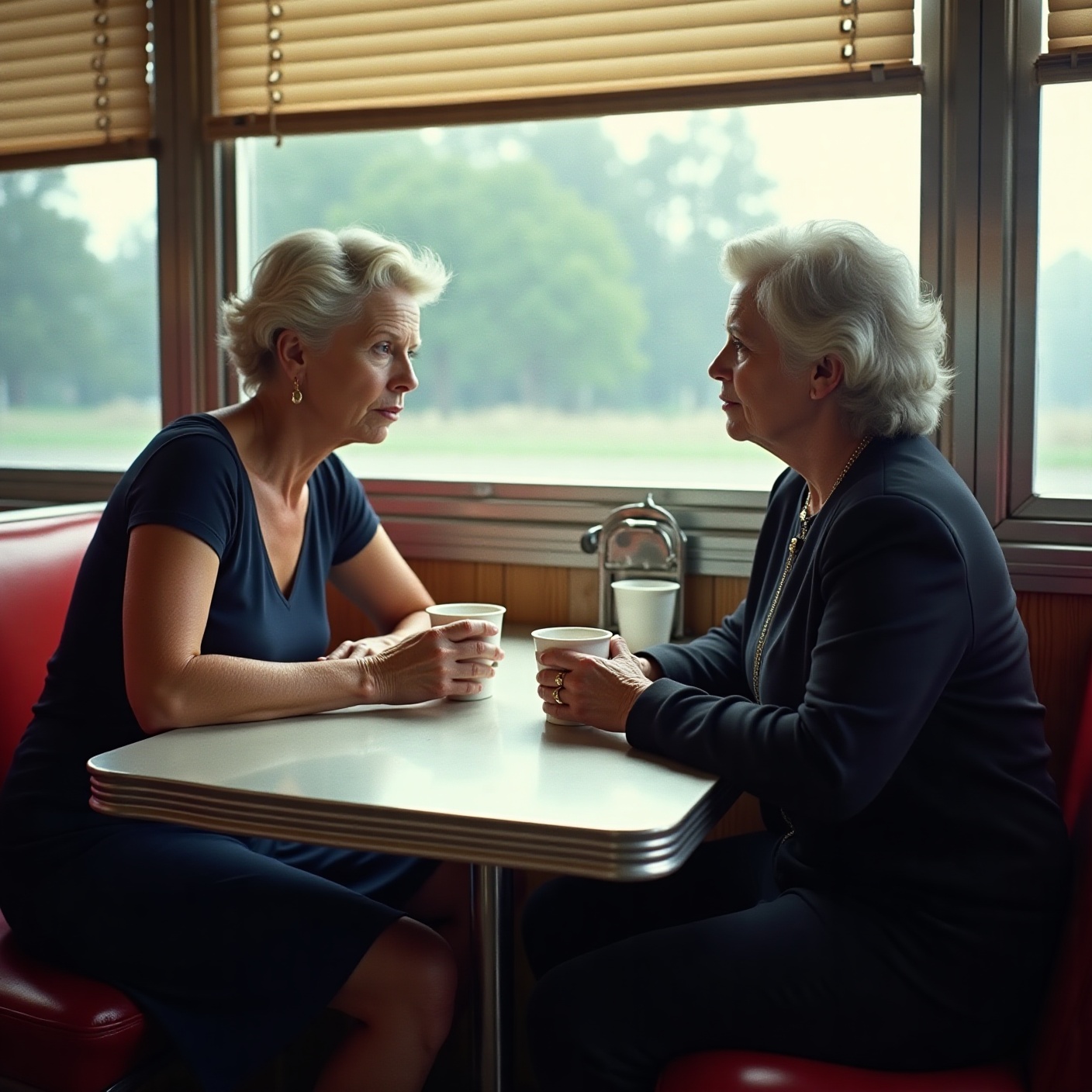
They did not scream at each other. Carol has thought about that a lot since, and she still can’t fully explain it. Maybe there wasn’t anything left to aim at. The man they would have thrown it at was six feet away in a box, and he’d left the room permanently, in the middle of the sentence, without answering a single question.
They went to a diner instead. The one by the highway, with the laminated menus.
Peggy ordered coffee and didn’t drink it. Carol put her hands flat on the table and left them there, because they wouldn’t stop moving otherwise.
They compared. It took two hours.
The dates lined up like a train schedule. His week away was her week home. His “double shift” was a birthday party in another state. He had two toolboxes, two coffee mugs he was particular about, two recliners with a groove worn into the same spot. He’d told Peggy his mother was dead. He’d told Carol his mother lived in Arizona and hated to travel. His mother, it turned out, had been dead since 1994.
At one point Peggy laughed. Not a nice laugh. She put her hand over her mouth right after, like it had gotten away from her.
“He was so tired,” she said. “All the time. I used to feel bad for him.”
Carol didn’t laugh. But she understood exactly what Peggy meant, and that was the worst part of the whole afternoon.
On Tuesday, they walked into the county clerk’s office together.
Each of them carried a marriage certificate in a manila envelope. They stood side by side at the counter, two women in their sixties, and neither of them said the word “husband.”
The clerk’s name was Ms. Alvarez. She looked at the first certificate. Then the second. Then she looked up at the two of them for a long moment without saying anything at all, and Carol watched a professional woman decide, in real time, to be gentle.
“Give me a minute,” Ms. Alvarez said, and went into the back.
She was gone eleven minutes. When she came out she was carrying a third document, and she was carrying it the way you carry something that’s going to hurt somebody.
She laid all three flat on the counter and turned them around so the women could read them right-side up.
“Ladies,” she said, “I think you need to sit down for this one.”
Doug had filed for divorce from Peggy. Once. Twenty-three years ago, six months before he married Carol.
He had filed the petition. He had paid the fee. And then he had never finished it. No final decree. No judge’s signature. The file sat open in a drawer in a county courthouse for twenty-three years, and nobody chased it, because nobody chases you to end your marriage.
Which meant that on the day Doug stood in a church in front of Carol’s whole family and said the words, he was already married. Which meant Carol’s marriage. Twenty-two years of it. Had never legally existed at all.
Not the certificate. Not the survivor benefits. Not the pension he’d talked about for a decade. Not the house, which he had bought the year before he met Carol and never got around to putting her name on the deed of, because, he said, the paperwork was a headache and he’d get to it.
Legally, at 2:15 on a Tuesday afternoon, all of it belonged to a woman Carol had met four days earlier at a funeral.
Ms. Alvarez brought two paper cups of water and set them down without being asked.
Carol has said since that the strangest thing about that moment was that she didn’t cry. She looked at the papers, and she thought about the top line of the mortgage, and she thought: he knew. Every day, for twenty-two years, at breakfast, at Ethan’s graduation, at her father’s funeral, holding her hand in the hospital in 2011, he knew, and he chose not to fix it, because fixing it would have required telling someone.
Peggy stood next to her, reading the same page.
Then Peggy said, out loud, to the clerk, in a voice like a door closing:
“What do I have to sign to give it back?”
Carol turned and looked at her.
“He took twenty-five years off me,” Peggy said. She wasn’t looking at Carol. She was looking straight ahead at the wall behind the counter. “He took twenty-two off you. He is not taking your house too. I won’t help him do it from where he is.”
It took four months and a lawyer they split down the middle.
Peggy filed a disclaimer of interest on the house. She signed the survivor’s paperwork over. She sat in a conference room across from Carol’s kids and told them, calmly, that none of this was their fault and that their father had loved them, which she had no way of knowing and said anyway, because they were twenty-six and thirty and their whole floor had come out from under them.
Lindsay asked her why she was doing it.
Peggy thought about it for a while.
“Because there are two of us,” she said, “and only one of him, and I’d rather we came out of it better than he did.”
They still talk. Not every week. Carol will pick up the phone and there’s Peggy on the other end, and they’ll go twenty minutes about nothing, about a recipe, about Peggy’s knee, about Lindsay’s new job.
Neither of them ever says his name. It’s not a rule. It just doesn’t come up.
Carol took the ring off in the parking lot outside the clerk’s office and put it in the change tray of her car, and it stayed there for eleven months, sliding back and forth every time she took a turn.
Peggy kept hers on.
“It’s a good ring,” she said. “The man was a liar. The gold didn’t do anything.”