“Pack up your locker, Marcus. I’m done handing out warnings.” The words left my mouth sharp and cold, and they cut clean through the busy Saturday hum of the store.
Marcus snapped awake so fast he knocked over a stack of receipt paper. His eyes were bloodshot, and the dark circles under them looked less like tiredness and more like deep, purple bruises. Behind him a woman in a windbreaker tapped her foot and glared at the eighteen-year-old boy who had just dozed off, mid-bag, with a carton of eggs balanced in one hand.
“Ms. Davis, please,” he whispered. His voice shook. He grabbed the lip of the checkout counter, and his knuckles went white. “It was just a few seconds. I swear it won’t happen again.”
I shook my head. I’d managed this supermarket for six years, and I ran a tight ship — everybody in town knew it. Fast lanes. Full shelves. Cashiers who smiled whether they felt like it or not. I was proud of that. I had built my whole idea of myself on it.
“That’s what you said Tuesday, Marcus,” I told him, crossing my arms. “And Thursday. This is a business, not a charity. I need people who are actually awake. Hand in your name tag.”
He didn’t argue. That was the part that should have stopped me, if I’d been paying any attention at all. He didn’t beg, didn’t make excuses, didn’t blame anyone. He just unclipped the little plastic tag that said MARCUS in cheerful red letters, set it on the belt between us, and looked at me for one long second with an expression I couldn’t read at the time. I can read it now. It was the look of someone who had already lost so much that losing one more thing barely registered.
“Okay,” he said quietly. “Thank you for the chance, Ms. Davis.”
And he walked out through the automatic doors into the bright parking lot, and I went back to my office feeling righteous. Efficient. Fair. I told myself I’d done the responsible thing. I told myself a story about myself, the way we all do, and in that story I was the reasonable one.
I found out how wrong that story was two mornings later.
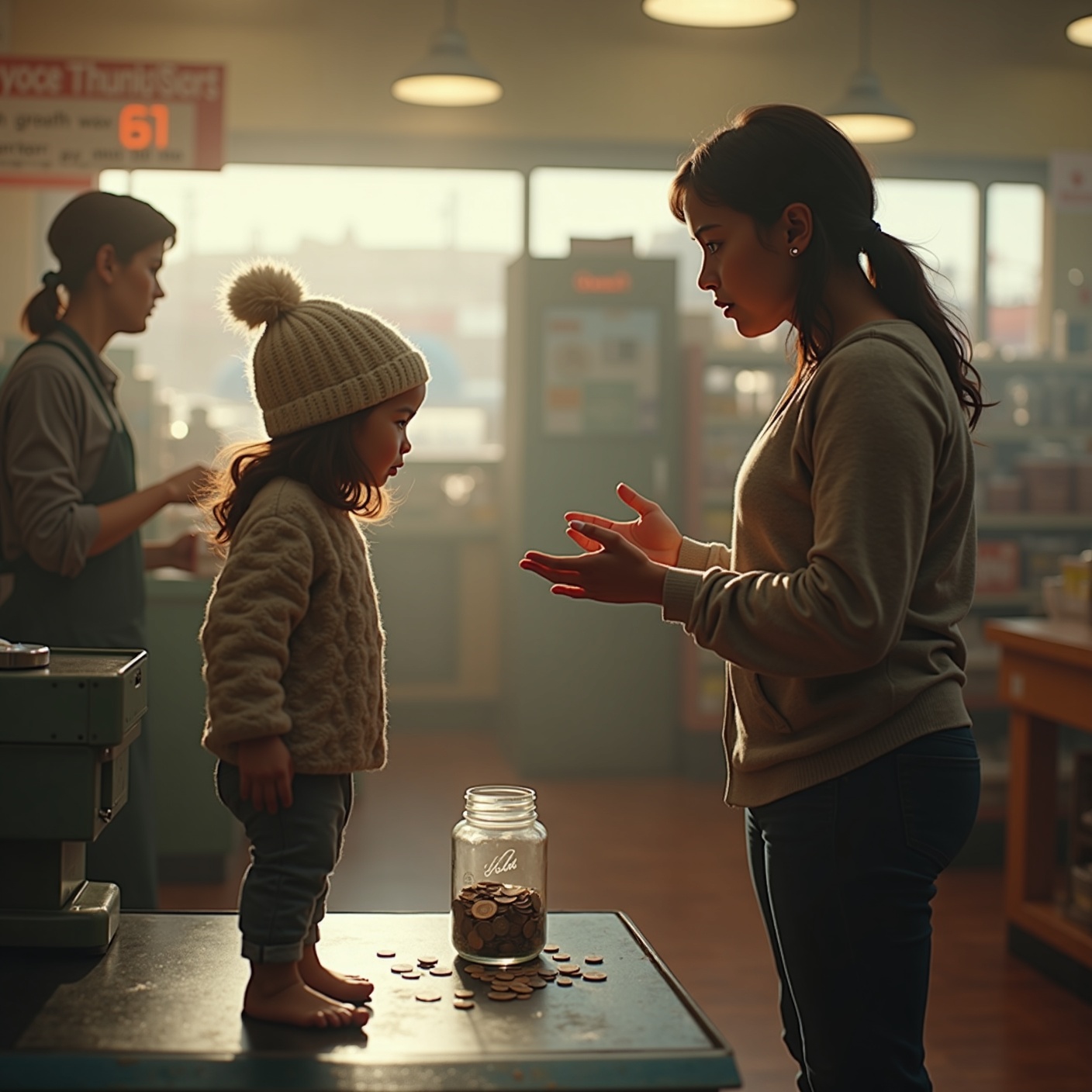
She came in right at open, when the floors were still wet from mopping and the first pot of coffee was hissing in the break room. A little girl, maybe nine years old, in a knit hat pulled down over her ears even though it was warm out. She walked straight up to my register — the one Marcus used to work — and she set down a mason jar full of pennies and nickels and a few crumpled dollar bills, and she looked up at me with the most serious face I have ever seen on a child.
“I’d like to buy my brother’s job back, please,” she said.
I laughed. God forgive me, I actually laughed — a small, confused laugh, the kind you make when you think someone is joking and you don’t yet understand that they are not. “Sweetheart,” I said, “that’s not really how jobs work.”
“He didn’t fall asleep because he’s lazy,” she said. She said it fast, the way kids do when they’ve practiced a sentence in their head the whole walk over and they’re afraid they’ll lose their nerve. “He falls asleep because he works at the warehouse all night. And then he stays up with me. Because I’m the one who wakes up scared.”
I felt the floor tilt a little under me. “Honey,” I said carefully, “where’s your mom?”
Her chin didn’t wobble. She’d clearly answered this before. “She passed away. It’s just me and Marcus now. And the medicine.” She reached up and, very matter-of-fact, pulled the knit hat off her head. Underneath, her hair was gone — the soft, cropped fuzz of a kid who has been through months of treatment. “It’s called leukemia,” she said, like she was reciting a spelling word. “The doctors say I’m getting better. But it costs a lot. So Marcus works nights so we can keep the apartment, and days he was working here, and in between he sits with me at the hospital so I’m not by myself.” She pushed the jar an inch closer to me across the belt. “There’s forty-one dollars and sixty cents. It’s everything I have. I counted it three times. Please don’t make him find another job. He’s so tired already.”
I have replayed the next few seconds of my life more times than I can count. The wet floor. The coffee hissing. The cheerful red name tag still sitting in my desk drawer where I’d tossed it two days before, like it was trash. And this child — this brave, bald, nine-year-old child — offering me a jar of pennies to undo the cruelest thing I had ever done without even knowing I was doing it.
Her name was Lily. Her brother had been carrying all of this, alone, at eighteen — the night shifts hauling freight, the day shifts bagging my groceries, the hospital vigils in between so his little sister wouldn’t wake up frightened in the dark — and when he’d finally closed his eyes for three seconds over a carton of eggs, I had called him lazy and taken his name tag.
I came out from behind the register. I got down on my knees on that wet floor so I was level with her, and I closed her small cold hands back around the jar.
“Keep your money, Lily,” I said, and my voice was not steady at all. “Your brother isn’t fired. He was never fired. I made a mistake, and I am so sorry. Can you tell me where I can find him?”
She studied my face for a moment with those serious eyes, deciding whether to trust me. Then she nodded once, and something in her small shoulders came down, and she started to cry — quiet, exhausted, relieved tears, the tears of a child who has been carrying a grown-up weight for far too long. I put my arms around her, jar and all, and I cried right along with her in the middle of my perfectly efficient store.
That afternoon I drove to their apartment complex on the east side of town. Marcus opened the door in a warehouse uniform, and I watched the fear cross his face when he saw me — the fear of a kid who assumes another adult with a clipboard energy has arrived to take one more thing away.
“Marcus,” I said before he could speak. “Lily came to see me.”
He closed his eyes. “She wasn’t supposed to do that.”
“I’m glad she did,” I said. “Your job is yours. But we’re going to fix the schedule, and we’re going to do a lot more than that. Can I come in?”
We sat at his little kitchen table — two chairs, a crayon drawing taped to the fridge, a pill organizer the size of a briefcase — and he told me the rest. The mother gone eight months. The warehouse that paid just enough. The treatment center in the next state that had a trial he was trying to get Lily into. The way he’d stopped telling anyone anything because every time he did, people looked at him the way you look at a problem, not a person.
I did not sleep that night either.
The next morning I did something I probably should have run past corporate first, and didn’t. I put a sign by the registers, and I told the regulars — the ones who’d known Marcus’s face for a year, who’d watched him bag their groceries and never once wondered why the kid looked so tired. I told them the truth, with his permission. And this town, which I had spent six years thinking of mostly as a stream of impatient customers to be moved efficiently through my lanes, showed me something I had forgotten it could do.
By the end of the week there was a jar on every register — Lily’s jar, in a sense, multiplied. The bakery started donating the day’s unsold bread to their apartment. A retired nurse who shopped every Tuesday offered to sit with Lily on Marcus’s warehouse nights, for free, “because that’s what neighbors used to do.” An elderly man who never said more than two words at checkout pressed a folded check into my hand and walked out before I could read the number. It was not a small number.
I thought that was the end of the story. I thought it was the good part, the part where the hard-hearted manager learns her lesson and the town rallies and everyone cries the good kind of tears. And it was all of that.
But there was another part coming, and it taught me a second lesson I hadn’t asked for — that sometimes the people who offer to help you are the ones you have to watch the most carefully.
Because the story got out. A local reporter wrote it up, and it traveled, the way these things do now. And within a few days I got a call from the Regional Director — the same corporation that owns my supermarket and a few hundred others — asking me, very warmly, to come to the regional office. They had heard about “the situation with the young man and his sister,” the woman on the phone said, and the company wanted to “get involved in a big way.”
I drove out there hopeful. I sat in a glass conference room across from a Regional Director in an expensive suit and a woman in a cream blazer from something called Brand Partnerships, and they slid a folder across the table toward me. Inside was a number that made my breath catch — enough to cover Lily’s treatment, the travel, the trial, all of it, with room to spare.
“That’s incredible,” I said. “Marcus and Lily are going to — “
“There’s just a small ask,” the woman in the cream blazer said, smiling. “We’d want the family to be the face of a campaign. Interviews. Photos. A commercial, ideally, with Lily. ‘A company that cares.’ We’d need exclusive rights to their story, and a few appearances a quarter. The funding is contingent on participation, of course.” She tapped the folder. “Standard, for a partnership of this size.”
Contingent. That was the word that stuck in me like a splinter.
I asked to see the paperwork, and because I’d managed one of their stores for six years and knew where things were filed, I asked a question that made the Regional Director’s smile flicker — about the corporate Emergency Relief Fund. The one buried three levels deep in the employee handbook. The one that already existed, fully funded, sitting untouched, meant for exactly this — an employee in crisis — with no publicity attached to it at all.
They didn’t have a good answer for that. They had a lot of words, but no answer.
They wanted to buy Lily’s face. They had a fund that could help her for free, quietly, tomorrow — and instead they wanted to make a sick nine-year-old the star of a commercial about how much they cared, and only pay if she smiled on cue.
I drove back to town with that folder on the passenger seat and my hands tight on the wheel. That night I sat with Marcus and, carefully, told them both the offer. I watched Marcus do the math a person shouldn’t have to do — the treatment his sister needed weighed against his sister’s dignity — and I watched him start, exhausted, to say yes, because when you’re drowning you’ll grab anything.
Lily didn’t say a word. She got up from the table, went and found a marker and a piece of paper, and came back and slid it across to me the same way the woman in the cream blazer had slid the folder. On it, in careful nine-year-old capitals, she had written five words.
MY FACE IS NOT FOR SALE.
And that settled it. Because if a child who had counted out forty-one dollars and sixty cents to buy back her brother’s job could still hold onto her dignity, then I could certainly find mine.
The company was hosting one of those staged “community impact” events that week — balloons, a step-and-repeat banner, a giant cardboard check, local press invited. They wanted me there. They wanted, I understood now, a photo of the grateful store manager. So I went. And when the Regional Director handed me the microphone to say a few warm words about our wonderful corporate family, I said a few words they had not rehearsed with me.
I told the crowd about the Emergency Relief Fund. The one that already existed. The one already paid for. I told them, calmly, that this company could help Marcus and Lily today, with no strings, no cameras, no contract for a child’s face — and that everything else, the balloons and the cardboard check and the “contingent on participation,” was a photo shoot dressed up as mercy. I said that real help doesn’t come with an invoice you pay in your dignity. Then I set the microphone down on the podium and I went and stood next to Marcus and Lily, and I did not smile for the cameras.
It was, I’m told, a very awkward event.
I thought they might fire me. I’d made my peace with it on the drive over. Instead — and I still don’t fully know why, except that a room full of local reporters had just heard the whole thing — the board met the following week and quietly approved full support for Lily’s treatment out of the very fund I’d named. No campaign. No commercial. No contract for a little girl’s face. Just the help, the way help is supposed to arrive: without an audience.
Lily is doing well now. Her hair is growing back — she keeps trying to get me to guess what color it’s coming in as, and she is delighted every time I’m wrong. Marcus quit the warehouse; he’s back at my store part-time, days only, and he’s starting community college in the fall. He wants to be a nurse, he says. Because of the ones who were kind to his sister. He’s still the most tired-looking kid I’ve ever met, but the bruises under his eyes are gone.
That mason jar of pennies sits on my desk now, where the name tag used to live in the drawer. I never gave the money back — Lily wouldn’t take it, said a deal’s a deal — so I keep it. Forty-one dollars and sixty cents. It is the most valuable thing I own.
I used to think mercy was easy. A soft feeling, a nice gesture, the kind of thing you can afford when the store’s not busy. I know better now. Real mercy costs you something — it cost me my certainty that I was a fair person, and later it nearly cost me my job. But the counterfeit kind, the kind with a contract and a camera, costs the person receiving it far more.
A nine-year-old with a marker taught me the difference. My face is not for sale. Neither, it turns out, is a clear conscience — and I nearly gave mine away for the price of running a tight ship.