
Neptune and Uranus are the two most distant planets in our solar system, a pair of cold blue-green giants so far out that sunlight takes hours to crawl all the way to them. We’ve only ever visited each of them once, in passing, with a spacecraft that couldn’t stop.
And deep inside both of them, according to everything we know about physics, the weather does something no forecaster on Earth would ever have to warn you about.
It rains diamonds.
Not “sort of like” diamonds. Not a poetic flourish. Actual carbon, crushed into the same crystal you’d find in an engagement ring, forming in the dark and drifting slowly down toward the center of the planet like hail through an ocean with no bottom.
Here’s how a thing like that even gets started.
Neptune and Uranus are called ice giants, and a big part of what’s sloshing around inside them is methane, a simple molecule of one carbon atom bonded to four hydrogen atoms. It’s a hydrocarbon, the same family of stuff that makes up natural gas. Now go down. Not a little way down, thousands of kilometers down, to a place where the weight of the entire planet is pressing on everything at once. The pressure there is monstrous, more than a million times what you feel standing on a beach, and the temperature runs into the thousands of degrees.
Under that kind of squeeze, methane doesn’t stay methane. The pressure and heat rip the hydrogen away from the carbon. The freed carbon atoms, with nowhere to go and everything pressing in, lock together into the tightest, most orderly arrangement carbon knows how to make.
Which is diamond.
And because a diamond is denser than the hot slurry around it, it doesn’t float. It sinks. Slowly, steadily, toward the core, a quiet snowfall of jewels thousands of kilometers beneath a sky nobody will ever stand under.
For a long time this was one of the most beautiful ideas in planetary science, and also one of the most frustrating, because there was no way on earth to check it.
You cannot send a probe into those depths. Anything we could build would be flattened into foil before it got a fraction of the way down. So for decades, “it rains diamonds inside Neptune” lived in the awkward place where a calculation sits when it’s very probably true and completely unprovable. A very good guess, dressed up in equations.
So in 2017, a team at the SLAC National Accelerator Laboratory in California decided to stop guessing and make diamond rain happen on a lab bench instead.
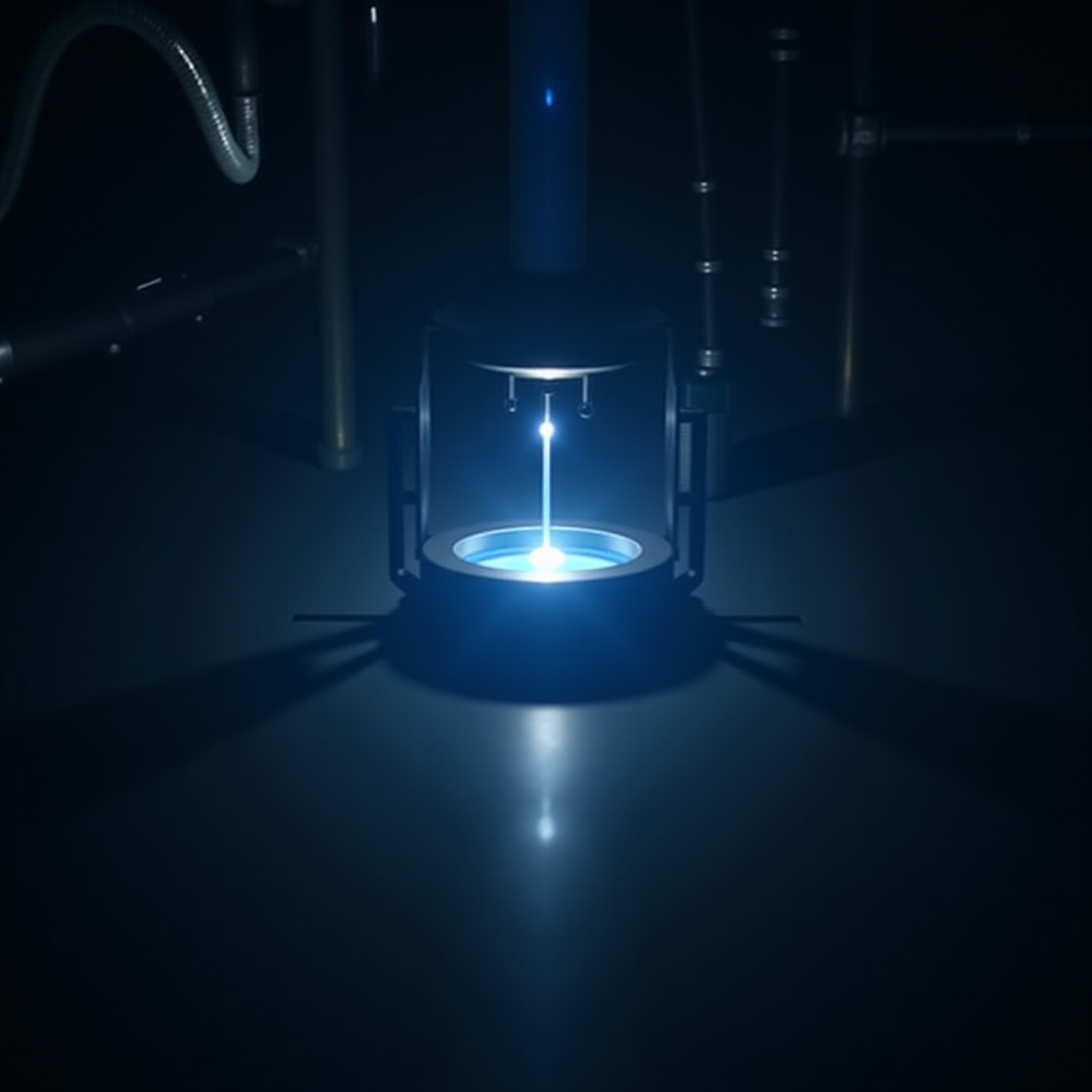
They couldn’t use methane; it’s a gas, and it won’t hold still. So they used polystyrene, ordinary plastic, which is built from carbon and hydrogen just like methane is. Then they hit a tiny sample of it with two rapid pulses from an X-ray laser, one right on the heels of the other, at an instrument with the wonderfully blunt name Matter in Extreme Conditions.
The first pulse slammed the plastic with a shockwave. The second caught it at the instant of maximum compression and let the scientists photograph, with X-rays, exactly what the carbon was doing. For a sliver of time, that little chip of plastic was living under pressures about 1.5 million times Earth’s atmosphere, roughly the conditions you’d find some ten thousand kilometers down inside Uranus or Neptune.
And in that sliver of time, diamonds appeared.
“Nearly every carbon atom inside the plastic turned, within this 1 nanosecond or less, into a diamond crystal structure,” said Dominik Kraus, who led the work. One nanosecond. A billionth of a second. Faster than the word “diamond” leaves your mouth, a piece of packing foam became a dusting of tiny diamonds, exactly the way the models said it would happen a billion kilometers away.
That should have been the end of the story. It was actually the middle.
Because in January 2024, the same lab went back and made the experiment more honest. Real ice giants aren’t pure methane; they’re a messy stew that also includes water and other stuff, meaning oxygen is in the mix too. So this time the team used a plastic that contained oxygen, a closer match to the actual chemistry inside the planets.
The diamonds still formed. And, if anything, they formed more easily, at lower pressures and temperatures than the earlier work suggested. The oxygen seemed to help pull the carbon and hydrogen apart, which means diamond rain may fall through a bigger slice of these planets than anyone first assumed.
That 2024 run turned up a bonus, too. Both Neptune and Uranus have strangely lopsided, off-center magnetic fields that have puzzled scientists for years. The new experiments hinted at a culprit: as diamonds form and fall, they sink through a layer of hot, electrically conductive ice, stirring it as they go. Moving conductive fluid is exactly the recipe for generating a magnetic field. The falling jewels may be part of what makes these two worlds magnetically weird.
Now, one honest caveat, because it matters. Nobody has ever seen the diamonds. We can’t photograph the inside of Neptune, and we can’t scoop up a sample. What we have is the physics, the computer models, and now the lab bench proving the same reaction under the same conditions, over and over. That’s strong evidence. It is not a snapshot from the core. When someone tells you diamonds rain on Neptune, the accurate version is: everything we can test says they do, and we’ve made the exact same rain fall in a laboratory.
One more thing worth holding onto. The diamonds the lab made are nanoscale, a few billionths of a meter across, because the crushing lasts only an instant before it lets go. Inside Neptune, the same process runs not for a nanosecond but for millions of years, without ever letting up. Given that kind of time, the diamonds have every opportunity to grow, and grow, before they finally sink out of reach.
So there are two planets in our own solar system, the two we’ve paid the least attention to, quietly manufacturing treasure in the dark. Nobody will ever hold it. Nobody will ever spend it. It just keeps falling, forever, a billion kilometers from the nearest eye that could ever appreciate it.