The coffee shop on Franklin Street has a chalkboard out front that says “Be nice or leave.” I stood in front of it for a full minute, reading it over and over like it was a set of instructions I was supposed to follow.
I was twenty minutes early. I’m always early. That’s a habit you pick up when you spend a couple of years being the kid who gets picked up last.
Inside, it smelled like burnt sugar and steamed milk. I ordered a large coffee I didn’t want, took the table by the window so I could see the parking lot, and pulled a paperback out of my bag because my hands needed a job. Black cover, gold roses, cracked spine. One of those enemies-to-lovers books my best friend Tasha shoves at me in the hallway between classes with her face doing this whole you have to, you HAVE to thing. I was on page 212. The prince was being terrible. It was very stupid and I loved it.
My mother was going to walk through that door in twenty minutes. I hadn’t seen her since I was twelve.
Here’s how twelve went.
My parents split in March. Diane sat me down on the edge of my bed with her hands folded like she was about to give a presentation, and my dad, Russ, stood in the doorway with his arms crossed and this look on his face like he’d already been told the ending. Diane said she and my father had “grown into different people.” She said it would be better this way. She said we’d figure it out together.
Two weeks later she said she’d be staying with Greg for a while, just for a while, just until things settled.
Greg had a boat and a laugh you could hear from the driveway. I’d met him exactly twice. He shook my hand both times like I was a coworker.
The plan was that I’d go back and forth. That was the plan she said out loud in the kitchen, in front of my father, with the fridge humming behind her. Two weeks with Dad, two weeks with her. She bought me a purple duffel bag for it. She let me pick the color.
I used that duffel bag one time.
That April I stayed at Greg’s house for nine days. I remember the guest room had a comforter with sailboats on it, and I remember lying under it listening to them talk through the wall. I couldn’t get all of it. I got enough. I got Greg saying he didn’t sign up for the drama, that he wasn’t going to have Russ in his driveway every other Friday, that he wasn’t going to spend his fifties in the middle of someone else’s divorce. He wasn’t yelling. That’s the part I think about now. He was talking the way you talk about a parking spot.
And I waited for my mother’s voice to go hard. I lay there in the dark with sailboats over me and I waited for her to say that’s my kid, Greg.
What she said was, “Okay. Okay. Let’s not do this tonight.”
My dad picked me up the next morning. She stood in the doorway in a robe with her arms wrapped around herself and told me she loved me, and that she’d call Sunday. I believed her. I was twelve. Believing her was basically my whole personality.
She didn’t call Sunday.
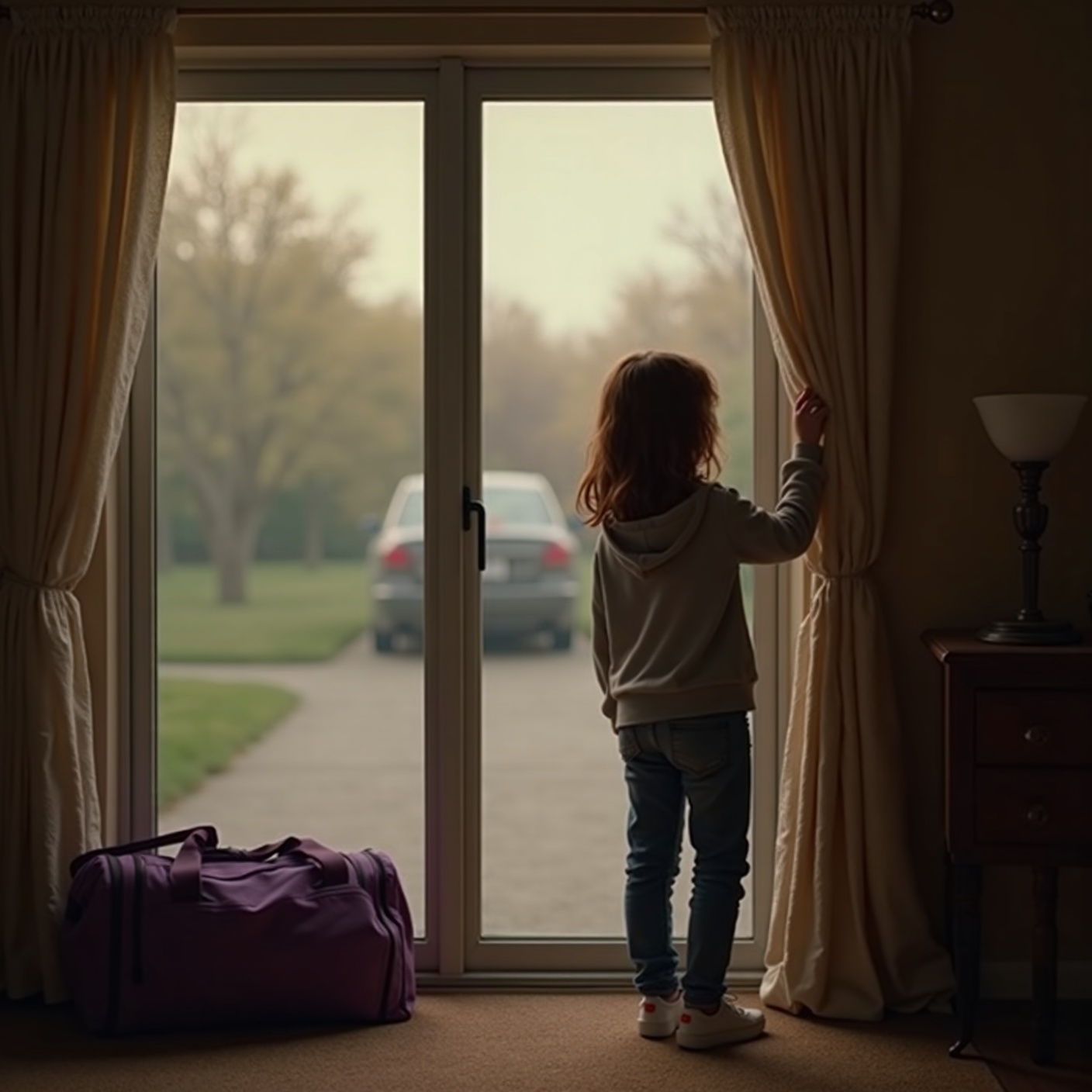
She didn’t call the Sunday after that either, and somewhere in there I stopped keeping track of Sundays, because a kid can only stand at a window so many times before the window starts to feel like an insult.
There was a birthday card when I turned thirteen. Signed Love, Mom and Greg, in her handwriting, both names. Twenty dollars inside. My dad found me in the garage with it and didn’t say anything, just handed me a Coke and sat down on the step next to me, and we watched the neighbor’s sprinkler go around for probably fifteen minutes.
That was the last thing that came in the mail.
So my dad raised me. Russ, who works HVAC and comes home smelling like attic insulation and can’t cook anything except three things, which he made in rotation for six years, and I still ask for the bad one on my birthday because it’s ours. Russ, who sat in a folding chair in the rain at every single one of my track meets, including the ones where I came in last, including the one where I came in last and threw up on the infield. Russ, who taught himself to French braid off a YouTube video because I cried once about it in seventh grade and he didn’t want me to cry about it in eighth.
He never trashed her. That’s the thing that gets me, looking back. Not once. When I was fourteen and angry and asked him straight out why she left, he took a long time answering, and then he said, “People pick, Nora. She picked. It isn’t about you being worth picking.”
Six years. No visits. Not one. She lived thirty-one minutes away. I know because I looked it up on my phone one night when I was fifteen and mad, and then I sat there staring at that number until the screen went black. Thirty-one minutes. She could have driven it on a lunch break.
Then, three weeks before my eighteenth birthday, my phone buzzed while I was studying for a chem final.
Hi sweetheart. It’s Mom. Greg and I have separated. I’ve had a lot of time to think about things. I’d love to see you. I’d really love to rebuild our relationship.
I read it maybe forty times. I showed Tasha, who said something about Greg that I won’t repeat. I showed my dad, and he read it twice, and his jaw did the thing it does, and then he handed the phone back and said, “That’s your call, kid. Not mine. If you want to go, I’ll drive you and I’ll wait in the car.”
That’s how I ended up at a window table on Franklin Street with a coffee I didn’t want and a stupid book about a terrible prince, and my dad’s truck idling out in the lot where I could see it.
She came in at 2:04.
She looked smaller. That was the first thing. In my head she’d stayed the same size she was when I was twelve, when she filled a doorway. She had a good coat on and her hair was shorter and lighter, and she scanned the room twice before she found me, which I understand, because I was nine years old in her head and now I was five foot eight.
“Nora,” she said, and her eyes went wet, and she hugged me before I’d fully stood up, so it landed wrong, half around my shoulders. She smelled like the same perfume. I hated how much I noticed that.
“Hi,” I said.
She sat down across from me and put both hands around her cup and asked me about school. I told her about school. She asked about track. I told her I’d quit after sophomore year. She said, “Oh, that’s a shame, you always had those legs,” and laughed, and I laughed too, which annoyed me for the rest of the day.
We got about six minutes in. That’s honestly the number. Six minutes of the smoothest small talk you have ever heard in your life, and then her eyes dropped to the table, to the paperback sitting there next to my elbow with my thumb still holding page 212.
She turned it toward her with one finger. Looked at the back. Made a small sound with her mouth.
“Nora.” Her voice changed. It got warm and patient and a little bit tired, and I knew that voice, I knew it from being eleven and getting caught with a phone after ten. “Honey, you are way too young to be reading this kind of thing.”
I didn’t say anything.
“This is toxic romance,” she said, tapping the cover twice with her fingernail. “This is not what a relationship looks like. Girls read this stuff and it rewires how they think about men, and then they end up with someone who treats them like garbage and they call it passion.” She slid it back across the table to me. “I’m just saying. As your mother. You’re at an age where this matters.”
The espresso machine screamed behind the counter. Somebody’s kid was dragging a chair. And I sat there and looked at this woman I had not seen in six years, telling me I was too young.
“I was twelve when you disappeared,” I said.
She blinked.
“Six years ago,” I said. “I’m eighteen now. I’ve been eighteen for eleven days.”
I want to be clear that I did not say it mean. I said it the way you’d read something off a receipt. That might have been the worst part for her, honestly.
Her face did about four things at once. And out of all of it, out of six years, out of the purple duffel bag and the sailboat comforter and the birthday card with two names on it, out of all the Sundays, do you know what she picked?
She sat up straight, and her chin went hard, and she said, “Disappeared? Nora. That is an ugly word. That is a really unfair word to use about your own mother.”
Not I know. Not you’re right. Not I’m sorry.
She was mad about the word.
“I had a very complicated situation,” she said. “You have no idea what I was dealing with. And you’re going to sit there and say I disappeared? After I reached out to you? After I’m the one who reached out?”
I looked at her hands. She’d wrapped them around that cup so tight her knuckles had gone white, and I remember thinking, very clearly, with no drama at all: she’s not upset that she missed it. She’s upset that I named it.
So I picked up my book. I put it in my bag. I said, “Thanks for the coffee,” which was insane, because she hadn’t paid for my coffee, I’d paid for my coffee twenty-five minutes before she walked in.
She said my name twice while I was walking out. Once soft. Once not.
My dad had the truck running. He didn’t ask. He just looked at my face for about a second and a half and then reached over and turned the radio up, some classic rock station he refuses to change, and pulled out of the lot.
We were four blocks away when he said, “You hungry?”
“Yeah,” I said.
He made the bad one that night. The one only he and I like. I ate two plates.
Tasha says I should have said more. My aunt on Facebook says I broke my mother’s heart and that someday I’ll understand, because someday I’ll have kids of my own. Maybe. I’m eighteen. I’ve been told I don’t understand a lot of things.
But I keep coming back to the same place, and it’s this. She had six years and thirty-one minutes of highway, and the first thing she found worth correcting in me was a paperback.
She never did ask what page I was on.