My mother was sick for a year and a half, and in all that time her brother sent exactly one message.
It came the week we got the diagnosis. Nine words, no punctuation at the end, like he couldn’t finish it. “I can’t bear to see her like this. I’ll see her in another life.” Then nothing. No call. No card. Not at Thanksgiving, not on her birthday, not on the two separate nights the doctors sat us down in the family room and told us to get everybody there, because they weren’t sure she’d see morning.
His name was Ray. He was my mother’s older brother, and for most of my life he’d been the uncle who fixed things. The one who showed up with a truck when you moved. The one who could get a dead furnace going in January and stood at the back of every graduation squinting like the sun was a personal insult. Quiet. Steady. There.
And then, when it counted, gone.
The disease took her slowly, which is the cruelty of it. Her hands went first. Then the small muscles in her face, so the smile I’d known my whole life started arriving a half-second late and lopsided. It was the same thing that had killed my grandfather, a man I never met, and every time I said that out loud a nurse would nod like it explained something. It didn’t explain anything to me. Not then.
My brother Mark stopped saying Ray’s name somewhere around month six. He’d just call him “your uncle,” to me, like handing me a thing he didn’t want to hold. My mother asked about Ray exactly once, early, when she could still talk clearly. “Is Ray okay?” she said. I told her he was fine. I didn’t tell her he’d gone silent, and I hated him for making me lie to a dying woman in her own kitchen.
I ran into him once, about a year in, outside the pharmacy on Route 9. I had a bag of her medications in my hand, the good stuff, the stuff that meant we were past pretending. He saw me from maybe forty feet. And this grown man, sixty-five years old, crossed the street. Walked into traffic a little to do it. Rather than say one word to me about his sister.
So when she died, I made a decision, and I made it fast and I made it hard.
I was the one who told him not to come to the funeral. I sent it in a text, because that’s the language he’d chosen, and I picked the words to hurt him. I told him he’d given up his seat at that church the day he sent nine words and disappeared. I told him a coward doesn’t get to stand at the front and be comforted.
He wrote back one word. “Okay.”
He didn’t come. I stood at that service half-hoping he’d walk in the back so I’d have somewhere to put what I was feeling, and he never did. Not the church, not the graveside, not the lunch after where every folding chair had somebody in it except the one my mother would’ve saved for her brother. He kept the distance I’d ordered, right down to the inch.
Then the strange things started, and I was too worn out to notice them for what they were.
The first was the hospital bill. Eighteen months of what insurance won’t touch had piled into a number that made me sit down on the stairs. Nineteen thousand, four hundred dollars, and change. I’d been dreading it for a year. Then a letter came on hospital paper, and the balance line said one word. Satisfied. I called the billing office twice. A tired woman told me both times that the account was closed, paid in full, and no she couldn’t tell me by whom, and honestly, honey, count your blessings.
We figured it was a charity write-off. A program. You hear about those.
Then it was the lawn. Mom’s house sat empty while we fought over whether to sell it, and every two weeks that grass got cut, clean, edged, the clippings bagged, and none of us was doing it and none of us was paying for it. Mark thought I’d hired somebody. I thought he had. We let it go.
And then the headstone. We picked it out ourselves, the four of us kids, argued about the font like it mattered, ordered it, and when I called to pay the balance the man told me the stone was covered. Twenty-eight fifty. Already handled. He’d assumed I knew.
I want to tell you we investigated. We didn’t. We were grieving and exhausted and a little relieved, and I told myself it was the church, or her old union, or the universe finally cutting a family a break. I filed my uncle under coward and closed the drawer on him and moved on with my anger intact, because the anger was easier to carry than the hole she left.
Eleven months after we buried her, Ray died. In his recliner, alone, found two days later by the man who plowed his driveway. Sixty-six years old. The obituary I didn’t write ran four lines.
And then a lawyer I’d never heard of called my cell phone on a Tuesday.
I assumed it was a debt, or a form, some last piece of Ray’s small life that needed a signature. His voice was careful in the way that tells you the person has done this before and it never gets easier. “Before you say anything,” he said, “your uncle left a file with me. Years ago. He asked me to read it to the four of you, in person, only after he was gone. I’d like to do that this week if you’ll let me.”
He came to Mark’s kitchen on a Thursday. He set a worn accordion folder on the table, the kind with a string you wind around a button, and he untied it slowly, and he laid out what my uncle Ray had actually been doing for eighteen months while I was calling him a coward.
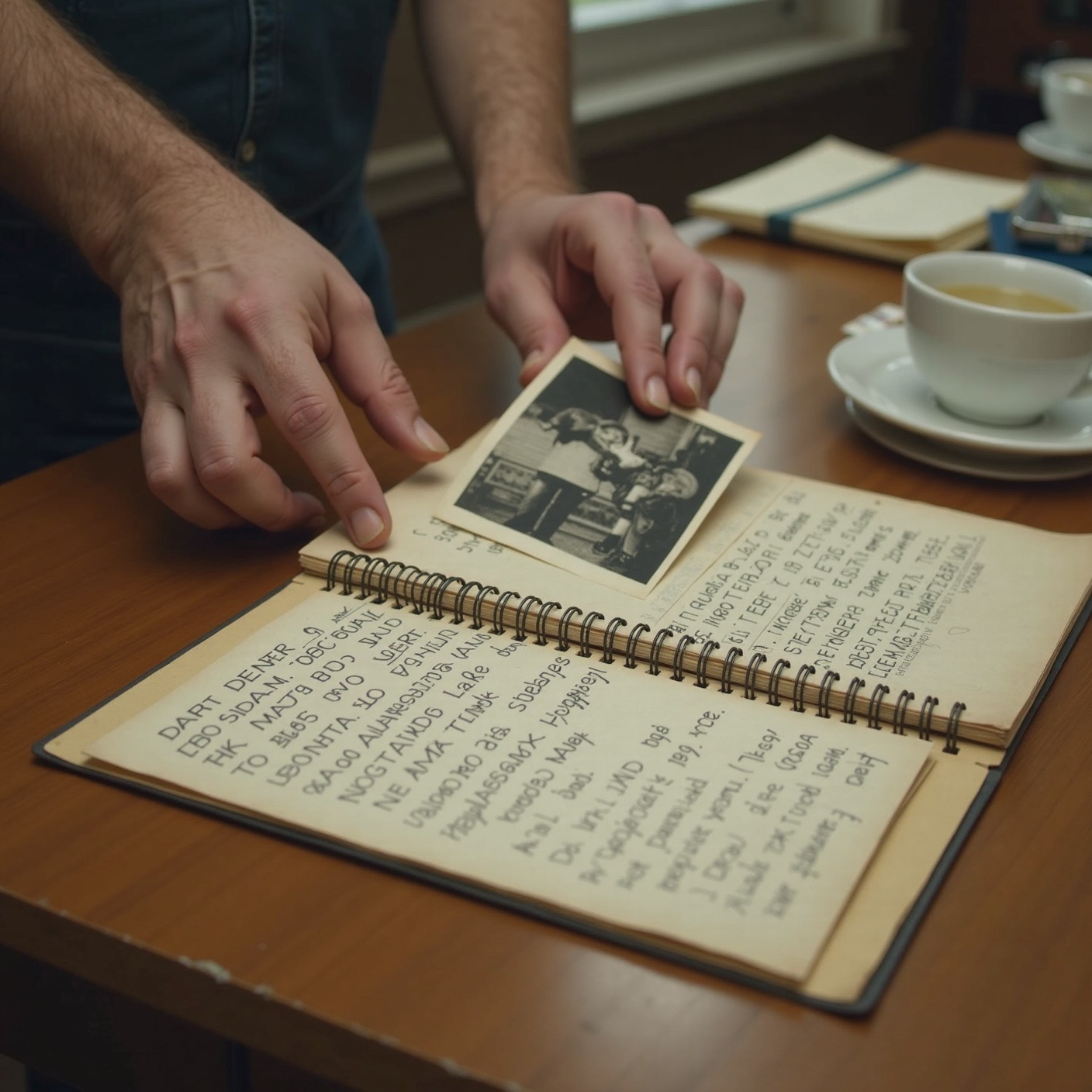
There was a ledger first. A cheap spiral notebook, dollar-store, and in Ray’s blocky all-caps handwriting was every bill. The day of her diagnosis was the first line. From that day, every dollar insurance didn’t cover, he’d paid. He’d routed it through the lawyer’s trust account so it would land on us as “assistance” and “adjustments” and “closed accounts,” so we would never, ever know it was him. The nineteen thousand. The lawn, forty dollars every two weeks to a kid up the street who was sworn to say a company sent him. The headstone. The stone I told him he had no right to stand beside. He paid for it in full and never once drove to the cemetery, because I’d told him not to, and he did what I said.
Under the ledger was a rubber-banded brick of parking stubs. The lawyer set it down like it was heavy. Sixty-three of them. Every one stamped with the same hospital garage, dated, timed. Some of them he’d stayed past two in the morning. And clipped to the stubs was a printout the lawyer had requested from the hospital, because Ray had told him where to find it. The visitor log. Sixty-three nights, my uncle’s name signed in at the front desk in that same block print. Raymond. Raymond. Raymond.
He signed in every single time.
He never once went up.
He’d sit in the parking garage on the third level, where you could see the oncology wing, and he’d count the windows until he found hers, the one with the lamp we brought from home so it wouldn’t feel like a hospital. He’d sit there for hours in the dark with the engine off. Then he’d sign the log on his way out, the way you’d leave a note that says I was here, and he’d drive the forty minutes home and do it again the next night. Sixty-three times.
The last thing in the folder was a letter, and the lawyer read it in a flat voice because Ray had asked him not to perform it.
Ray wrote that when he was nineteen, our grandfather got the same diagnosis my mother would get forty-odd years later. The same disease, the same slow taking-apart. And Ray was the one who found him, collapsed at the bottom of the cellar stairs, the disease having finally taken his legs out from under him where he’d gone down to fetch the oil filter for the furnace. Ray was the one who rode with him to that hospital, that exact hospital, and sat in that exact wing and watched his father disappear a muscle at a time over eleven weeks. He was nineteen. He never told a soul it was him who found him down there, alone, frightened, calling for help nobody heard for most of an afternoon. He carried it up those cellar stairs and he carried it for the rest of his life and he never set it down for anybody, not a wife, not his sisters, not us.
“I have not been able to walk through the front doors of that building in forty-one years,” he wrote. “I tried. I got as far as the lot. I want you to know I got as far as the lot, every night I could, for as long as she was in there. It was the only room I could reach. I am sorry it was not the right one. Tell her I was close. If it is not too late, tell her I was as close as I could make myself go.”
By then she’d been gone almost two years and there was nobody left to tell.
I drove out to the hospital that night. I don’t know why. I paid for parking and I took the ramp up to the third level and I sat in my car with the engine off and I looked at the oncology wing, and it took me a while, but I found the window. It’s a nothing window. It’s just a window. And I sat there long enough to understand that a man had loved my mother from that exact spot for sixty-three nights while I stood forty feet away outside a pharmacy watching him step into traffic to keep from having to break in front of me.
I still have the text I sent him. The cruel one. I read it sometimes, not to forgive myself, just to remember how sure I was.
He wrote back one word. And then he went and paid for a stone he was never allowed to touch.