Juno had been at the rescue for four months, and in all that time nobody had seen her tail move once.
She was a brindle shepherd mix, barely two years old, with the kind of eyes that watched every door in the room. Rachel, who ran a small rescue out of her converted garage, knew Juno’s file by heart and never read it out loud to visitors. It was enough to say the dog had come from a bad place and had learned, early and thoroughly, that people were something to survive rather than trust. When Juno first arrived, she pressed herself into the back corner of the kennel and stayed there, flinching at the scrape of the food bowl, at the click of the light, at kindness most of all.
Rachel had brought a lot of frightened dogs back from the edge. She was good at it, patient in the way that only comes from failing a few times and staying anyway. But Juno was different. She didn’t snap and didn’t cower for show. She simply went somewhere far behind her own eyes and would not come back. Months of slow work, hand-feeding, soft voices, never once reaching over her head, had bought a little ground. Juno would take a treat if Rachel set it down and stepped back. She would tolerate a leash. But she never leaned in. She never asked for anything. And she never, not one single time, wagged.
“I don’t know how to reach her,” Rachel admitted to the shelter vet one evening, her voice worn thin. “It’s like some part of her decided a long time ago that it was safer to feel nothing at all.”
Then, on a Tuesday night, Pip arrived in a shoebox lined with a dish towel.
He was a scrap of an orange kitten, no bigger than Rachel’s palm. Someone had found him and his littermates behind a shuttered building, and Pip was the only one who made it to a doorstep. Five weeks old, give or take. His eyes were already open, and somehow that was the hardest part. He was not a newborn who knew nothing yet. He was old enough to have known warmth once, and old enough to remember losing it.
Rachel did everything right. Heating pad set to low, kitten formula warmed against her wrist, feedings around the clock. And Pip refused all of it. He turned his face from the bottle. He wouldn’t cry or wobble about the way kittens do. He just tucked himself into the corner of the shoebox, in the exact shape a certain brindle dog made in the corner of her kennel, and got smaller and quieter by the hour.
By the third day the vet’s voice on the phone was gentle and honest. “Sometimes the little ones just give up,” she said. “He’s not sick that I can find. He’s alone. And that’s the one thing I can’t write a prescription for.”
So at two in the morning, sitting on the cold garage floor with a fading kitten cupped in her hands, Rachel ran out of ideas she trusted and reached for one she didn’t.
Warmth. A heartbeat. Another living thing that knew exactly what it was to be afraid.
On paper it was a terrible plan. You do not set a five-week-old kitten down beside a traumatized, unpredictable dog three times his weight. The vet had said so herself, weeks back, about introducing Juno to much of anything. “Don’t ask too much of her,” she’d warned. “A dog that’s shut down can go the other way without warning. Keep her world small and safe.”
But Rachel had watched both of these creatures decide, each alone in their own corner, that the world had nothing left to offer them. And some stubborn thing in her chest refused to let them be right about it.
She carried the shoebox to the far side of the garage, where Juno lay with her chin on her paws, watching. Rachel set it down a few careful feet away, close enough for the dog to catch the small, milky, frightened smell of the kitten, far enough that she told herself she could scoop him up in a heartbeat if she had to. Juno’s ears came forward. Something in her face sharpened. Rachel’s own heart began to pound.
“Easy, girl,” she whispered. “Easy. I’m right here.”
She meant to stay. But the phone rang inside, another rescue, another emergency, the way it always went, and she stepped through the door for no more than two minutes.
When she came back, she stopped in the doorway and forgot how to breathe.
Juno was on her feet.
The dog who hadn’t crossed a room toward anything in four months had risen, walked to the shoebox, and was standing over the tiny orange kitten with her big head lowered all the way down, close enough to do absolutely anything at all.
For one long second Rachel couldn’t move. “Juno,” she breathed. “Juno, no.”
And then Juno’s tail moved.
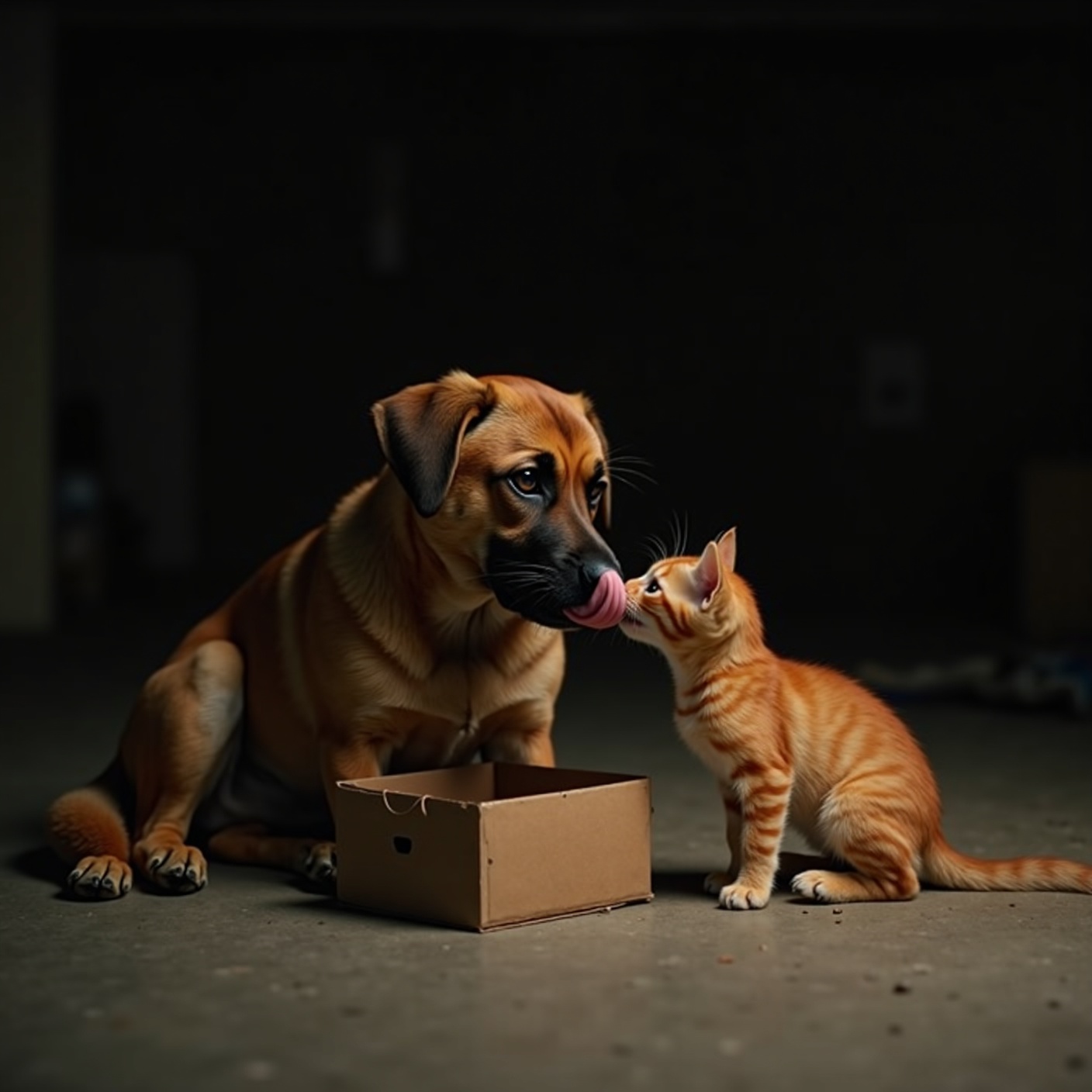
Just once. A slow, uncertain sweep across the concrete, the first wag Rachel had seen in four months. The big dog lowered herself to the floor beside the shoebox, folded those long legs under her, and with a tenderness that made no sense at all from an animal who had been shown so little of it, she began to wash the kitten’s face. Slow, careful strokes, the way a mother does. Pip flinched. Then he went still. Then, impossibly, he pushed his small face up into it.
Rachel slid down the doorframe, sat on the floor, and cried as quietly as she could, so she wouldn’t break whatever this was.
That night, for the first time, Pip ate. Not from the bottle Rachel held out, but afterward, once he had burrowed into the curve of Juno’s belly and vanished into that warm brindle fur, he took the formula from a syringe without a single fight, because now he had somewhere to be. Juno would not leave him. When Rachel finally tried to lift the sleeping kitten back to his heating pad, the dog raised her head and made a low, worried sound, and Rachel, laughing through wet eyes, put him right back where she’d found him. “Okay,” she whispered. “Okay. He’s yours.”
He was.
The two of them healed on the same schedule, as though they had agreed on it beforehand. Pip grew round and bold and ridiculous. Juno grew younger somehow, the years of wariness melting off her a little more each week. They slept in a single knot of orange and brindle that Rachel could never quite bring herself to disturb. Juno, who had once flinched at her own food bowl, took to nosing pieces of kibble out onto the floor for Pip and then standing back while he ate, and she never guarded so much as a crumb.
And Pip, raised by a dog, quietly became a little bit dog himself. He learned to fetch, trotting back with a bottle cap or a chewed-up brush in his mouth and dropping it proudly at Juno’s feet. He rough-housed, launching off the couch onto her flank and getting a patient paw in return. When he caught a moth, he carried it straight over and laid it down in front of her, a gift, the way she had taught him without ever meaning to teach him anything.
Rachel had put them together to save the kitten. What she hadn’t understood, that night on the garage floor, was that she was saving the dog too. Juno needed something to be gentle with just as badly as Pip needed something to be gentle to him. Each of them had a hole shaped exactly like the other.
They were adopted together, naturally. Rachel wouldn’t hear of anything else, and neither would the family who took them, a household that understood from the first meeting that these two came as one unit or not at all. There is a photograph on Rachel’s wall now, the last one she took before they left: a big brindle dog asleep in a square of afternoon sun, and a fat orange cat asleep against her chest, one small paw flung across her heart, both of them finally, completely safe.
Underneath it Rachel wrote the only line that fit.
“Two broken things don’t add up to a whole one. But sometimes they find the one other broken thing they fit, and they save each other’s lives.”