Raymond Hale had built an empire from a garage. Software, satellites, a name that showed up on magazine covers and skyscrapers. At seventy-one, he was worth more money than some countries. And he was dying, and not one of the smartest people on the planet could tell him why.
He had the best private suite money could rent, on the top floor of the best hospital in the state. His people had flown in twenty specialists — cardiologists, neurologists, a man from Zurich who charged by the minute. They filled his room with machines and words nobody else understood. They scanned him, tapped him, argued over him in the hallway in low voices.
And still, week after week, Raymond faded. He stopped eating. He turned his face to the window. The great mind that had seen around every corner had simply switched off, and no test in the building could find the reason.
The person who finally reached him didn’t have a single medical degree.
His name was Sam. He was twenty-four, and he pushed a cleaning cart down the twelfth floor every night from eleven to seven.
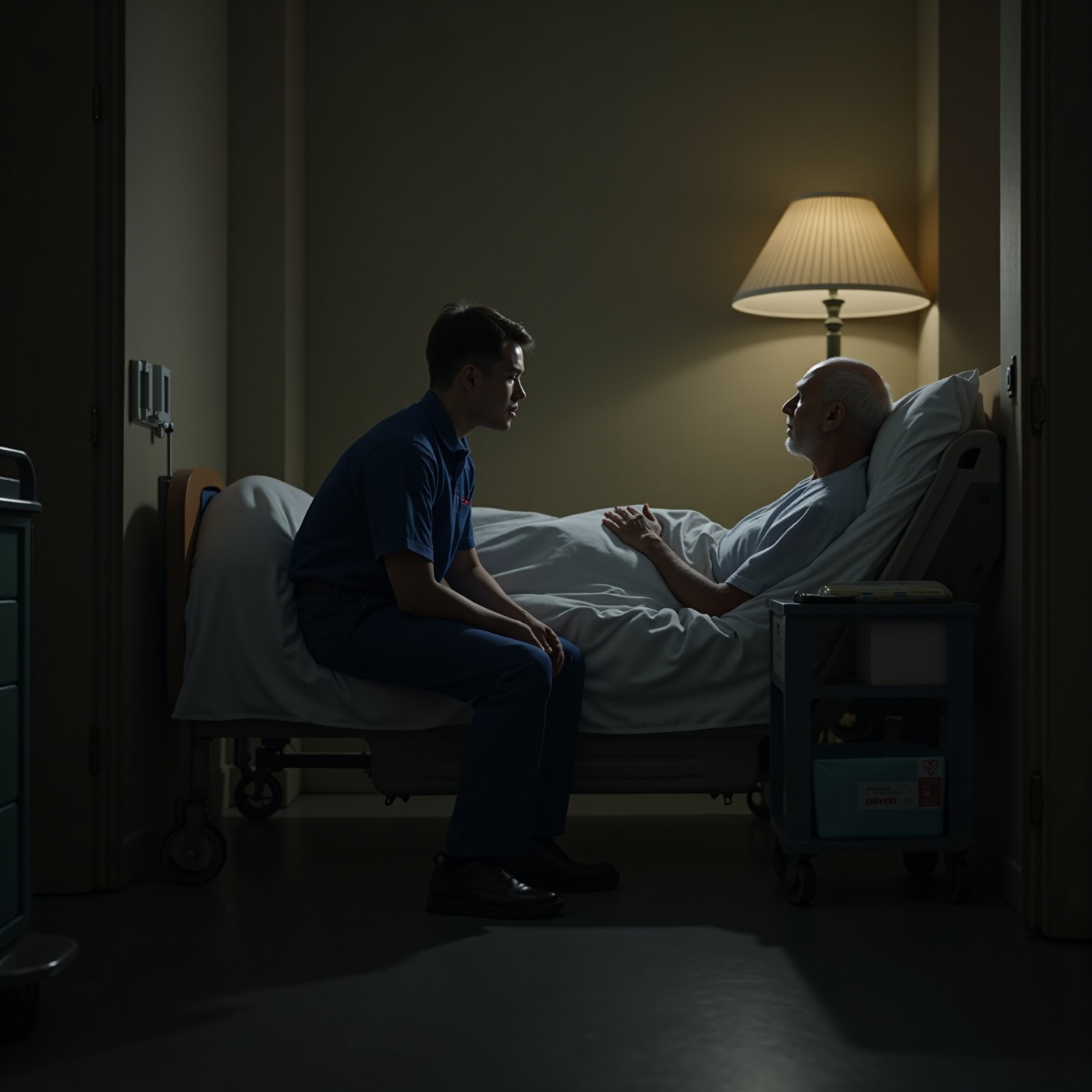
Sam didn’t know he was supposed to be intimidated. To him, the old man in 1204 wasn’t a titan of industry — he was just a lonely guy who looked sadder than anyone he’d ever seen. So Sam did what he did with everybody. He talked to him.
“Evening, Mr. Hale. Cold one out there tonight. You want the blinds open or closed?”
The first few nights, Raymond said nothing. Then one night, quietly, he said, “Open. I like to see the lights.”
And that was the beginning. Every night, while he emptied the bin and wiped the sill, Sam chatted — about the ballgame, about his little girl learning to ride a bike, about the diner across the street that made terrible coffee. He never once asked Raymond for anything. He never mentioned the money. He just treated him like a person.
One night, Raymond spoke first. “Sam,” he said. “Do you know what none of them have asked me? Not one of those doctors. Not in three weeks.”
“What’s that, Mr. Hale?”
“How I’m feeling.” The old man’s eyes were wet. “My wife, Margaret… she died fourteen months ago. Sixty-one years. And I just… I didn’t see the point in staying anymore. That’s the great mystery they flew across the world to solve.” He laughed, and it turned into something else. “A broken heart. That’s all it ever was.”
Sam sat down on the edge of the visitor’s chair — something no specialist had done — and said the simplest, truest thing he could think of. “Well. Margaret didn’t spend sixty-one years with you so you’d give up the second she was gone. That doesn’t sound like a love worth quitting over. Sounds like one worth living up to.”
Nobody wrote a prescription that night. But in the morning, for the first time in weeks, Raymond Hale asked for breakfast.
He recovered slowly. And when he finally left that hospital, he didn’t thank the man from Zurich. He set up a fund — a big one — for the night-shift workers, the aides, the cleaners. The invisible people. And he named it after the young man who’d noticed that sometimes the thing killing a person isn’t in any scan at all.
It’s just that nobody’s asked them how they feel.