
Wombats poop cubes.
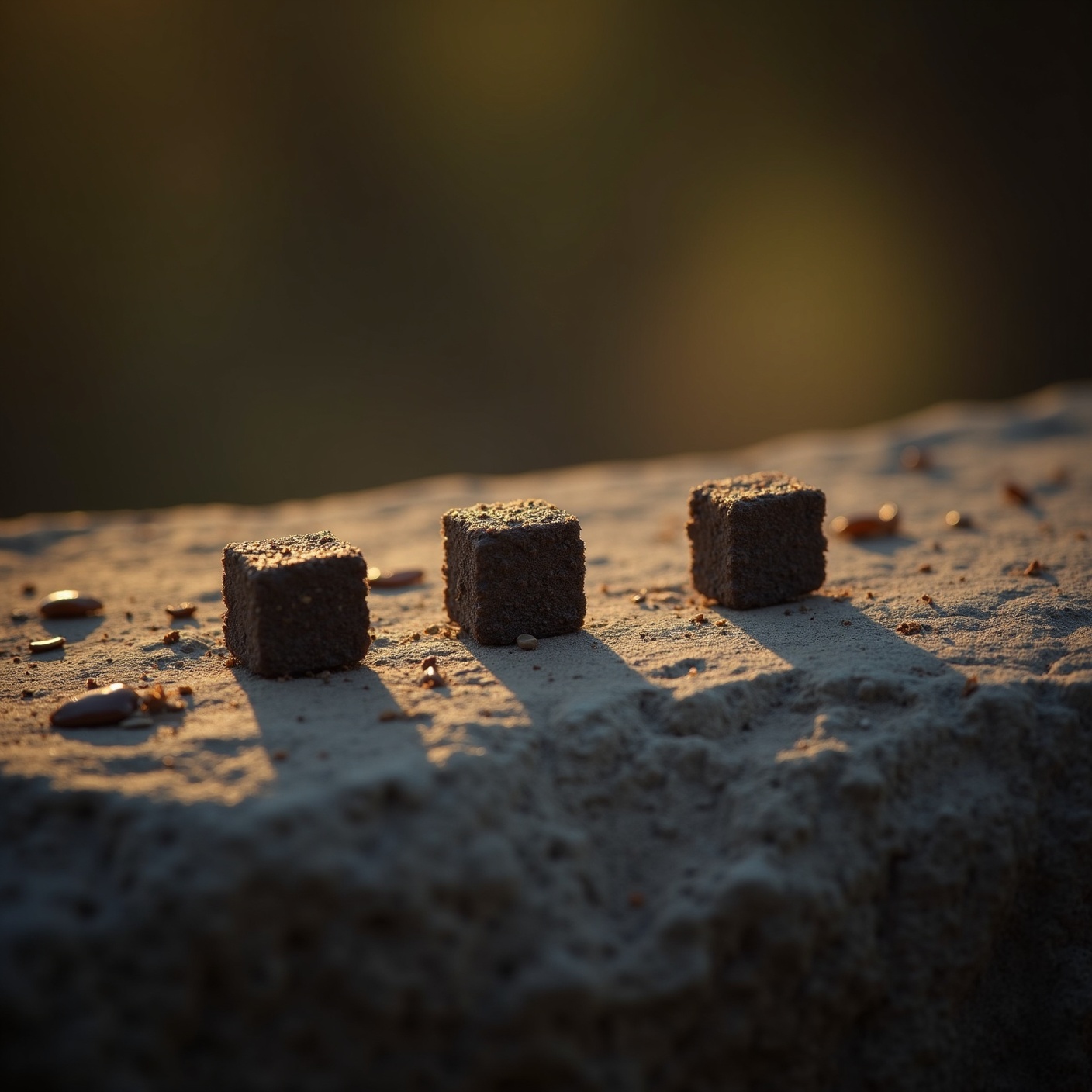
Not roughly cubic. Not lumpy things that happen to have a flat side. Actual cubes, about 2 cm on a side, with faces and edges, and one wombat can leave up to a hundred of them in a single night.
No other animal on earth does this. Not one. Every other creature with a digestive tract produces pellets, ropes, splats or piles, and then there is this flat-faced Australian marsupial quietly turning out geometry in the dark.
The wombat has a good reason, and the reason is real estate.
A wombat marks its territory by stacking droppings in high places. On top of a rock. On a fallen log. On anything that lifts the deposit off the ground so the scent carries further and other wombats get the message from a distance. It is a signboard, and the signboard has to stay where you put it.
Now try that with a round pellet. It rolls off. It lands in the grass, and the message is gone.
A cube sits there and waits.
So the shape is not a novelty. It is the entire point of the exercise, and it is the reason a wombat’s evening walk doubles as an admin task.
Here is the part everybody gets wrong.
Ask around and someone will tell you, with complete confidence, that a wombat has a square anus. You have probably heard it. It is the kind of fact that sounds too good to check, which is exactly why nobody checks it, and it has been repeated at dinner tables for years.
It is flatly untrue.
The opening is round, the same as yours and mine, and the scientists who worked the problem out said so in plain language. The cube is finished long before it gets anywhere near the exit.
Patricia Yang and David Hu at Georgia Tech, working with Scott Carver at the University of Tasmania, published the full mechanism in the journal Soft Matter in 2021.
What they found is that the shaping happens upstream, in the last stretch of the large intestine, roughly the final 17 percent of it. That is the factory floor. Everything after it is just the loading dock.
And the machinery in there is not what you would design if you sat down to design it.
A wombat’s intestinal wall is not the same thickness the whole way around. Going around the circumference, there are two stiff bands and two stretchy ones. The stiff parts contract fast and hold their line. The soft parts give slowly and bulge outward.
Now push a drying mass through that arrangement, and keep pushing for days, because a wombat’s digestion is famously unhurried. The stiff zones press in. The soft zones let out. Corners form where the two meet, and then those corners get pressed again, and again, the way dough takes the shape of whatever keeps kneading it.
By the time anything reaches the round opening, the cube is already a cube. The exit just lets it out.
That is the whole trick. No mould, no press, no square anything. Just two textures of muscle and a great deal of time.
The team walked away with two things nobody expects to get from a wombat.
The first is medical. A stiffened patch of colon is an early warning sign of colon cancer, and the wombat is a working demonstration that stiffness in one part of an intestine shows up further down as an odd edge or an unexpected shape. Something changing upstream can leave a signature you can read downstream, which is a useful thing to know when you are looking for a disease that hides.
The second is industrial. They had just watched a mammal manufacture perfect cubes with no mould at all, using nothing but tissue of two different stiffnesses and timing. We make cubes by cutting them or by pouring material into a box. The wombat does it by squeezing, and it does it a hundred times a night without supervision.
Which is a strange thing to say about an animal with a flat face, a grumpy walk and no interest whatsoever in being useful to us.
But wombats have been quietly outengineering us for a long time. We only noticed because of what they left on a rock.