They named me after my grandfather, and for most of my childhood he was the one who showed up to my school things. Not because my parents were cruel. Because my sister needed them, and there wasn’t much left over after that.
Claire is three years older than me. When she was four and I was one, she caught something the doctors first called a bad flu and then, two weeks later, called encephalitis. She went into the hospital as a little girl who could sing the alphabet, and she came home someone else. Her legs stopped listening to her. She couldn’t feed herself. The words she’d been collecting were mostly gone, and they never fully came back.
I don’t remember any of it. That’s the part people never expect. The thing that decided the shape of my entire family happened before I was old enough to hold a memory, so I didn’t grow up watching my family change. I grew up inside the change, the way you grow up inside a climate. It was just the weather in our house. Everything leaned toward Claire, and I never once knew a version of home where it didn’t.
My mother, Sharon, quit her job the month Claire came back from the hospital. My father, Doug, picked up a second shift to cover the therapy that insurance kept calling optional. By the time I was old enough to notice anything, the machine was already running, and I was the one small moving part that could take care of itself. So I did.
I learned to pour my own cereal standing on a chair. I learned that “in a minute” meant not tonight. I learned to read my mother’s back, the set of her shoulders at the stove, and to know from the doorway whether it was a night I could ask for something or a night I should disappear into my room and be no trouble at all.
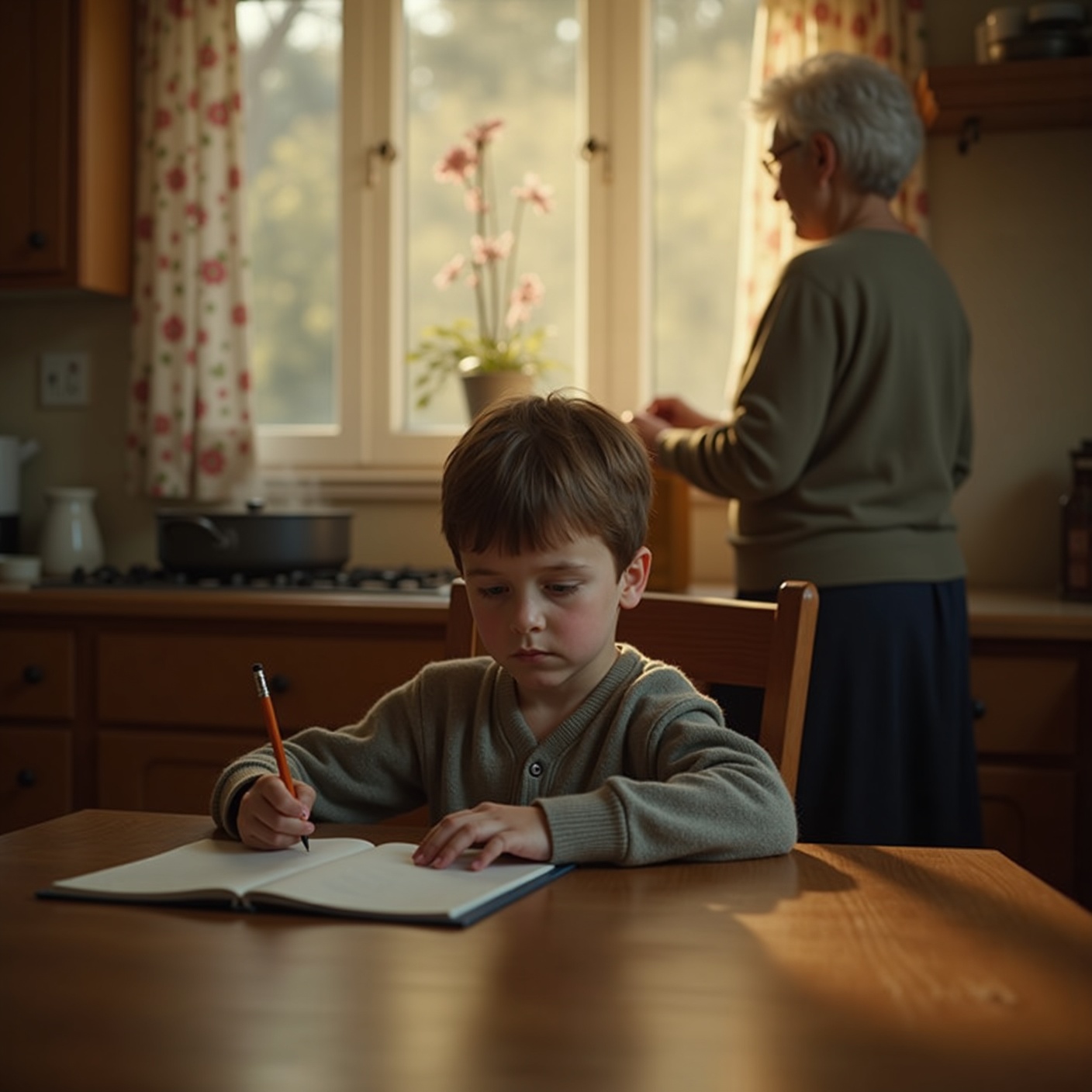
Mostly I went to my grandparents’. Gran, my mother’s mother, was named Marlene, and she and my grandfather Harold lived four streets over in a house that smelled like coffee and cut grass. That’s where I did homework. That’s where I ate dinner more nights than I ate it at home. When people ask me now who raised me, I don’t say my parents, and I don’t say it to be unkind. I say Gran and Pop, because that’s just the true answer.
Nobody was hitting me. Nobody was starving me. I want to be honest about that, because when I tell this story people look for a villain and there isn’t one, not really. What there was, instead, was a slow, total erasure. I was a healthy kid in a house organized entirely around a child who wasn’t, and healthy meant invisible. Healthy meant fine. Healthy meant later.
There’s actually a word for kids like I was. I didn’t hear it until I was twenty-six, sitting across from a counselor I’d finally talked myself into seeing. She listened for most of an hour and then she said, gently, “You were what some people call a glass child.” I asked her what that meant. She said, “Not fragile. Glass because everyone looks straight through you to the person behind you. They don’t see the glass at all until it cracks.”
I sat in my car in that parking lot for twenty minutes afterward. I was twenty-six years old and a stranger had just described my whole childhood in one sentence.
Let me tell you about the fifth-grade concert, because it’s the one I can’t put down.
I had a solo. Four lines in a spring program, and I’d practiced them in Gran’s kitchen for two weeks while she clapped with soapy hands. The night of the concert my mother meant to come. She really did. But Claire had a seizure that afternoon, a bad one, and by the time the buses were loading for the school my parents were in an emergency room across town and my grandfather was in the third row of the gym in his good jacket, holding my mother’s phone up so she could listen from the hospital hallway.
I found out years later that she cried in that hallway. That she wanted to be there. I believe it. And I also know that I stood on that stage in a paper bow tie and sang my four lines to a row of other people’s parents, and the thing I felt wasn’t sadness exactly. It was a kind of settling. A quiet click of understanding that this was simply how it went, and it would keep going this way, and I should stop expecting anything else.
So I stopped. That’s the survival skill nobody warns you about. You don’t rebel. You don’t act out for attention. You do the opposite. You get so good at needing nothing that you forget needing was ever an option.
The trouble started when I got old enough to be useful.
Around fourteen, I stopped being the child who could take care of himself and became, quietly, another set of hands. Watch Claire while your mother runs to the pharmacy. Sit with Claire so your father can sleep before his shift. Learn how she likes to be turned, how to work the lift, what her sounds mean when she’s uncomfortable. I loved my sister. I want that on the record too. I would sit and read to her and she’d get this loose, delighted grin, and for that grin I’d have done almost anything.
But somewhere in there the asking turned into assuming. Nobody said thank you anymore, because you don’t thank a wall for holding up the roof. And at some point my father started talking about the future in a way that made my stomach drop, about how Claire would always need family, how it would be good for me to know all of it now, how someday it would be on me.
I was sixteen when he said that last part out loud at the dinner table, like he was handing me a set of keys. Someday this is your responsibility, Ethan. And I looked at my plate and understood that in my parents’ whole map of the future, I existed as one thing: the person who would take over Claire when they no longer could.
Not a son with his own life waiting to happen. A plan. A contingency.
I said no for the first time when I was seventeen. It came out badly, the way first no’s do, in a fight about a weekend I’d wanted to spend at a friend’s lake house and had to cancel because nobody else could stay with Claire. “I’m not her nurse,” I said, and my mother went white, and my father said I was selfish, and the word just hung there in the kitchen. Selfish. The healthy child who wanted one weekend.
I moved out the week I turned eighteen. Not dramatically. I’d been working at a hardware store since I was sixteen and I’d saved almost every dollar, because saving quietly was another thing I was good at. I found a room in a house with three other guys, I packed two duffel bags, and I told my parents I was going. My mother cried. My father shook my hand like I was a business associate. Claire didn’t understand, and that was the only goodbye that actually broke me.
Then I did the thing I’d been building toward without admitting it. I stopped calling. I didn’t scream, I didn’t send a letter, I didn’t make a scene. I just stepped back out of the frame the way I’d always been half out of it anyway, and I let the silence grow until it was a wall, and then I let the wall grow until it was just the landscape.
Eleven years. I built a whole life in that silence, and it was a good one. I got my contractor’s license. I met a woman named Priya who thinks I’m worth looking at, actually looking at, and some nights the way she pays attention to me still catches me off guard, like a light turned on in a room I’d stopped entering. Gran and I stayed close until she passed, two winters ago, and Pop the year before her. They’re the ones I grieved. I said that to Priya once and she just held my hand. She never told me I was wrong to feel it.
Then, on a Tuesday last October, my phone rang, and the screen said MOM.
I hadn’t seen that word on a screen in over a decade. I let it ring twice. I nearly let it go. And then some old reflex, some eight-year-old still standing in Gran’s kitchen hoping, picked it up.
“Ethan,” my mother said, and her voice was older than I was ready for. “Ethan, honey. It’s Mom.”
There was a long pause where I could hear her breathing, gathering herself, and I already knew, the way you know weather, that something had shifted on their end of the world.
“We put Claire in a home,” she said. “A good one. Rosewood, out past the highway. It was time. Your dad’s back can’t do the lifting anymore and I can’t manage her alone, and the doctors said it’s the right thing, they said she’ll be looked after.”
I didn’t say anything. I stood in my own kitchen, in the life I’d built with my own two hands, and I waited.
“The house is so quiet now,” my mother said. “It’s just the two of us, and we’ve been talking, your father and me. We’ve been talking about you. About how much we missed. And we thought, we hoped, maybe you’d come home. Come for Sunday dinner. Start again. We’re your parents, Ethan. We’re not getting any younger, and family is family.”
Family is family. My father’s exact phrase, coming out of my mother’s mouth.
And here is the thing I understood in that kitchen, so cleanly it almost didn’t hurt. For thirty years there had been no room for me in that house, not because there was no love in them but because their love ran entirely in one direction, toward the child who needed the most. Now the child who needed the most had been moved out past the highway. The house was quiet. There was room, finally. And into that room they wanted to move me, like furniture, into the space a person leaves behind.
They didn’t want their son back. They wanted the silence filled.
“Mom,” I said. My voice was very level. I surprised myself. “I’m glad Claire’s somewhere safe. I mean that. I’ll visit her. I’d like to visit her.”
“Oh, Ethan, she’d —”
“But I’m not coming home,” I said. “There isn’t a home to come back to. There’s a house I grew up outside of. You didn’t lose me last week. You lost me a long time ago, and you didn’t notice, because you were never really looking at me to begin with.”
She started to cry, and the old reflex nearly buckled me, the one that spent a whole childhood reading her shoulders and folding myself smaller to make her night easier. I held on.
“I’m not angry,” I told her, and it was almost true. “I understand why it was the way it was. Claire needed everything, and there was a reason for all of it. But you can’t skip to the end. You can’t be absent for thirty years and then call the healthy one back the minute the house gets quiet and expect him to still be standing where you left him. I’m not standing there anymore, Mom. I grew up. You just weren’t there for the part where I did.”
I meant every word, and I still went to my truck afterward and sat in the dark for a long time, the way I’d sat in that counselor’s parking lot, the way I’d sat in a hundred parked cars over the years, being fine. Being no trouble. Being the glass nobody saw until it was already cracked.
I do visit Claire now. Once a month, sometimes twice. Rosewood is bright and the staff are kind and she still gives me that loose, delighted grin when I read to her, and I sit there and I love my sister with my whole chest and none of it is her fault, none of it, it never was.
My parents I see at Rosewood sometimes, by accident, in the hallway. We’re polite. My mother’s eyes always go wet. My father always looks like he’s about to say something and never does.
And I go home afterward to a woman who looks at me across the table like I’m the only person in the room. Some nights I still can’t quite believe it’s mine to keep.
I was a glass child for thirty years. It took me most of that time to learn the thing nobody in that house ever told me. Being easy to look through is not the same as being nobody. And you are allowed, once you’ve finally been seen, to stop letting the people who never looked decide where you belong.