The storm came in faster than the radio said it would.
Ruth Callahan had lived on that road for thirty-one years, long enough to know the difference between snow that would blow through by morning and snow that meant business. This was the second kind. By four in the afternoon the light outside had gone the color of dishwater. By six she couldn’t see the mailbox from the kitchen window, and the mailbox was forty feet from the porch.
She’d made soup because that’s what she did when the weather turned. Chicken, too much celery, a pot big enough for a family she didn’t have anymore. Her husband Walt had been gone four years. Her daughter Karen lived two states away and called on Sundays. Ruth had stopped scaling recipes down. It felt like giving up on something.
She was wiping the counter when somebody knocked.
Not a neighborly knock. Three hard strikes, then a pause, then three more, the kind of knocking a person does when they’ve already decided nobody’s going to answer.
Ruth stood very still in her own kitchen. She was sixty-four years old, alone, a mile and a half from the nearest house, and the phone line had been crackling all evening.
She turned the porch light on and looked through the glass.
There was a man out there. Young, maybe twenty-five, in a canvas jacket that was absolutely wrong for the weather, no hat, snow packed solid in his hair and eyebrows so that he looked half-frosted, like something pulled out of a freezer. He wasn’t even shivering right. He was shaking in long slow waves.
“Ma’am,” he said through the door, and his voice came out wrecked. “My car went off the road. About a mile back. My phone’s dead.”
Ruth’s hand stayed on the lock.
She thought about every warning Walt had ever given her about opening the door after dark. She thought about Karen, who’d have told her to call the sheriff and wait. She thought about the fact that she’d have to shout that decision through the glass at a boy who was turning white.
“Step back from the door,” Ruth said.
He stepped back. She opened it.
“Get in here before you lose a finger.”
He came in and stopped just inside the mat, dripping, not moving further, like he was afraid of the floor. Up close he was younger than she’d guessed. His hands had gone a color she didn’t like at all.
“Boots off. Jacket off. Sit,” Ruth said, pointing at the chair nearest the woodstove. “Not that close. You’ll hurt yourself.”
“I’m getting your floor wet.”
“It’s linoleum from 1978. Sit down.”
His name was Daniel. He was driving from his mother’s place to a job three hundred miles the other way, and he’d tried to beat the storm on a county road he didn’t know, and the storm had won at a curve near the culvert. The car was nose-down in a drift with the back end sticking up like a flag.
Ruth put a bowl of soup in front of him and he looked at it for a second too long before he picked up the spoon.
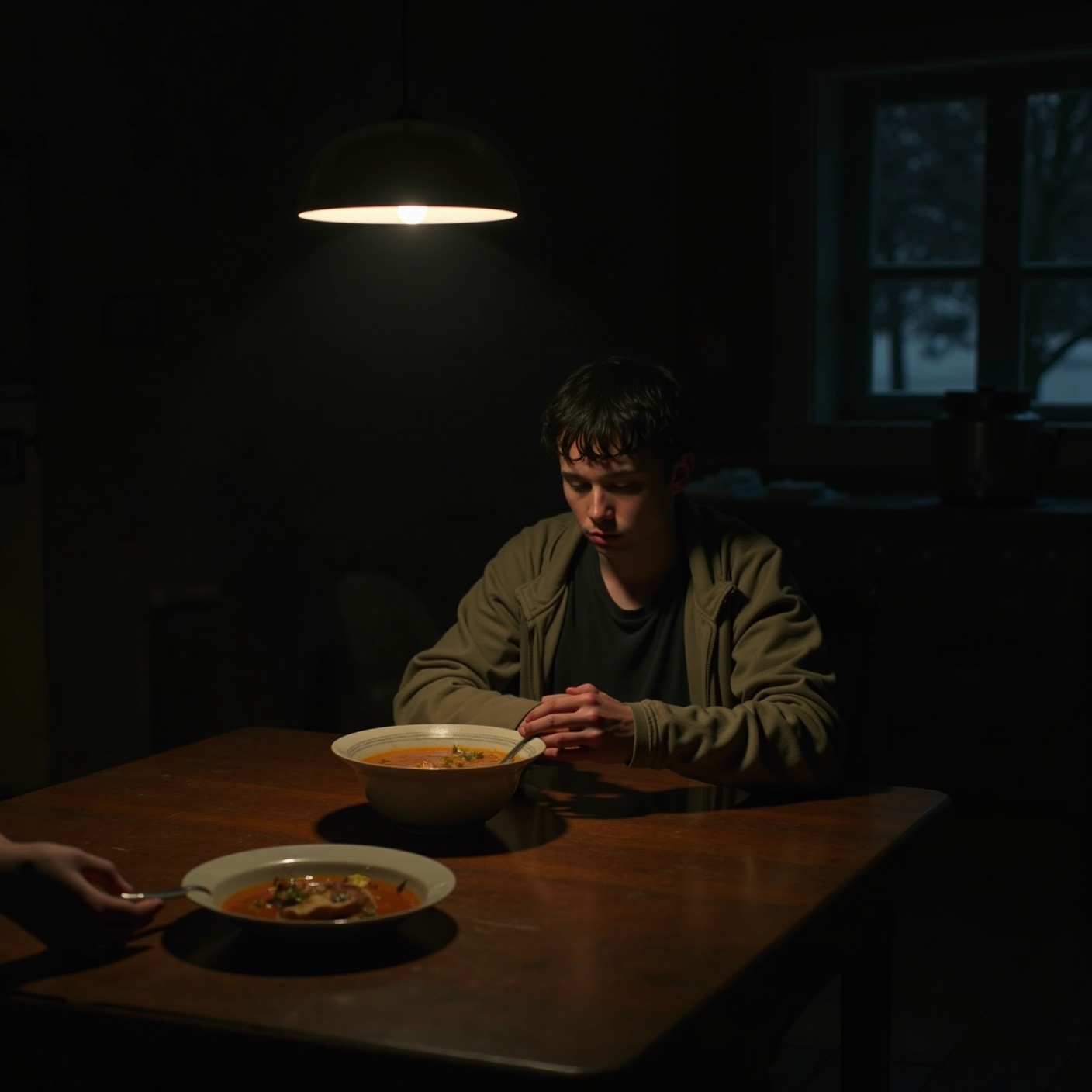
“When did you eat last?” she asked.
“I had coffee,” Daniel said.
“That’s not what I asked.”
He didn’t answer that one. He ate two bowls. He apologized for both of them.
The phone worked well enough to reach the sheriff’s office, where a tired dispatcher told Ruth what she already suspected: the plows weren’t going out again until the wind died, nobody was pulling a car out of a ditch tonight, and if the young man was warm and indoors he should stay warm and indoors.
“You’re on the couch,” Ruth told him. “There’s blankets in the hall closet, second shelf, the ones that smell like cedar. Bathroom’s on the left. Don’t touch the thermostat, it’s a liar.”
Daniel stood in her living room holding a stack of blankets and looked like he was trying to say something and couldn’t find the front door of the sentence.
“I don’t know why you let me in,” he finally said.
Ruth thought about it honestly, because he’d asked honestly.
“Neither do I,” she said. “Go to sleep.”
She lay awake most of that night with her bedroom door shut and, she’d admit it later, a cast-iron skillet on the nightstand. Nothing happened. Around two in the morning she heard him get up, and she went rigid, and then she heard the sound of a stranger very quietly putting another log in the stove so the house wouldn’t go cold.
In the morning the wind had quit and the world outside was blinding.
Daniel had folded the blankets into a stack so square it looked ironed. He’d washed his bowl, and her pot, and the pan she’d left in the sink from two days before. He was standing at the window with his jacket already on when she came out.
A neighbor with a tractor pulled his car out of the drift before noon. It ran. The bumper was bent and one headlight pointed at the sky, but it ran.
He stood in her driveway with the engine going and put out his hand and Ruth shook it.
“Ma’am, if you ever need anything —”
“I won’t,” Ruth said. “Drive slower.”
He laughed. He got in. He drove off down a road that was one lane of packed white between two walls of plowed snow, and Ruth went inside and washed the coffee cups and that was the end of it.
Except it wasn’t.
The first card came the following December. Plain envelope, no return address, postmarked from a town she’d never heard of. Inside, a drugstore Christmas card with a cardinal on the front, and in handwriting that leaned hard to the right:
You didn’t have to open the door. I think about it every winter. — D.
Ruth read it standing at the mailbox with her coat unbuttoned. Then she put it in the drawer of the hall table.
The next December, another one. A different town. A different cardinal.
She never wrote back. She didn’t have an address to write back to. She thought about it, some years harder than others, and then another December would come and another envelope would show up and she’d stand at the mailbox in her unbuttoned coat and read four or five sentences from a man she’d fed one bowl of soup in 1999.
They kept coming. Through the year her hip went. Through the two winters she spent mostly in the recliner. Through the last one, when Karen had moved back in and was doing the mail because Ruth couldn’t get down the steps anymore.
Ruth Callahan died in March, at home, eighty-six years old.
It was Karen who found the drawer.
Twenty-two envelopes, rubber-banded in order, and her mother had written the year on the back of every single one in pencil. Karen sat down on the hallway floor and read them from the beginning, and it took her until the fourth or fifth to understand what she was actually holding. Some stranger had marked every December of her mother’s last two decades and her mother had never once mentioned it to anybody.
The last envelope in the stack was postmarked that April. After.
It was addressed to the house, not to Ruth.
To whoever is there now,
I’ve sent one of these every year since 1999 and this year mine came back. So I think I know.
I was twenty-four and I was in worse shape than the storm, and I want whoever is reading this to know that she never asked me a single question about it. She told me to take my boots off and she gave me soup and she went to bed and left a stranger in her living room, and that is the reason I turned my life around, though she never knew that and I could never figure out how to say it in a card.
I have two kids. The younger one is named Ruth. My wife knows the whole story.
I’m sorry I never knocked again.
— Daniel
Karen keeps the stack in the same drawer. She says she’s read the last one maybe forty times, and the part that gets her is never the ending.
It’s the sentence about the boots.