
The first year, Kayla told herself it was a work thing.
It was the 23rd of December, and Daniel had gone to the bank that morning and pulled two thousand dollars in cash out of their joint account, and by four in the afternoon he was gone. He didn’t say where. He kissed her on the top of the head, said he’d be back late, and drove off in the truck with the heater that never quite worked. He came home a little before eleven, smelling like cold air and floor wax and the particular flat smell of a big-box parking lot in winter, and when she asked how his day was he said, “Long,” and went to bed.
The second year, she stopped telling herself it was a work thing.
Same date. Same withdrawal. Two thousand dollars, gone from the account like clockwork, on the one day of the year when money is already tightest and every dollar has three jobs. Same disappearance. Same eleven o’clock return, same smell, same one-word answers. Kayla stood in the kitchen with the Christmas lights blinking on the counter and did the math a wife does when she’s scared, and the math kept landing on the same ugly word.
Gambling.
There was a casino ninety minutes north. There were card rooms she’d read about in the paper. Two thousand dollars in cash, once a year, on a schedule, coming home late and lying about it — she’d watched enough daytime television to know how this story went. She didn’t accuse him. She was afraid of the answer. Instead she started watching the account like a hawk the rest of the year, waiting for the pattern to spread, waiting for the second withdrawal and the third, waiting for the whole floor to fall out from under them.
It never did. Eleven months of the year, Daniel was the most careful man with a dollar she had ever met. He clipped coupons without irony. He drove the truck with the bad heater because a new one was “a want, not a need.” He was the man who, when her car needed brakes, spent two Saturdays under it in the cold rather than pay a shop. And then, one day a year, he took out two thousand dollars and drove into the dark.
By the third December, Kayla had decided she was going to know.
She didn’t plan it like a detective. She just told him she was running to her sister’s, and instead she sat in her own car at the end of the block with the engine off and her breath fogging the windshield, and when his truck pulled out she counted to twenty and followed it.
He didn’t go north. He didn’t go to the casino, or the card rooms, or anywhere she’d built up in her head across two years of quiet dread. He drove eight minutes to the Walmart Supercenter on the county road, the one with the garden center and the tire bays, and he parked at the far end of the lot where the carts don’t reach, and he sat there for a minute in the dark before he got out.
Kayla parked three rows back and watched him walk in, and then she did the thing you’re not supposed to do, which is she followed her own husband into a store two days before Christmas to catch him at whatever it was.
He didn’t go to electronics. He didn’t go anywhere a person goes to spend money on themselves. He went to the customer service desk at the front, the long counter where you return things and buy stamps, and he leaned on it and talked to a young woman in a blue vest like he knew her, and Kayla drifted into the seasonal aisle two over — wrapping paper, tape, rolls of ribbon — and pretended to shop, and watched him through a gap in the shelving.
The woman in the vest went in the back. She came out with a stack of paper, a printout, and she slid it across the counter to Daniel, and Kayla was close enough now, close enough to hear it over the tired Christmas music, when the young woman said the thing that took the floor out from under her after all — just not the way she’d braced for.
“Same as last year,” the clerk said, quiet, almost shy about it. “Forty-seven this time. You want the whole list?”
Daniel nodded and pulled a folded bank envelope out of his coat, the fat one, the one that had two thousand dollars in it.
“Just — don’t tell them who,” he said. “Same as always. If anybody asks, it was the store.”
And Kayla, standing in the wrapping-paper aisle with a roll of snowman paper going soft in her hand, felt her phone buzz in her pocket.
She almost didn’t look. But she did, because your hand does that on its own, and it was a text from her mother, three towns over, and it said:
Honey I have to tell you something. Do you remember 3 Christmases ago when Emma’s bike got paid off at the Walmart and nobody knew who did it? I never told you because I felt silly but I always call him the angel. I just want somebody to know I still think about it. Merry almost Christmas. Love Mom.
Three Christmases ago.
The exact December Daniel started disappearing.
Kayla put the snowman paper down very carefully on the shelf, because her hands had stopped working right, and she looked back through the gap at her husband, who was writing something on the printout with a pen chained to the counter, forty-seven names long, and she understood all at once that she had spent two years being afraid of the best thing about the man she married.
She didn’t go over. Not yet. She stood there and let herself remember something he’d told her exactly once, early on, drunk enough on two beers to say it, then never again.
Daniel had been eleven the Christmas his father died.
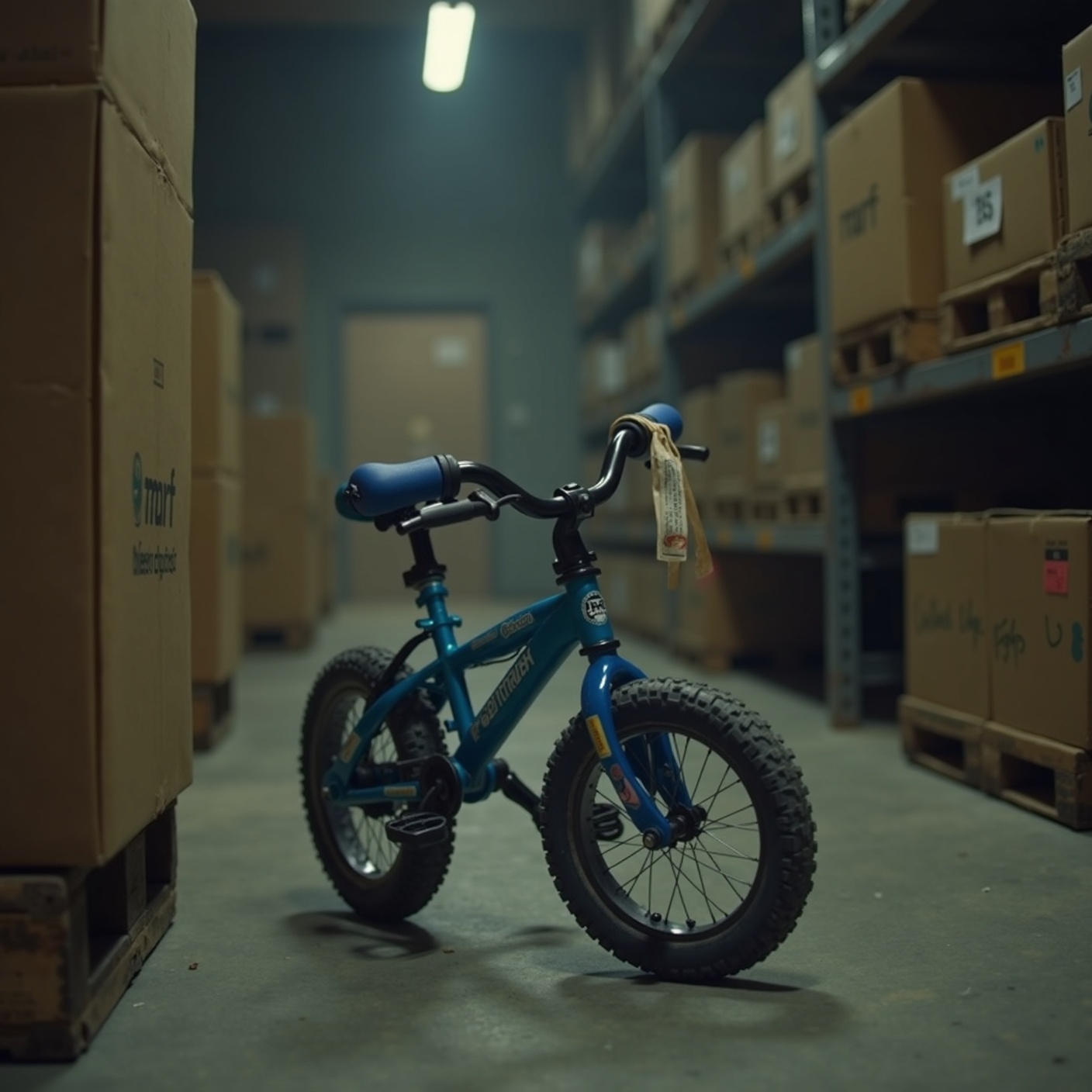
It was fast — a heart thing, in November, no warning. And his dad, who worked the loading dock at a grocery distribution center and never had two extra nickels, had done one secret thing that fall. He’d gone to the store and put a bike on layaway. A blue one, with the pads on the handlebars, the exact one Daniel had circled in the catalog and then pretended not to want because he knew what money was even at eleven. His father had been paying it down five and ten dollars at a time, a little each week, so it would be there under the tree, paid off, his.
He died with forty dollars left owing on it.
And in January, when the layaway deadline came and the balance hadn’t been paid, the bike should have gone back on the floor. Except it didn’t. A store manager called Daniel’s mother — Daniel remembered her taking the call at the wall phone in the kitchen, remembered her face — and said the balance had been taken care of. Somebody had come in and paid off the forty dollars and asked that nobody be told who. “Tell the boy it was the store,” the manager said. “Tell him his dad set it up.”
Daniel got the blue bike. He rode it for six years. And he never, ever found out who paid the forty dollars, because that person had done the one thing that makes a kindness enormous, which is they made sure he could never say thank you and never feel like he owed anybody anything. He just got to be a kid whose dad, somehow, from wherever he’d gone, had come through.
It took Daniel thirty years and a decent job and a marriage to a woman who watched every dollar with him, and then, one December, he’d done the arithmetic he’d been carrying his whole life. Somewhere in that same town were forty, fifty families with a bike, a doll, a winter coat sitting on a layaway shelf, ten and twenty dollars from being lost, and a kid who’d circled it in an ad and then said they didn’t really want it.
So he took two thousand dollars in cash out of the account he shared with his wife, and he drove to the Walmart on the county road, and he paid off every unclaimed Christmas layaway on the list, and he told the clerk to say it was the store. Same as the man who did it for him. He never told Kayla because telling her would have meant explaining the forty dollars, and the wall phone, and his mother’s face, and he wasn’t sure he could get through it, and anyway a thing like that isn’t supposed to have your name on it. That’s the whole point of it. That’s what makes it work.
Kayla waited until he was done. She watched him fold the empty envelope and shake the clerk’s hand and thank her by name, Destiny, it turned out, and she watched Destiny wipe her eyes with the heel of her hand and pretend she hadn’t. And then Kayla walked up the aisle and stood at the end of it where he’d see her, and Daniel looked up and went absolutely still, caught, seventeen kinds of caught, a man who’d guarded a secret for three years standing in a Walmart with the evidence of it all over his face.
“I thought you were gambling,” Kayla said. It came out cracked.
Daniel opened his mouth. Closed it.
“Three years,” she said, “I thought you were losing our money at cards, and you were — ” and she couldn’t finish it, so she just held up her phone with her mother’s text still glowing on it, Emma’s bike, the angel, and she watched him read it, and watched him figure out that she knew all of it now, the whole shape of it.
“It’s not our money,” he said finally, which was such a Daniel thing to say that she laughed and cried at the same time. “I mean it is. But I always — I make it back in the year. I skim it off. It’s never anything we needed. I couldn’t ask you because — “
“Because I’d have said yes,” Kayla said.
He looked at her.
“You’d have said yes,” he agreed, quietly, “and then it would’ve been ours, and it can’t be ours. It has to be nobody’s. That’s the only way it counts.”
They stood in the front of the Walmart with the Christmas music going and the automatic doors gasping open and shut, and Destiny at the counter very pointedly finding something to do with a stapler, and Kayla understood the last piece of it — that he wasn’t hiding a shameful thing, he was protecting a sacred one, keeping it small and quiet and unclaimed the way it had been given to him.
She reached over and took the empty envelope out of his hand.
“Forty-seven,” she said. “How many did you do the first year?”
“Twenty-two,” Daniel said.
“So it’s growing.”
“So it’s growing.”
Kayla nodded. She was already doing the arithmetic her husband had taught her, the careful, dollar-by-dollar kind, except she was running it the other direction now, up instead of down, toward how much two of them skimming quietly across a whole year could carry into that store next December.
“Next year,” she said, “we’re going to need a bigger envelope.”
And that was the third Christmas Daniel disappeared. It was also the last one he disappeared alone.