
Rachel bought the shoebox for four dollars because of the postcards on top.
That’s her whole business. She resells old postcards, the linen-finish kind with scalloped edges, hunts them down at estate sales and church rummages and the back shelves of Goodwill outlets where things go to be sold by the pound. The box was sitting on an end cap at a Goodwill outside Columbus, a beat-up Buster Brown shoebox with a rubber band around it that snapped to dust when she touched it. She saw a few good postcards poking out and figured four bucks, easy resale, done.
She almost didn’t look underneath.
Under the postcards were letters. Not loose paper. Envelopes. Dozens of them, the paper gone the color of weak tea, all addressed in the same careful hand, a young man’s hand trying hard to be neat. She counted them later at her kitchen table. Forty-three.
Every single one was still sealed.
Not opened and tucked back in. Sealed. The flaps still gummed down, eighty years on, some of them stamped and some of them not, none of them postmarked. Forty-three letters that had been written and closed and never, ever mailed.
They were all to the same girl. A first name and an address in a town two states over. Dorothy.
And they were all from the same soldier. He’d signed the outside of a few, up in the corner where a return address goes, with a name and a base. Thomas. 1944.
Rachel sat with that for a long time.
She’s not a sentimental person, she’ll tell you that herself. She flips postcards for eight dollars apiece. But there is something about forty-three sealed letters from a boy to a girl in the middle of a war, letters that girl never got to read, that reaches into you and turns something. She did not open them. It didn’t feel like hers to open.
Instead she started digging.
This is the part Rachel is good at, actually. You don’t find postcards worth finding without learning how to chase a paper trail. She had a first name, a town, a year. She pulled county records. Old marriage licenses. A census page. An obituary index. She was braced, the whole time, to find that Dorothy had died in 1969, or 1988, or last spring, that the girl those letters were meant for was long gone and the whole thing was just a sad little artifact.
Dorothy was alive.
Ninety-eight years old, two states away, in the same county she’d been born in. Rachel read it three times to be sure.
So she did the only thing that made any sense to her, which was to put forty-three eighty-year-old letters in a padded envelope inside a tote bag on the passenger seat, and drive most of a day to hand them to a woman she’d never met.
The house was small and neat, geraniums on the step. A grandniece answered, wary the way you’re wary of a stranger at an old woman’s door, and Rachel understood how insane she sounded (hi, I bought a box at a thrift store, I think it’s full of letters to your aunt from 1944), but she got the shoebox halfway out of the bag, and the grandniece looked at the handwriting on the top envelope, and went quiet, and let her in.
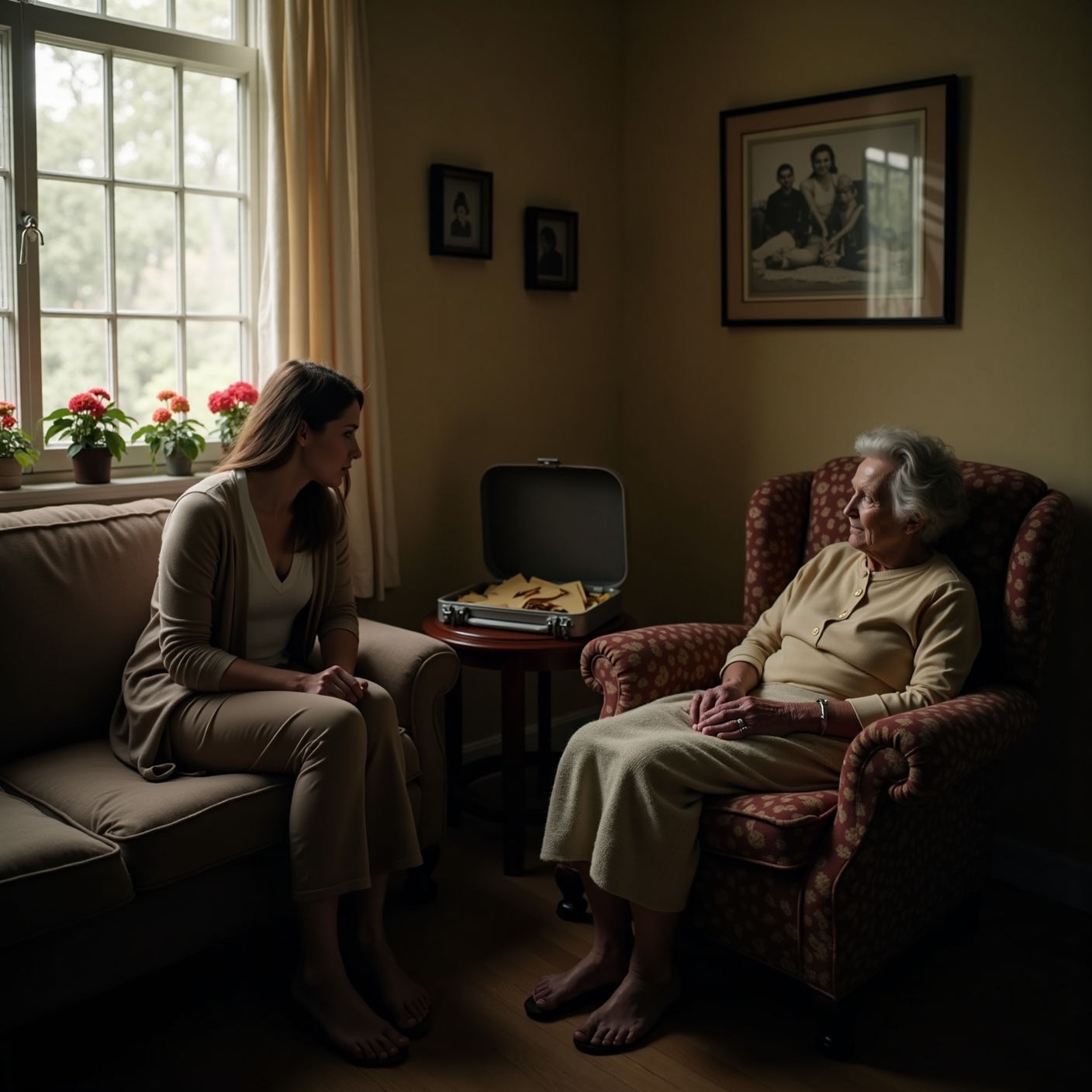
Dorothy was in a chair by the window with an afghan over her knees. Small now, the way the very old get small, but her eyes were clear and they went straight to the box.
Rachel started to explain. Goodwill, the postcards, the name on the envelopes. Dorothy wasn’t really listening to the how of it. She was looking at the top letter, at the careful young handwriting, and her mouth moved before any sound came, and when the sound came it was one word.
“Thomas.”
Rachel hadn’t said his name yet.
Here is what Dorothy told her, in pieces, over the next two hours, with the box in her lap and her hand flat on top of it like you’d keep a hand on something that might fly away.
Thomas had been her sweetheart. Seventeen and eighteen, the two of them, in the last ordinary summer before he went. He was quiet and funny in a way only she seemed to catch. They’d walked out together maybe a dozen times. He shipped out in the spring of 1944, and he wrote, he’d promised he’d write, and then no letters came. Weeks. Months. And then he didn’t come home at all.
He never came back from the war. That’s as much as Dorothy would say about that part, and Rachel didn’t ask for more, and neither will I. He was there, and then he was one of the ones who wasn’t, and a whole town folded that grief up and carried it the way that generation carried everything, without making a fuss.
Dorothy grieved him the only way a girl was allowed to grieve a boy she wasn’t engaged to, which is quietly, and mostly alone. She thought he’d forgotten her out there. That’s the thing that had sat in her for eighty years. That he’d gone off and met the world and simply stopped thinking about the girl back home, because why else does a boy who promised to write just stop.
He hadn’t stopped. He’d written forty-three times.
The letters had never gone in the mail because Thomas’s mother had them. Rachel and Dorothy pieced this together between them. A boy at a training base, then overseas, writing letters and giving them to be sent, or meaning to send them, and somewhere in that chain they landed with his mother instead. And after the telegram came, after the worst thing, that woman had sat with her dead son’s handwriting in her hands, forty-three envelopes addressed to a girl across two state lines, and she had not been able to do it. Could not carry those to the post office and mail a dead boy’s love to a living girl. So she kept them. In a shoebox. And the box outlived her, and got packed and unpacked through a family that no longer knew whose letters they were, and finally rode a donation truck to a Goodwill outlet where a postcard dealer paid four dollars for it.
Dorothy asked to open one.
Not all of them. One, for now. The grandniece got the letter opener from the kitchen and Dorothy waved it off. She wanted her hands to do it, even shaking, even at ninety-eight, even after all this time. She worked a thumb under the flap of the top envelope, the paper letting go with a small dry sound, and she took out a single folded sheet, and she read the first three lines out loud.
Then she stopped.
She sat there with her mouth open and the letter trembling in her hand and she said, so quietly Rachel had to lean in, “He knew. He knew before he shipped out, and he never told me.”
Because in those three lines Thomas had written down the thing an eighteen-year-old boy in 1944 could not make himself say to a girl’s face on a front porch. That he loved her. Not the careful, hedging way boys said it then. All the way. That he’d made up his mind about her before he ever got on the train, that he’d been carrying it the whole time, and that when he got home (he wrote when, not if, the way you write it when you’re young and can’t imagine the world doing to you what it was about to do), the first thing he was going to do was ask her a question he already knew the answer to.
He’d known. For years she’d believed he forgot her, and the truth was he’d loved her so completely he’d written it down forty-three times, and she was only finding out at ninety-eight.
Rachel was crying by then. She wasn’t the only one. And it was Rachel, reaching over to steady the letter, who happened to glance at the top of the page, at the date Thomas had written there in that careful hand.
She checked it against what she already knew. She’d traced the records, after all. She knew the day the world had lost Thomas.
The last letter in the stack, the final one, the very bottom of the box, was dated the same day.
He had written to Dorothy on the last day of his life.
Dorothy didn’t open that one that afternoon. She said she wasn’t ready, and that she had time, which is a remarkable thing for a woman of ninety-eight to say and mean. She keeps the box on the table by her chair now. She reads them slowly, one every few days, in order, the way you’d ration something you waited eighty years for. She told Rachel she isn’t sad about it, or not only sad. She said she got him back. Forty-three days of a boy who never forgot her, arriving eighty years late, but arriving.
Rachel drove home the next morning and did not sell a single postcard from that box. She still has them. She says some things you don’t flip.