Lindsay Lohan has been famous since she was eleven years old, and for a long stretch in the middle of her life that fame had almost nothing to do with anything she actually did.
Start with the kid, though, because people forget the kid.
She was born on the second of July, 1986. In 1998, a redheaded eleven-year-old played both halves of a set of separated twins in “The Parent Trap,” and did it so well that a whole generation of children walked out of the theater half-convinced there really were two of her. That is a genuinely hard thing to pull off. Grown actors struggle to play a scene against themselves and keep it honest. She made it look like nothing.
Then she went toe to toe with Jamie Lee Curtis in “Freaky Friday” in 2003, at sixteen, in a body-swap comedy that only works if both actors fully commit to being each other. She committed. And in 2004 she was Cady Heron in “Mean Girls,” a movie that has aged into something close to scripture for two generations of teenagers. People still quote it, word for word, every October on its anniversary. Before she was anything else, she was a very good young actor.
And then the mid-2000s happened, and the story got taken away from her.
You know the shape of that stretch, so there’s no need to walk back through it. The point worth making is a quieter one: for a few years there, the coverage of Lindsay Lohan stopped being about a person at all. She became a running item. A thing the culture checked in on the way you check the weather, with about that much warmth.
Here is what that running item missed, because it wasn’t dramatic enough to photograph.
She left.
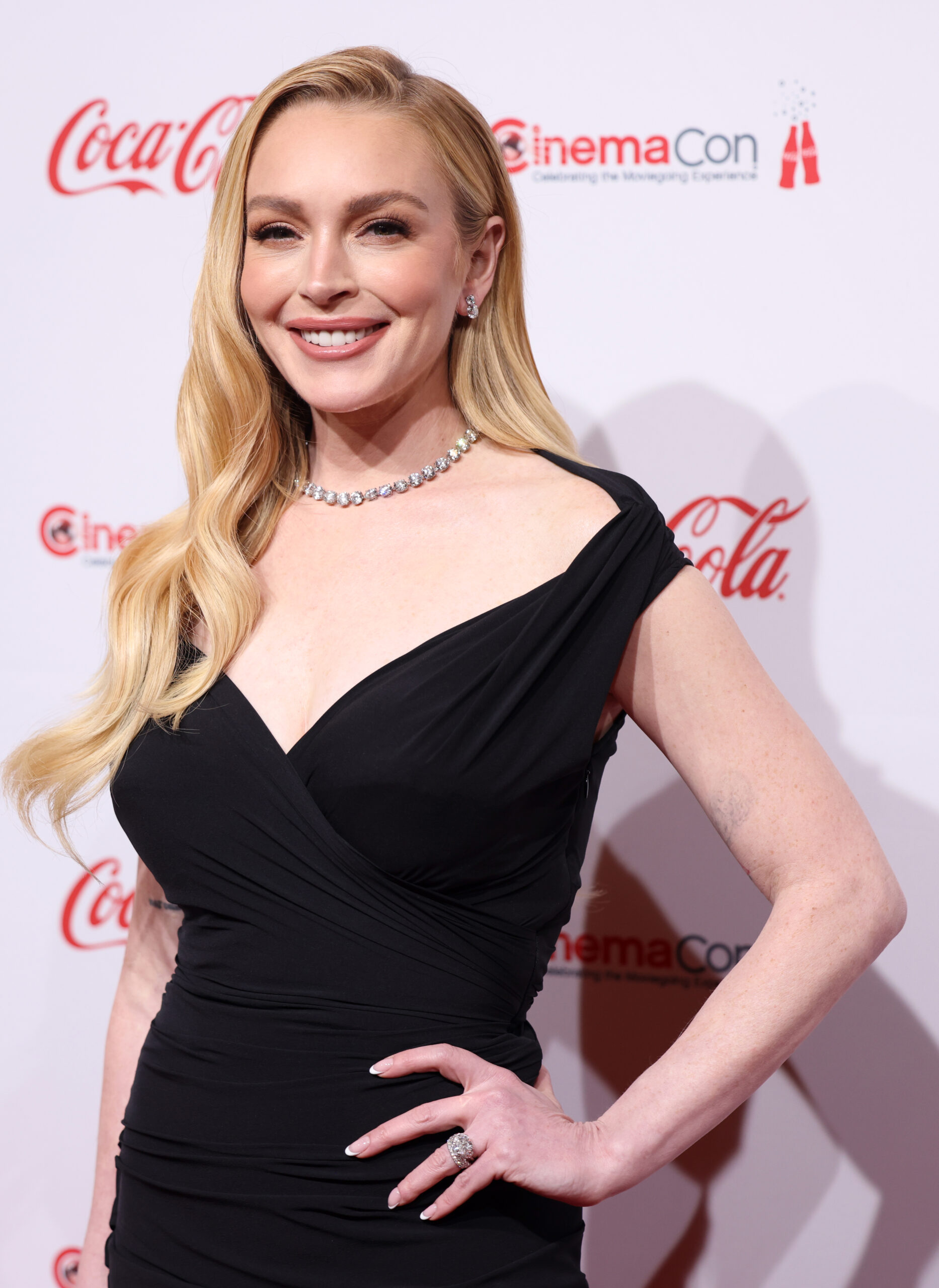
In 2014, Lohan moved to Dubai. Not for a role, not for a shoot, not for a comeback tour. To live there. She put an ocean and most of a continent between herself and the machine that had been running on her name since she was a teenager, and then she did the one thing that machine could not survive: she got boring on purpose. She stopped feeding it. She got an apartment, kept to a small circle, and slowly, deliberately, walked out of the American gossip cycle. For the first time in her adult life, nobody was waiting outside the restaurant.
It’s worth sitting with how unusual that is. The ordinary arc for someone in her position is to keep chasing the thing that hurt them, to keep trying to win back the room that turned on them. She didn’t. She just left the room.
And in the quiet she’d built, she met Bader Shammas.
He’s a financier based in Dubai, and by every account he’s about as far from the Hollywood world as a person can get. That appears to be the whole point. They dated for roughly three years, entirely out of the spotlight, the kind of ordinary courtship she had never once been allowed to have. He proposed on November 28, 2021. They married on April 3, 2022. She confirmed it herself, in her own time, on her thirty-sixth birthday, July 2, 2022, with a single word on Instagram: “husband.” No exclusive, no magazine deal, no staged reveal. Just the news, on her terms, which for her was practically the entire message.
The next summer, in 2023, their son was born in Dubai. They named him Luai. It’s an Arabic name, and it means shield, or protector. She has called him the greatest joy of her life, and she says it the way people say it when it’s simply true and they’ve stopped needing anyone to believe them.
This spring, at 39, she sat down with Vogue Arabia and talked about the marriage without any of the old armor. She was asked why it works. And her answer is the sentence this whole story has been walking toward.
He’s the calm one, she said. She’s “like a firecracker,” and he’s steady, and the two of them fit precisely because of that difference. It’s a small thing to say. It’s also the single least self-destructive sentence you could imagine coming out of the young woman who used to be the mid-2000s’ favorite cautionary tale. She has found someone who doesn’t try to put the firecracker out, and doesn’t try to light more of them either. He just stays calm next to it.
In the same conversation she said something else that lands quietly if you know where she started. She’s “very selective” now about the roles she takes, because of her husband and her son. The career, the thing that used to be the whole of her, now has to fit around the life. That’s the reversal. For most of her existence, the life bent around the work and around everyone else’s use of her name. Now the work waits its turn.
And the work, for the record, came back on its own.
In November 2022, Netflix released “Falling for Christmas,” a gentle, snow-globe of a holiday movie, and it became the most-watched holiday film on the platform that year. In March 2024 came “Irish Wish,” with her husband, Bader, credited as an executive producer, which is its own small note of how thoroughly the two halves of her life have merged. Then “Our Little Secret” in November 2024. None of them are trying to be prestige cinema. All of them are warm, low-drama, easy to love, and that is exactly the reinvention. She didn’t come back swinging for an Oscar and a redemption narrative. She came back doing the pleasant, professional, unbothered work of an actor who has nothing left to prove and no interest in the argument.
That’s the part the checkout-line version never had room for.
The most-photographed young woman in America, the one the culture treated as a punchline for the better part of a decade, quietly got on a plane, went somewhere no one was looking, and built the one thing all that noise had never let her have. A steady man. A small boy with a name that means protector. A career she gets to pick from instead of one that picks her apart.
She didn’t win the old room back. She found a better one, and she stopped inviting the noise inside.