Marcus almost didn’t stop. It was 12:40, he had twenty minutes of lunch left, and the gas station off the interstate had the kind of bathroom you hold your breath in. But two cups of truck-stop coffee win every argument, so he pulled the mower trailer into the lot, told the crew he’d be a minute, and went inside.
He was forty-three, ran a three-man landscaping outfit in central Florida, and had the hands to prove it. Cracked knuckles. A permanent tan line at the wrist. The kind of tired that starts in your lower back and never fully leaves.
The pack was hanging on the hook inside the stall door.
One of those old nylon fanny packs, the maroon gone gray at the seams, a strap frayed like it had been cinched around a waist for twenty years. Somebody had hung it up, done what they came to do, and walked off without it. Happens more than you’d think.
Marcus figured wallet. Phone, maybe. He’d hand it to the clerk, wash up, get back to the crew.
Then he unzipped it.
Cash. Not a loose twenty for gas. Stacks. Real stacks, rubber-banded, the way a bank hands it to you, tens and hundreds packed so tight the pack wouldn’t lie flat. He didn’t count it standing there. He couldn’t have; his hands weren’t working right. Later, on the hood of his truck, with two of his guys watching and nobody breathing, he did.
Thirty thousand dollars.
There was a driver’s license in the front pocket. An old man’s face, unsmiling, the way they always are. A name. An address maybe fifteen minutes up the road.
And there was one more thing, tucked down at the bottom where a hand would land on it without looking.
A rosary. Wooden beads worn smooth and pale at the edges, the little silver crucifix rubbed almost featureless from years of somebody’s thumb.
Marcus sat down on the closed lid of that toilet, in that terrible bathroom, holding thirty thousand dollars and a stranger’s rosary, and he did not think what you think a man thinks.
Here’s what most people get wrong about a moment like that. They imagine the temptation. The little devil on the shoulder. Thirty grand, no cameras in a bathroom, a beat-up pack nobody could ever trace to you. Who’d know?
Marcus told me it never came up. Not for one second.
He walked out, handed the pack to the woman behind the counter, and said, “Somebody left this. There’s a lot in it. Can I leave you my number, in case they come back?” The clerk looked inside, went a shade paler, and said she couldn’t keep something like that. Liability, the manager, all of it. So Marcus took it back out to his truck, and that’s when he counted it, and that’s when the size of it landed on him.
Thirty thousand dollars belonging to a man he’d never met.
He could have driven to the address on the license. He almost did. But something stopped him. The thought of pulling up to a stranger’s house, a big sweaty landscaper knocking on the door holding a bag of cash, saying trust me, this is yours. Half the world would call the cops on that man. The other half would wonder what he’d skimmed.
So he did the slow, dumb, honest thing instead.
He drove back to that gas station the next day on his lunch. Asked the clerk if anyone had come in asking about a lost pack. Nobody had. He came back the day after that. And the day after that. Same twenty-minute window, same question, the crew ribbing him now. “Marcus, man, that money’s the tip from God, take the hint.” He’d just shake his head and buy a Gatorade he didn’t want so it wasn’t weird to keep showing up.
Three days. Three lunches. Nothing.
What Marcus didn’t know was that the man from the license wasn’t looking for the pack the way you’d look for thirty thousand dollars.
His name was Earl. He was seventy-one. Five months earlier he’d buried his wife of forty-nine years, and the money in that pack was the last of her, literally. He’d closed out the little savings account that had her name on it beside his, the one they’d fed for decades a hundred dollars at a time, and he’d drawn it out in cash because that felt like the only way to make the numbers real. It was meant for the headstone. For the balance still owed to the funeral home, the part the insurance hadn’t covered. The last thing left to do for her.
He’d stopped at that gas station to use the restroom on the way to the monument company. Hung the pack on the hook. Prayed, the way he did now in every quiet room he stood in. And walked out into the heat with his hands empty and his mind three graves away, and never felt the weight missing from his hip until he was almost home.
When it hit him, he didn’t call the police. That’s the part that breaks you.
He sat in his truck in his own driveway and he decided the money was gone, and that it was his own fault, an old fool losing the last of his wife in a gas-station bathroom, and that the shame of telling anyone was worse than the loss. He waited two more days before a niece pried it out of him and made him file a report. He filed it, he said later, not because he thought he’d ever see it again. He filed it so it would be written down somewhere that he’d tried.
The police ran the name off the license Marcus had turned in.
They called Earl and asked him to come down to the station. They didn’t tell him why over the phone. And they didn’t tell Marcus, who they’d asked to come in the same afternoon “to sign a couple of things,” that the owner would be walking through the door at the same time.
So Marcus was standing at the counter, filling out a form, when the glass door opened and an old man came in slow, hat in his hands, braced for bad news the way you brace for a doctor.
Earl looked at the officer. Then he looked at the counter. Then he looked at the big tired landscaper standing there with a pen in his hand, and somehow, before anyone said a single word, before the officer could explain a thing, he knew.
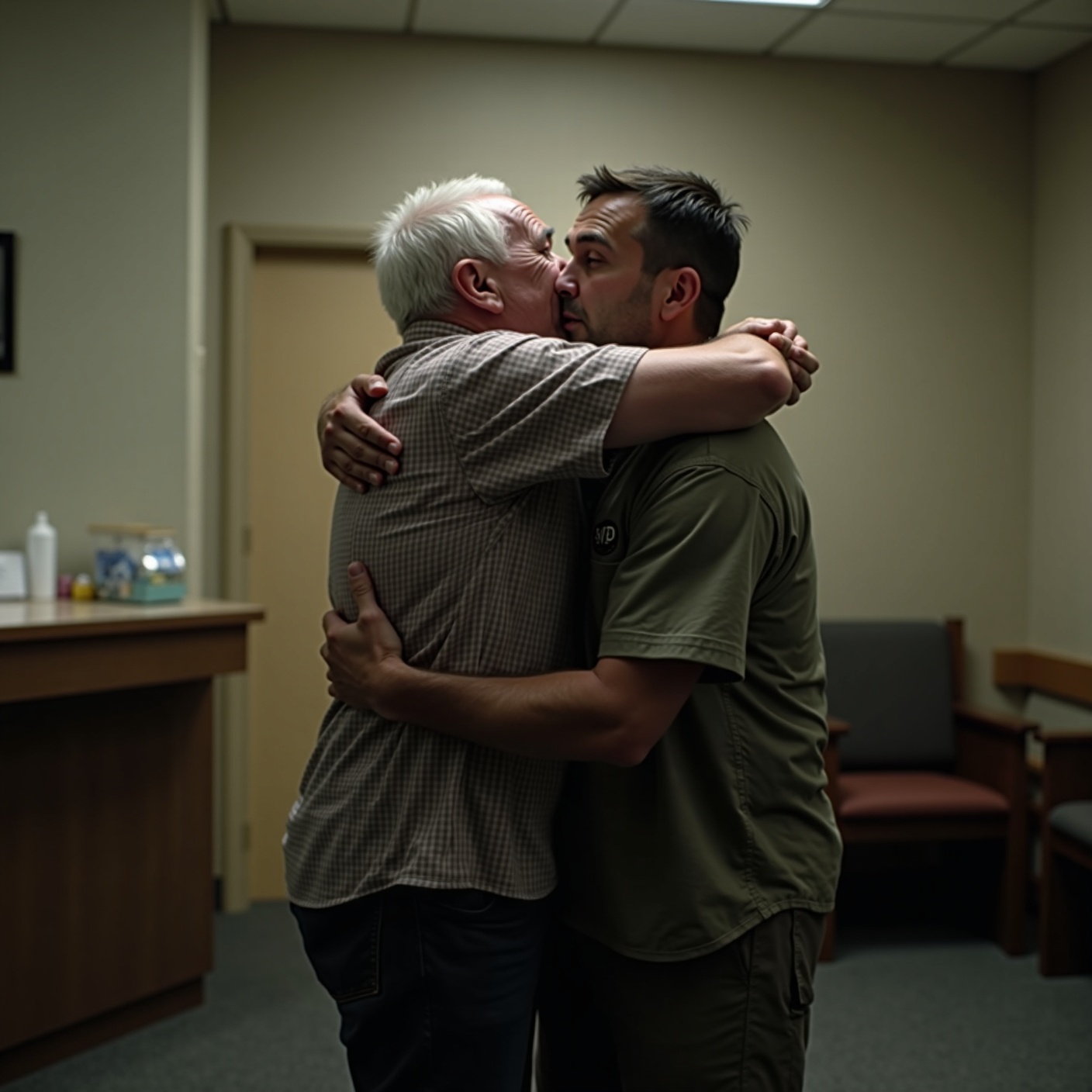
He crossed that room and he grabbed Marcus and he sobbed into his shoulder like a child, both hands gripping fistfuls of a dirty work shirt, and he could not stop, and Marcus stood there and let a stranger cry himself empty against his chest.
And that’s when Marcus understood he still hadn’t told him. The old man was thanking him, over and over, for being honest, for being a good man, for not keeping it. And Marcus hadn’t said the one true thing yet. Because to Earl, this was a miracle. A stranger who could have taken everything and didn’t.
But it was never a choice Marcus had to make. He’d known the second he saw the rosary at the bottom of that pack.
His own mother had carried one just like it.
She’d raised Marcus and his sister alone on two jobs and a lot of prayer, and when she died, and he was only twenty-six, there hadn’t been thirty thousand dollars. There hadn’t been three thousand. He remembered the specific, acid shame of sitting across from a funeral director doing math he couldn’t do, of a plot he couldn’t afford, of asking the church for help and hating every second of it. And he remembered a man he’d never met, an usher, an old guy who barely knew his mother, quietly handing the director an envelope and telling Marcus, “You don’t worry about that part, son. You just bury your mama.”
Marcus never learned that man’s name. Never got to pay him back. Had carried it, the receiving of it, for seventeen years, the way you carry a debt you can’t settle.
So when he unzipped a fanny pack in a gas-station bathroom and saw stacks of cash sitting on top of a worn wooden rosary, he didn’t see a windfall. He saw grief money. He saw somebody’s whole last act of love for somebody. He saw an envelope in a funeral home, from the other side of it this time.
He never told Earl that day. It didn’t seem like the moment to make it about himself. He just held the man up until his knees stopped shaking, walked him to a chair, and stayed until his niece came.
Earl set the headstone the next week. Marcus went to see it, once, on his own, on a lunch break, and stood in front of a stranger’s wife’s grave in his grass-stained boots for a while, and figured that old usher, wherever he was, was finally square.