
Start with the fact that sounds made up, because it’s true.
Somewhere in the South Pacific there is a point of open water so far from everything that, on a regular basis, the nearest human beings to it are not on any beach or boat or island. They are in space. When the International Space Station happens to fly over this particular spot, the crew inside, orbiting a bit over 250 miles up, are closer to it than any person standing on dry land anywhere on the planet. The nearest coastline is genuinely farther away than orbit.
The place is called Point Nemo.
The loneliest coordinates on Earth
Point Nemo sits at roughly 48.9 degrees south latitude and 123.4 degrees west longitude, deep in the South Pacific, in a part of the ocean that shipping lanes avoid and almost nobody has any reason to visit.
Its official title is the oceanic pole of inaccessibility. Every ocean has one: the single point that is as far as you can possibly get from any surrounding land. Point Nemo is that point for the Pacific, and because the Pacific is the largest ocean there is, it is effectively that point for the whole world. It is the most remote place in any ocean on Earth.
The number that captures it is the distance to land. From Point Nemo, in every direction you could choose, the nearest solid ground is about 1,670 miles away. Not one convenient island 1,670 miles off with closer ones behind it, but 1,670 miles to the very nearest speck of anything, whichever way you go. The closest land turns out to be a scatter of tiny, uninhabited islets, and they are all more than sixteen hundred miles out.
So set the two distances side by side. Nearest land: about 1,670 miles, sideways, across the water. Nearest astronauts, when the ISS is passing over: about 250 miles, straight up. The math isn’t close. Out there, space is the nearer neighborhood.
Named by a man for “no one”
The point was only precisely located in 1992, when a survey engineer named Hrvoje Lukatela used a computer to calculate the exact spot on the globe farthest from any coastline. It had no name, so he gave it one, and the choice was perfect.
He called it Nemo, after Captain Nemo, the brooding submarine commander from Jules Verne’s “Twenty Thousand Leagues Under the Sea,” a man who turned his back on the world and vanished into the deep ocean to be rid of it. And there’s a second layer folded into the joke, because “Nemo” is simply the Latin word for “no one.” The most solitary place in all the world’s water is named, quite literally, for nobody.
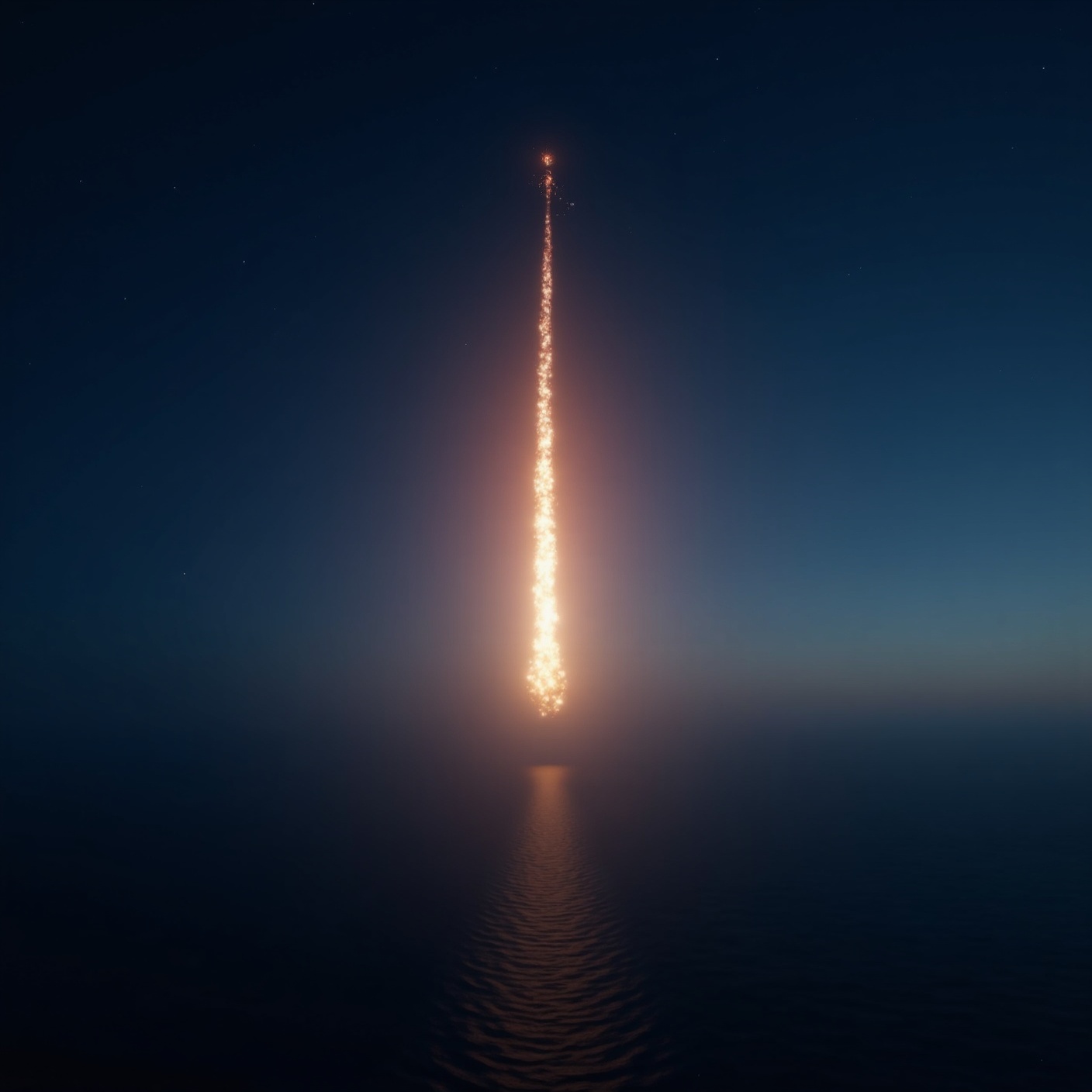
The spacecraft cemetery
Here is where the emptiness stops being a curiosity and becomes useful.
When a satellite or a space station reaches the end of its life, you can’t just let it fall wherever gravity decides. Most of it burns up on reentry, but the biggest, densest pieces, fuel tanks, structural spars, heat-hardened parts, survive the fire and hit the surface intact. Drop those over a city and you have a disaster. Drop them over the one patch of ocean farthest from every human being on Earth, and you have the safest disposal site the planet offers.
So that is precisely what the world’s space agencies do. Point Nemo has quietly become the global spacecraft cemetery. Since about 1971, an estimated 250 to 300 retired spacecraft, dead satellites, spent cargo ships, whole space stations, have been deliberately steered down out of orbit to fall in the empty water around it. Mission controllers aim for it on purpose. It has a nickname to match: the spacecraft graveyard.
The most famous resident is the Russian space station Mir. After fifteen years in orbit, Mir was brought down in a controlled reentry in 2001 and scattered across this stretch of the South Pacific, and it remains the largest object ever intentionally deorbited to the site.
It won’t hold that title forever. The International Space Station itself, the one whose crew keeps turning out to be Point Nemo’s nearest neighbors, is slated to make the same final trip when it’s decommissioned. The station that has flown over this lonely water thousands of times is, one day, meant to come to rest in it.
The desert with no sand
And then there’s the last strange thing about Point Nemo, which is what’s living there. Which is: almost nothing.
The point sits inside the South Pacific Gyre, an enormous, slow, rotating system of ocean currents. A gyre like this behaves as a kind of wall. It spins in on itself and pushes away the cold, nutrient-rich water that feeds ocean life everywhere else, and it sits too far from any coastline for rivers to wash nutrients in. Nothing arrives to feed the base of the food chain, so the food chain barely gets started.
The result is water that scientists describe as one of the most lifeless patches of ocean anywhere on the planet, so barren that it’s often called an oceanic desert. It’s warm, it’s clear, it’s blue, and it’s close to empty. The main biological activity down at the bottom, researchers have found, tends to cluster around the sunken spacecraft themselves, which is a haunting little detail: in the deadest sea on Earth, some of the only structure for life to gather on is the wreckage we sent down to be forgotten.
Put the whole picture together and Point Nemo becomes one of those places that shouldn’t feel possible on a planet this crowded. A stretch of sea so far from us that the nearest people are usually astronauts. A name that means no one, borrowed from a man who fled the world. A graveyard on the seabed holding a couple hundred spacecraft, with more on the way. And nearly dead water on top of all of it.
The emptiest place we have, quietly doing the one job only true emptiness can.
Sources: Encyclopaedia Britannica (britannica.com); CNN (cnn.com).