
In 2008, a family in Ohio stopped at a grocery store on the way to the funeral home. They bought a can of Original-flavor Pringles, took it out to the car, and drove on with it.
It was not a snack for the road. It was the coffin, or part of one, and the man it was for had asked for it himself, years earlier, at the dinner table.
His name was Fredric J. Baur.
He was an organic chemist and a food-storage specialist, which is one of those job titles that sounds dull right up until you find out what it actually means. It means you spend your working life on a question most people never think about: how do you keep food from going stale, going soft, going bad, going anywhere it shouldn’t?
Baur took his first degree at the University of Toledo, then a master’s and a doctorate at Ohio State. Before any of the food work, he served in the US Navy as an aviation physiologist, keeping pilots functioning at altitude. He went to Procter & Gamble in Cincinnati and stayed.
The problem was never the chip
Here is the thing most people get wrong about him, and it is worth being precise about, because the truth is better than the myth.
Fredric Baur did not invent Pringles.
The chips themselves came out of a different effort at P&G, and the distinctive saddle shape, the curve that lets one sit inside the next, was refined by another researcher there named Alexander Liepa. Baur’s problem was the one that came afterward, and in the potato chip business it was the expensive one.
Chips break. Chips take up an enormous amount of air. Put them in a bag and you are shipping a pillow of nitrogen across the country with a handful of potato in the bottom, and by the time the customer opens it, a good share of what’s inside has turned to crumbs.
Baur’s answer was to stop treating chips like a loose commodity and start treating them like a stacked product. A rigid cylinder. A curved, uniform chip that nests against the one below it. A seal that keeps the air out and a lid that goes back on.
In 1966 he filed for a patent on the can and on the method of stacking the chips inside it. The patent issued in the early 1970s.
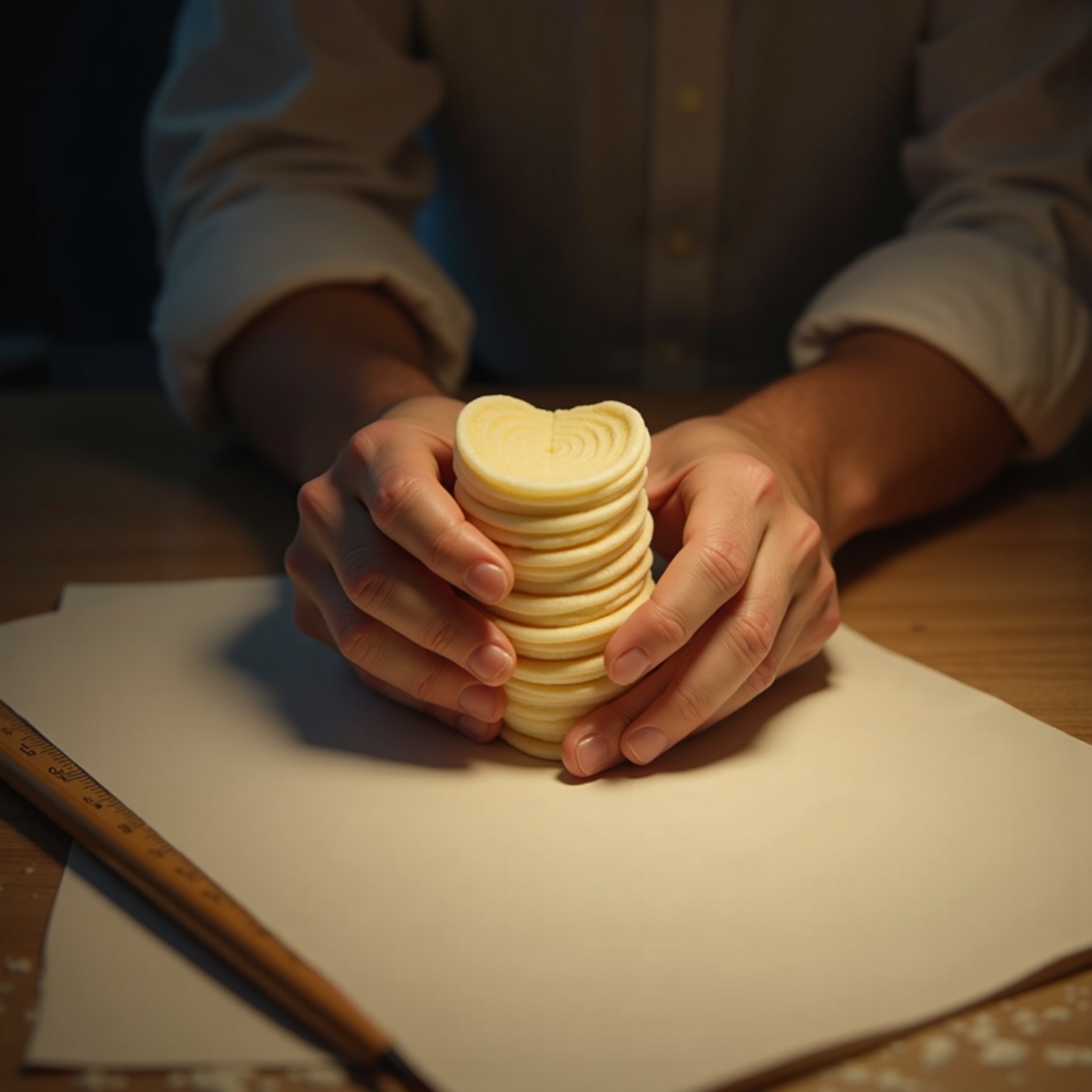
It is a strange kind of genius, the packaging kind. Nobody buys a product because of the tube. Nobody thanks the man who worked out the tube. But without it there is no product on the shelf at all, and everything about how those chips travel, survive, stack and sell traces back to one chemist’s decision about a shape.
The can was not the only thing he worked on either. His research at P&G touched frying oils, and, at one point, freeze-dried ice cream. He spent decades solving the unglamorous half of food: not how it tastes, but how it gets to you still worth eating.
The request
At some point, Baur told his family what he wanted done when he died.
He wanted to be buried in the can.
His children took it for a joke at first. It wasn’t one. He meant it plainly, and once you understand what that cylinder represented to him, it stops sounding like a punchline and starts sounding like a man asking to be buried with his work.
Fredric Baur died on May 4th, 2008, at the age of 89.
His children honored it. They drove to the store, bought a fresh can, and part of his ashes was placed inside it and buried at a cemetery in Springfield Township, a suburb of Cincinnati. A portion went to one of his grandsons. The rest was buried right there beside the can, in a standard urn.
That last detail is the one that stays with people, and it is the most human thing in the whole story.
He didn’t fit.
The man who spent his career calculating how to get the greatest possible amount of product into the smallest possible volume, who built a career out of eliminating wasted space, could not, in the end, be fitted into his own packaging. There was more of him than the container held. So they put the remainder in an ordinary urn and set it in the ground next to the can, which is a solution he would probably have found unacceptable and completely inevitable at the same time.
There is a rumor that has followed this story around the internet for years, and it deserves killing off. No, his ashes were never sold to anyone in chip cans. Nothing was mixed with anything. The can his family bought was new, sealed, and empty by the time it went into the ground. The whole thing was as ordinary and careful as any other burial, apart from the container.
Somewhere in Springfield Township, Ohio, there is a grave with a cylinder in it.
Not a monument, not a stunt, not a joke played on the mourners. Just a man who solved one specific problem so well that he wanted to be inside the answer.