
The invoice was taped to Sarah’s storm door with blue painter’s tape, in a Ziploc bag, because it had been raining.
Four thousand eight hundred dollars. Three sections of cedar privacy fence, materials and labor, from a company in the next county over. Handwritten across the top in ballpoint, pressed hard enough to dent the paper: “Your responsibility. Please remit by the 30th. D. Prescott.”
She read it standing in her own doorway with her work bag still on her shoulder. She’d owned the house for a year and a half. She’s thirty-eight, she bought it by herself, and up to that afternoon her entire relationship with Doris Prescott next door consisted of waving at her on the porch and one conversation about a package the mailman put in the wrong box.
Here is the thing about those three fence sections. The storm came through the first week of March, sixty-mile gusts, and it took down half a maple in the Hollands’ yard two streets over and peeled shingles off everything on the block. Sarah was at work when it happened. She came home to the fence lying flat in the grass like a dropped deck of cards, all three sections still nailed together, the posts snapped off at ground level. Rot. You could see it from the driveway, black and soft where the wood met the dirt, the kind of rot that takes fifteen years.
She called the number on the invoice. The contractor was polite and confused. He said a woman had called him for a quote, and no, ma’am, nobody had authorized any work, and no, he hadn’t been asked to look at the posts.
So she walked over.
Doris answered in a cardigan with a tissue tucked in the sleeve. Seventy-two, small, silver perm, the sharpest eyes Sarah has ever seen on a person that size.
“I got your bill,” she said. “I’m not going to pay it. Those posts were rotted through before I ever moved in.”
“That fence protects your property too,” Doris said.
“Then it’s a shared repair and we split it,” Sarah said, “and I’d want a second quote.”
Doris didn’t argue. That was the part that should have told her something. She just looked at her for a second, said, “All right, hon,” and closed the door.
Her son Wayne started coming by that Saturday.
Wayne is forty-nine and lives in an apartment across town, and until then his truck had been at his mother’s maybe once a month. Now it was there every weekend, and he brought a riding mower on a trailer, and he mowed Doris’s yard in about twenty minutes, which is generous, because it’s a small yard.
Then he kept going.
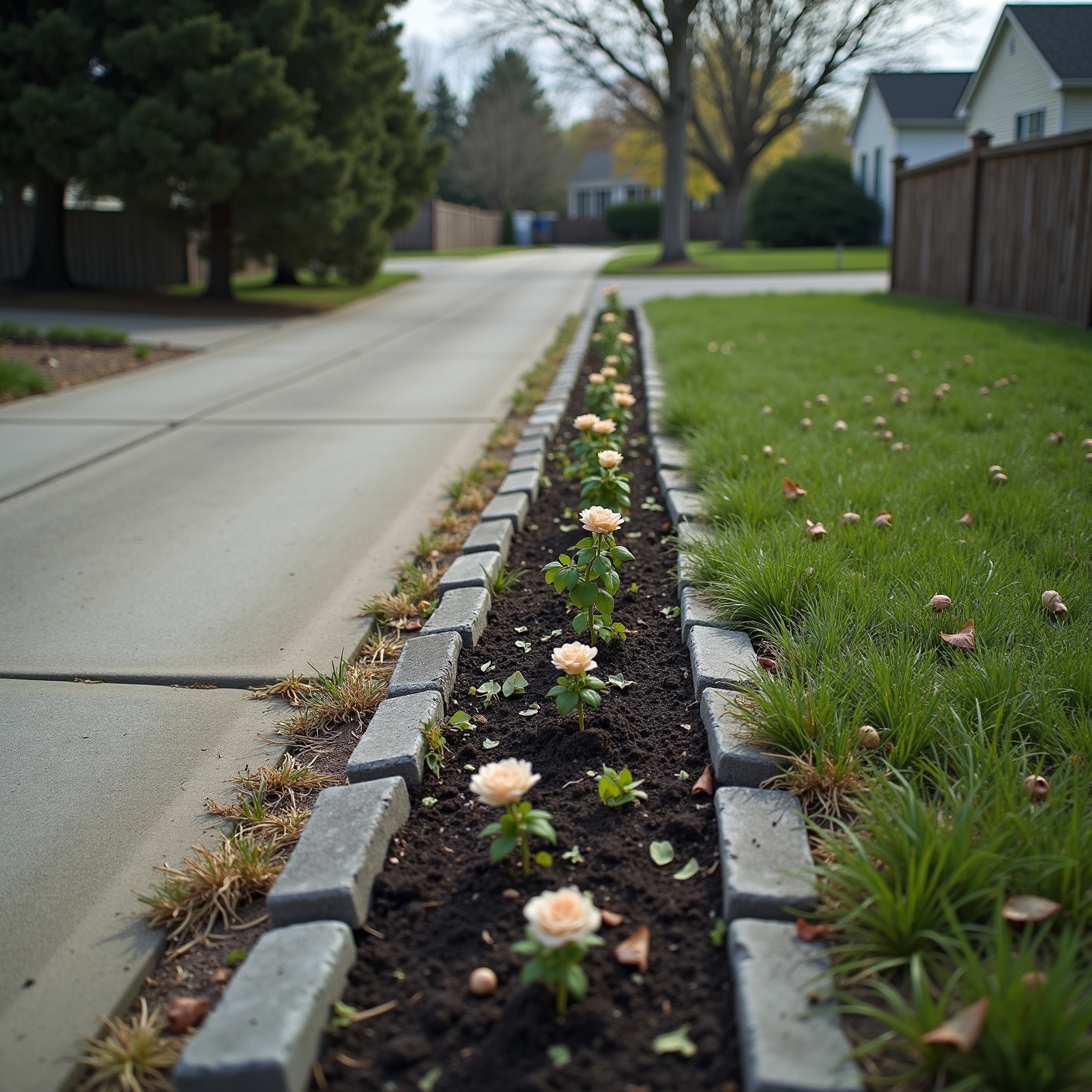
The first time, he ran the mower across the end of Sarah’s driveway and clipped the corner of the bed she’d put in along the property line. Sixteen feet of it. She’d dug that bed out by hand the previous spring, hauled the border stones from a place forty minutes away in the back of her Civic, and planted fourteen knockout roses that had finally, that year, decided to live.
He took the corner. Three bushes, cut to the crown.
She went out. He shut off the mower and pulled off his sunglasses and gave her a look of such wide, warm concern that she actually apologized for bothering him.
“I couldn’t tell where the line was,” Wayne said. “There’s no marker. Mom says it’s always been kind of loose along here.”
“There’s a flower bed,” she said.
“I’ll watch it,” he said.
The next Saturday he took six more. The Saturday after that, five. Fourteen rose bushes, all of them, in three weeks, and every one of them cut off at three inches, and every time he shut off the engine and said something friendly and drove home.
She priced replacements at the garden center on a Tuesday. Six hundred and twenty dollars, and that’s the small ones, and roses take three years to look like anything.
What Wayne didn’t know is that she’d put a doorbell camera on the front of the house the week she moved in, because she lived alone and her mother wouldn’t stop asking about it. The camera looks straight down the driveway. It got all of it. Him steering into the bed. Him looking directly at the border stones. Him backing up and taking a second pass at a section he’d missed.
She sat in her kitchen that night with the footage open on her laptop and a cup of tea going cold, and she did not call the police.
She is honest about why. Part of it was that she’s watched neighbor feuds go nuclear on her sister’s street and nobody ever wins. But most of it was simpler. Something about the whole thing didn’t sit right. Nobody spends three weekends and two tanks of gas destroying a stranger’s flowers over four thousand eight hundred dollars they know they aren’t owed. That’s not greed. That’s something else, and she couldn’t name it.
The Sunday after the last of the roses, Doris was on her porch when Sarah came out for the paper. She had a glass of iced tea on the rail and she’d been waiting, and she said it in the exact tone you’d use to tell someone the store was out of milk.
“Honey, that fence has been ours since before you were born. Pay it — or Wayne will keep visiting.”
She said, “Okay, Doris,” and went back inside, and Monday morning she called a surveyor.
A boundary locate, it’s called. A hundred and fifty dollars. A kid in a reflective vest showed up Thursday with a tripod and a tablet, walked the lot for two hours, drove four orange-topped stakes into the ground, and handed her a printout.
The fence was in the wrong place.
Not by a hair. The line ran three feet inside her property at the street, and because it had been set crooked at some point long before either of them, it kept widening as it went back. At the rear corner of the lot it was almost nine feet off. All of it on her side of the paper.
Which meant Doris had billed her forty-eight hundred dollars to rebuild a fence that stands on her land. It also meant something bigger, and the surveyor pointed at it with his pen.
“That shed’s yours,” he said. “It’s inside your line by about six feet. Everything from here to that back post.”
The shed. Weathered gray board and batten, maybe eight by twelve, with a padlock hasp that hadn’t been latched in years, sitting on the strip of ground behind Doris’s garage where Sarah had assumed her neighbor’s yard ended and her own began. Twenty years of that family walking past it as if it were theirs, because it had been.
By the letter of that survey she could have had a crew out there on a Tuesday and taken the fence, the strip, and the shed down to bare dirt before lunch.
She walked back there that evening with the printout in her hand and pulled the door open.
The smell hit first. Sawdust and old motor oil and cold metal. There was a workbench along the back wall under a window furred with dust, and on the pegboard above it every tool hung on its own outline, drawn in black marker, the way a man does it when the shop is the one place in his life that stays how he leaves it. A coffee can of screws. A folded shop apron on a nail. A radio with a wire hanger for an antenna. On the corner of the bench, a piece of pine held in a vise, half cut, the pencil line still on it, and a handsaw laid across the top exactly where somebody set it down and meant to come back after lunch.
Taped inside the door was a feed store calendar. September 2019.
She stood there a long time.
Frank Prescott died in the fall of 2019. Sarah never met him. She knows his name because it’s on the mailbox Doris has never changed.
She wasn’t fighting for a fence. She was fighting for the line that fence drew, and everything she’d left sitting on the far side of it, exactly the way he left it, for six years.
Sarah paid a lawyer three hundred dollars to draw it up. A lifetime license, in writing, recorded with the deed. Doris Prescott has the use of that strip and that shed for as long as she lives, and it costs her nothing, and nobody can take it from her, including Sarah.
There was one condition, and she put it in the letter herself.
Wayne rebuilds the flower beds. By hand. No mower, no crew, no check written to make it go away. Fourteen bushes, stones reset, mulch, his own back and his own Saturdays.
He started the second week of May. Doris came out onto the porch with her iced tea and sat there the whole first afternoon, and she didn’t say one word to him, and honestly, that was worse for him than anything anyone could have done.
Around four o’clock she called across the driveway.
“Frank planted roses for me once,” Doris said. “1988. He killed every one of them.”
It was the first time Sarah ever heard her laugh.