Outside it was August in Chicago, the kind of afternoon where the asphalt shimmers and everybody walks a little slower on purpose. Inside Tropic World at Brookfield Zoo the air was warm in a different way, thick and green and humid, and full of the noise a building makes when it is packed with families on a Friday.
August 16, 1996. Kids up on shoulders. Strollers parked two and three deep along the viewing rail. Somebody’s toddler working through a bag of popcorn. That steady crowd hum that never quite stops.
Below the rail, past the barrier and a drop of about twenty feet, was the gorilla floor. Western lowland gorillas, several of them, spending an ordinary afternoon the way they always did: sitting, grazing, paying the people above almost no attention at all.
Then a three-year-old boy got away from his mother.
It takes about four seconds. Any parent who has ever crouched down to dig a juice box out of a bag knows exactly how long four seconds is.
He climbed the barrier. He went over the edge. He hit the floor of the enclosure and he did not get up.
The sound in that building changed all at once. People who were there described one noise, hundreds of voices going up together, and then a thin strange quiet underneath it while everyone looked around for somebody to do something.
“Somebody get down there,” a woman near the rail kept saying, to nobody in particular, over and over. “Somebody get down there.”
A man a few feet away had a camcorder up on his shoulder. He had been filming the gorillas for his family, the way you do. He kept filming. That tape is the only reason the rest of the world ever saw what happened next.
Because the gorillas had noticed.
This is the part that empties your stomach if you have ever stood in front of an adult gorilla. A big male’s forearm is thicker than a man’s thigh. There were several adults on that floor, and a small unconscious human had just dropped into the middle of their home.
The first one to reach him was a female named Binti Jua.
She was eight years old. Her name is Swahili. It means daughter of sunshine.
Her own start had been a hard one. Her mother did not raise her, so the keepers did, hand-rearing her on bottles and blankets, which sounds tender and is, but it also leaves a gap. A gorilla learns how to be a mother mostly by watching her own mother do it. Binti never got that lesson. So when she was expecting her first baby, the staff taught her by hand. They gave her a stuffed doll and they showed her, over and over, how to hold it, how to carry it, how to keep it against her body while she moved.
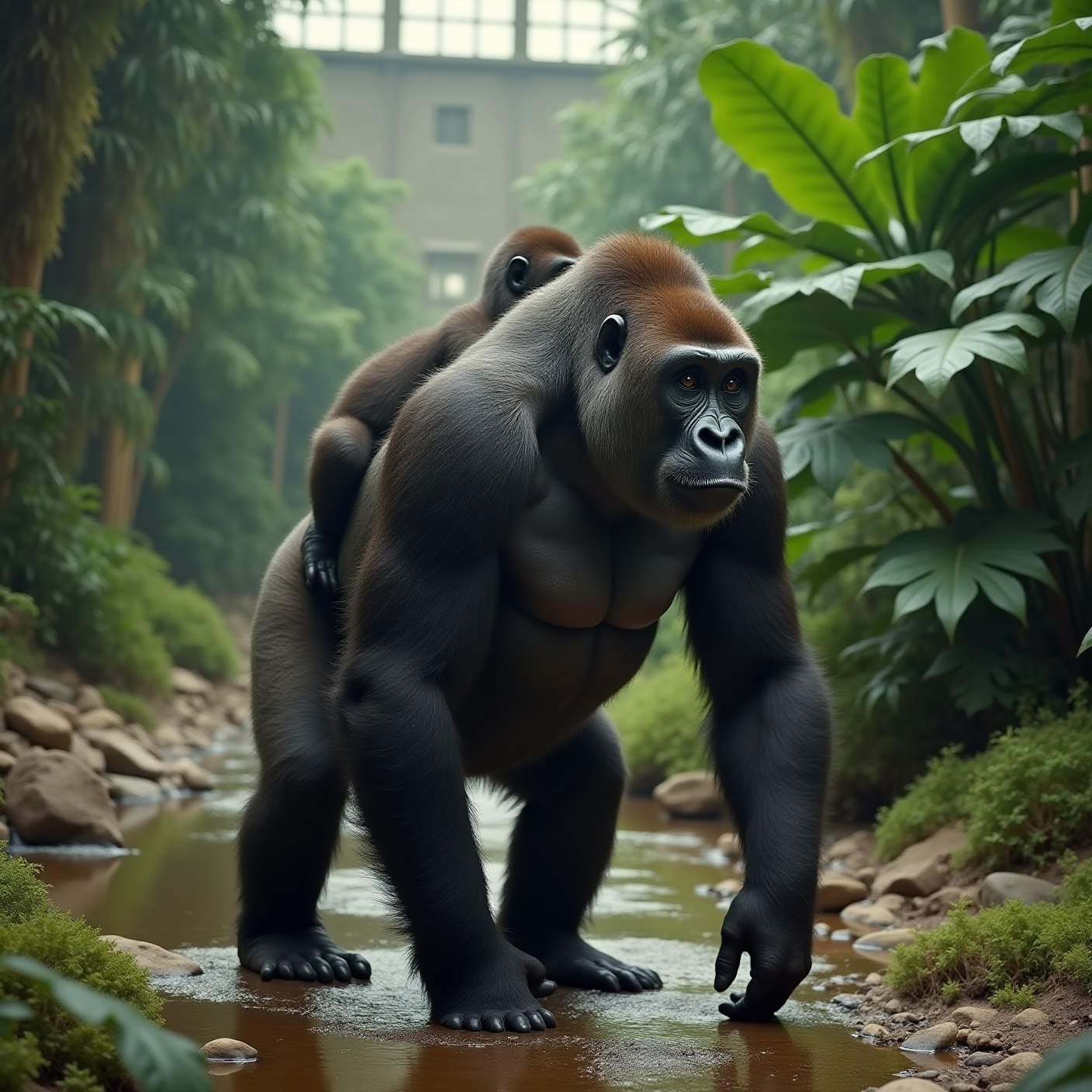
It worked. On her back that afternoon, riding the way baby gorillas ride, was her own seventeen-month-old daughter, Koola.
So when Binti Jua started across that floor toward the boy, she was not crossing it alone. She had her toddler holding on behind her.
The other gorillas were moving too, coming in from the far side.
Binti got there first. She leaned down and lifted the child into her arms.
What she did next is the part people replay.
She gathered him in against her chest, the way you carry something you would rather not jostle. Then she turned. She put her shoulder between the boy and the other gorillas and she kept it there, shifting her angle as they came, so that anything wanting to reach him had to come through her first.
And then she walked. Not to a corner. Not up onto a rock where she could sit with her prize. She carried him the whole length of the enclosure, past the water, past the other animals, to a service door in the wall. The keepers’ door.
She set him down there. Carefully. Right where the staff could get to him.
Then she stepped back with Koola still clinging to her, and let the others come.
Keepers were already at that door with a hose to hold the rest of the group off. Paramedics reached the boy within minutes.
His injuries, plainly: a broken hand, cuts to his face, four days in the hospital, a full recovery.
By that night the camcorder footage was on television. By the next morning it was on front pages on three continents, and a zoo outside Chicago had produced the most famous gorilla on earth.
Then came the argument, which ran for years and in some corners is running still.
One camp said it was empathy, plainly and simply. She saw a hurt infant and she did what a mother does. Frans de Waal, the primatologist who spent his whole career on exactly this question, cited Binti Jua as a textbook case of empathy in an animal and went on citing her for the rest of his life.
The other camp said: careful now. She was hand-reared by humans. She was trained with a doll. What looked like compassion could have been habit, a rehearsed routine of pick up the small thing, hold the small thing, bring the small thing to the keepers.
But training explains the hands. It does not explain the shoulder. Nobody drilled her on putting her own body between an injured stranger and the rest of her group. Nobody taught her which door mattered, or why the far wall was better than the rock she was already standing near.
What is not in dispute is the outcome. The boy went home. His family kept him out of the papers, which was their right and, twenty years on, looks like the wise call. When reporters came looking for the anniversary story in 2016, he was a man in his twenties living a private life, remembered by strangers only as the three-year-old who fell.
Binti Jua stayed at Brookfield Zoo. Visitors came specifically to look at her, and by every account she went on giving them the same amount of attention she always had, which was close to none.
The most remarkable thing on that tape is not the lifting. It is how unhurried she is. A seventeen-month-old on her back, a stranger’s child in her arms, and an eight-year-old gorilla taking the long way across a room to a door, because the door was where the help was.