Stevens County sits up in the northeast corner of Washington state, above Spokane, running north toward the Canadian line. Pine and rock and river. Long roads with nothing much on them, gravel turnoffs that go up into the trees and don’t announce where they’re headed, houses set so far back from the county road that you’d never know they were there. Beautiful country. Also the kind of country where, if something goes wrong, it can go wrong very quietly.
On September 25, 2024, something went wrong very quietly.
An 84-year-old man from Spokane was staying at his summer cabin, a small place up one of those unmarked tracks, tucked into the trees. He was out there with his dog. Her name is Gita, she was thirteen years old, and years earlier she had been the one who needed saving. Somebody rescued her. That detail is going to matter shortly.
He went outside. He fell. He hurt his leg, badly enough that he could not get up again.
That is the entire event. It takes one sentence. An older man, alone, on the ground, out of reach of the cabin, in a place where nobody drives by because there is nothing to drive by for. He had conditions that needed medication on a schedule, and the medication was inside, and inside might as well have been another state.
He called for help. Nobody was close enough to hear it.
The hours went by. Anyone who has spent an afternoon in the woods knows how the light works there, how it starts to lean and go gold and then start thinking about leaving. He was still on the ground.
And at some point Gita made a decision.
She left him. That is the part that stops people when they hear this story, because it sounds like the wrong move. She got up and she walked away from the man on the ground, down the steep unmarked track, all the way down to where it met the main county road. Thirteen years old. Gray in the face. And then she did the strangest, smartest thing a dog has done in that county in a long time.
She sat down in the middle of the road.
Not on the shoulder. Not trotting the ditch line the way a loose dog does. Square on the center line, facing the direction traffic would come from, and she stayed there.
Deputy Wright of the Stevens County Sheriff’s Office came around the bend and found her sitting in his lane.
He stopped, because you do. He got out. He talked to her the way everyone talks to a strange dog, easy voice, low hand, and she was perfectly friendly about it. He opened the back door of the patrol car and invited her in, which is standard: you scoop the loose dog, you run the plates on the nearest addresses, you get her home.
Gita would not get in the car.
She wasn’t frightened of him and she wasn’t snapping. She simply declined. She stayed exactly where she was, in the road, and looked at him, and made him work it out.
So he tried the other end of it. He drove up to the nearby residences, knocked, asked around, looking for anybody who was missing a gray-muzzled old dog. Nothing. Nobody knew her, nobody had lost her, nobody had any idea where she’d come from. On a road like that, the nearest neighbor is a project, not a stroll.
And here is where the whole thing turned on a hinge so small you could miss it. The deputy had done everything the job required. Loose dog, owner not located, note it and move on. Fifty times a summer, that’s how it ends.
He couldn’t let it go. Something about her sat wrong with him. She hadn’t behaved like a lost dog. Lost dogs run, or cower, or follow you around hoping for a sandwich. This one had picked a spot in the middle of a road and held it like a post she’d been assigned.
So he turned around and went back.
And the second Gita saw the patrol car again, she was up and moving. No sitting this time. She went straight at a lightly traveled side road, one of those unmarked tracks you’d pass a hundred times without registering that it was a road at all, and she started up it.
Then she stopped and looked back at him.
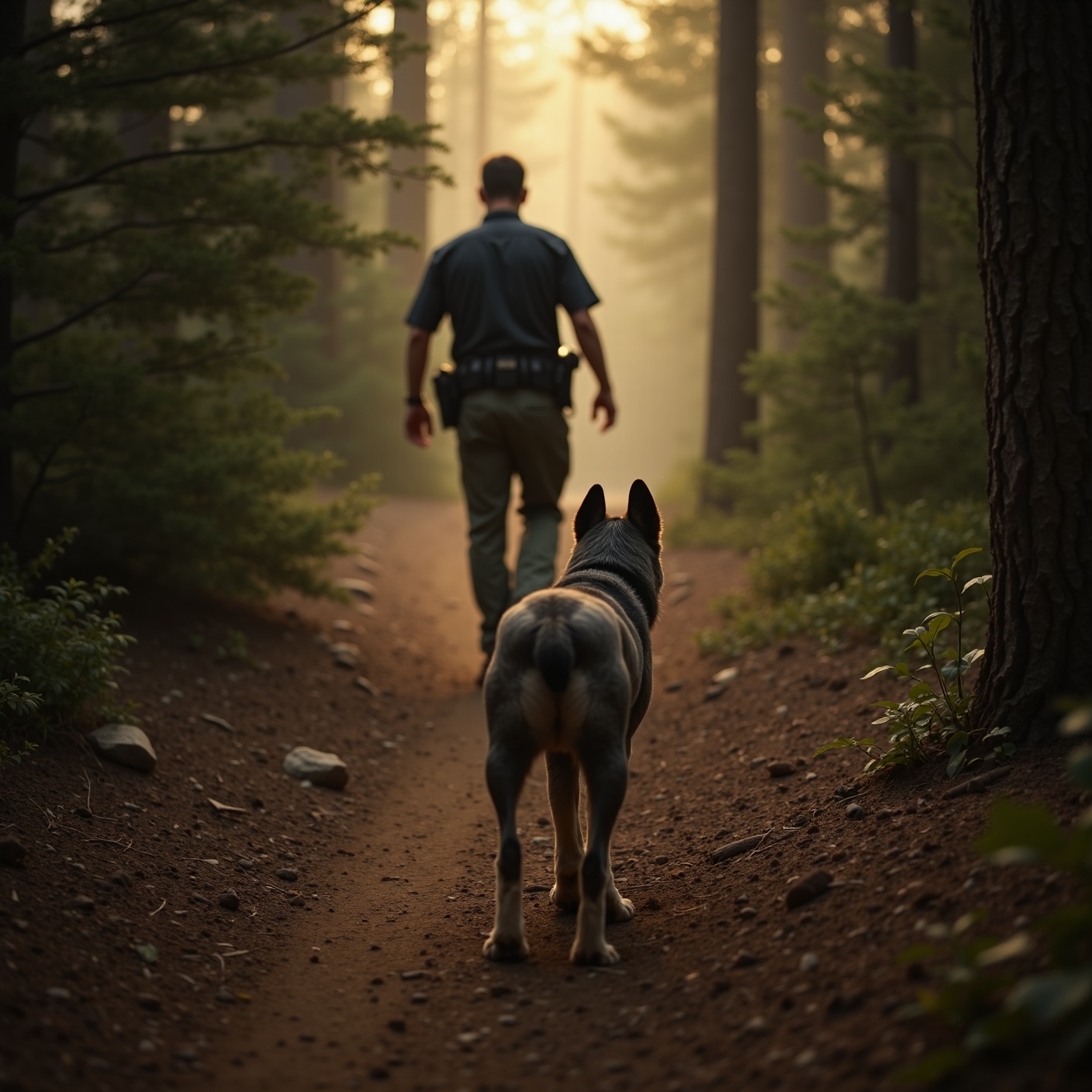
He got out and went after her on foot. The track was steep and rutted and climbing through the trees, the light coming down in long slanted bars, and up ahead of him a thirteen-year-old dog kept going and kept checking over her shoulder to make sure he was still following.
A short way from the cabin, he heard a voice.
The man was on the ground where he had fallen, calling for help. By then he had been down for close to seven hours.
Seven hours. Late September, in the trees, at 84, with medication he couldn’t reach and a leg that wouldn’t hold him. The Sheriff’s Office was blunt about the arithmetic afterward.
“He had laid there for hours and may have had serious consequences if he had not been found,” the Stevens County Sheriff’s Office wrote. “We credit Gita for saving his life that day.”
He got help. He was all right. So was she. And the sheriff’s office went ahead and said out loud what everyone involved was already thinking, naming Gita a hero dog, publicly, on the record.
What gets me about this one is the sequence. It isn’t one good instinct, it’s four in a row, each one harder than the last.
She understood that the man on the ground was not going to get up. She understood that help was not going to arrive at the cabin, and that it might arrive down at the road. She parked herself where a vehicle would have to stop rather than swerve, and she stayed there through however long it took for one to come. And then, when the deputy offered her the safe warm ride out of the situation, she turned it down, because getting rescued was never the job.
The job was getting him rescued.
Nobody taught her that. She wasn’t a search dog or a service dog. She was a rescue, an old one, in the last stretch of her life, who had been given a home by a man in Spokane and had apparently decided that the debt was payable on demand.
There’s a version of this where the deputy never comes back down that road. He was well within his rights to file it and drive on. He’d tried the car, he’d tried the neighbors, he’d done the whole checklist. The reason this story ends the way it does is that a dog was stubborn enough to make a point and a man was curious enough to go back and let her make it.
She was thirteen. Somebody once pulled her out of a bad spot, and years later, on a gravel road in Stevens County, she paid the whole thing back in a single afternoon.