I run the lost and found at the county fairgrounds, which is not a career anybody plans on.
August is the week it matters. The rest of the year it’s a green safe in a back office with a shelf of things people loved for about nine seconds. Forty-one sets of keys. Two retainers in napkins. A wedding ring, claimed in ninety minutes by a man who was gray in the face. One prosthetic leg, claimed the same night, and I have never asked.
The rule is twelve months. Twelve months and then it goes out, and I’m the one who signs the line.
The camera came in on the last Sunday of the fair. Little silver Canon, ten years old at least, gray duct tape wrapped around the strap where it had frayed. My log said: camera, digital, card inside. Found north end, by the lemonade. And nobody called. Not in August, not at Christmas, not in the spring when I do my one round of calls to see if anything turned into a mystery worth solving.
So last week I pulled it out of the safe to write it off, and because I have never once been able to throw away something with pictures on it, I put the card in the office computer first.
Four hundred and twelve photos.
The same family in most of them, which is normal. What was not normal was that the family kept changing decades. Big glasses and a station wagon in one shot. A minivan in another. Hair going from feathered to permed to flat. A man in a ball cap who got older, then got a cane, then wasn’t in the frame at all.
Somebody had scanned an entire shoebox of film onto that card. The file dates were all one week last June.
Then I noticed the thing that made me sit up.
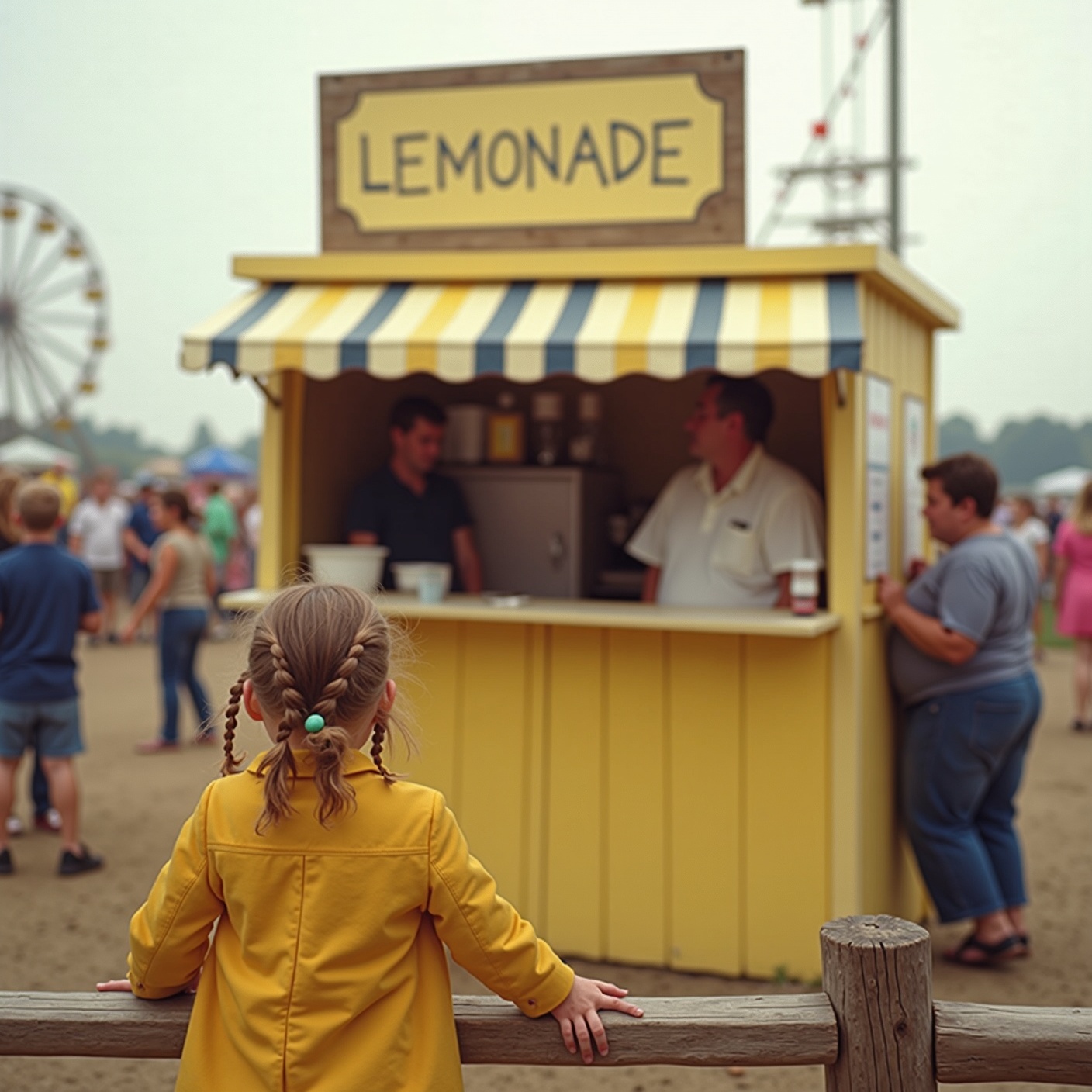
Every single photo had the same lemonade stand in it. Same little wooden booth with the awning. Same hand-painted sign, gone chalky and sun-bleached and never once repainted, so that from one photo to the next you could watch the paint die. And the same fence post in the bottom right corner of the frame. Every time. Same distance, same angle, same height.
Whoever it was hadn’t been taking pictures of their family. They’d been standing in one exact spot at the fair, once a year, and taking one photo. Thirty-nine of them, 1986 through 2024.
I put them in order and went through slowly, because at that point it stopped being work.
You can watch a fair get old that way. The Ferris wheel changes color twice. The trash barrels go from metal to plastic. A stall behind the stand sells funnel cake, then kettle corn, then it’s a phone-case tent. After 2013 the lemonade booth is gone entirely and the last eleven frames are a strip of trampled grass and a fence, shot from the same spot, at the same height, like he was still photographing something that was there.
And in the one from 1994, off at the left edge, half out of the shot, there is a little girl of about six standing with both hands on the fence rail, watching the stand and not the camera.
She has on a yellow coat with wooden toggle buttons, and one of the toggles has been replaced with a green one, because it fell off and her mother sewed on whatever was in the tin.
That coat is in a garment bag in my hall closet. It has moved with me to every apartment I have ever lived in, and my ex-husband once asked me why I keep a child’s coat I will obviously never use, and I said I don’t know, and that was true at the time.
She’s in 1995, on the other side of the frame, in the same coat with the sleeves too short. She’s in 1997, older, hanging off the fence with her ankles crossed.
And in 1997, standing at the fence about ten feet behind her with a cigarette and her hair down, is my mother.
I want you to understand what that is. There are no photographs of my childhood. Not one. My family did not own a camera, ever, and by the time phones had them my mother had already stopped being somebody who let anyone point one at her. She died four years ago and the picture on the funeral home’s little easel was her work badge from the linen service, blown up until you could see the printer dots.
I found the family off the sign. I put the photo up in front of the fair board secretary and she said Bell’s, without even thinking about it, the Bells ran the lemonade stand from 1974 until the year the county changed the vendor contracts. There is exactly one Bell left in the phone listings for this county.
The house is a one-story on Ackerman with a plywood ramp built over the front steps.
The man who opened the door was seventy-nine years old and had a walker and a hearing aid, and he looked at me through the screen for about a second and a half.
“Yellow coat,” Daniel Bell said. Not a question. He backed the walker up to let me in.
He’d started the picture as a joke on his wife. Ruthie painted that sign in 1986 and Daniel told her it wouldn’t last five summers, so every year he took a photograph of it to prove himself right, and every year Ruthie said it looks fine to me, Dan.
“After about ten years it stopped being about the sign,” he said, in a recliner with the TV muted on a fishing show. “It was the only picture I ever took where you could see the time in it.”
He knew who I was. He’d known since 1995. Our house backed onto the field behind the Bells’ side lot, and he’d worked out early on that the little kid at the fence was there every year and never in anybody’s photograph but his, because there wasn’t a camera in our house and everybody on that road knew it.
“I used to think, that girl’s mother’s going to want this someday,” Daniel said. “Then your mother passed, and I thought, well, now she’s going to want it.”
Ruthie died in February of last year. His son lives in Arizona and doesn’t want thirty-nine pictures of a fence. He got the whole shoebox scanned at the drugstore in June, put the card in his old camera, and then he sat on it for two months trying to work out how to hand it to me.
“I asked around who runs your counter over there,” he said. “Whole year I knew it was you.”
I asked why he didn’t just knock on my door.
“Because you’d have given it back,” Daniel said. “That’s the whole job over there, isn’t it. Giving things back to people.”
So he set the camera on a picnic table by the poultry barn on the last Sunday of the fair, walked twenty feet, picked it up again, and turned it in himself. His name is sitting in my own log book in the found-by column, in shaky ballpoint. I wrote that entry myself and never once looked at who handed it over. Then he waited out my twelve months, so the rule would put it in my hands and I wouldn’t be able to argue about it.
We went through the whole card that afternoon at his kitchen table, one year at a time, and he talked the entire way through it. That’s my brother-in-law. That’s the summer it rained every day. That’s Ruthie’s cousin who could not be trusted with the till.
He printed the 1997 one for me on his own printer, on paper that was too glossy, and it came out a little too dark.
It’s framed in my hallway now, over the closet with the coat in it. A stranger’s lemonade stand takes up two thirds of the picture. Down in the corner there’s a kid on a fence rail, and behind her, out of focus, a woman with her hair down who did not know anybody was looking.