
Every diesel engine on the planet does the same dirty trick: it burns fuel a little unevenly, and the leftover carbon comes out as black smoke and fine soot. Truck drivers know the smell. City dwellers standing at a red light behind a delivery van know it too. For decades the fix has meant expensive hardware — new catalytic converters, particulate filters, entire engine redesigns costing tens of thousands of dollars a vehicle. A team of Nigerian researchers just spent months combing through the science on a much cheaper idea, and it comes out of the tap.
The researchers work at the Federal University of Technology Owerri, in southeastern Nigeria, and their project wasn’t a single experiment. It was a review, a careful pass through years of published lab studies on something called water-in-diesel emulsion, or WiDE for short. The concept has been kicked around by fuel chemists since at least the 1990s, tested in small batches in university labs from Malaysia to Turkey to Brazil. What the Owerri team did was pull those scattered results together and ask a plain question: does it actually work, consistently, across different labs and different engines?
The mechanics of WiDE are almost stubbornly simple. Tiny droplets of water get blended directly into diesel fuel, each droplet held in suspension by a surfactant so the mixture doesn’t separate the way oil and water normally would. Done right, the resulting emulsion looks like ordinary diesel, pours like ordinary diesel, and can sit in a tank for up to 60 days before it needs stirring again. Pour it into a standard engine and nothing about the hardware has to change. The water travels along for the ride, right into the combustion chamber.
That’s where the numbers get hard to argue with. Across the studies the Owerri team reviewed, nitrogen oxide emissions dropped by as much as 67%. Particulate matter, the sooty stuff that coats city air and lungs alike, fell by up to 68%. Add it all up and overall diesel emissions came down 60%, and several of the reviewed engines ran a touch more efficiently on the water blend than on plain diesel, not less.
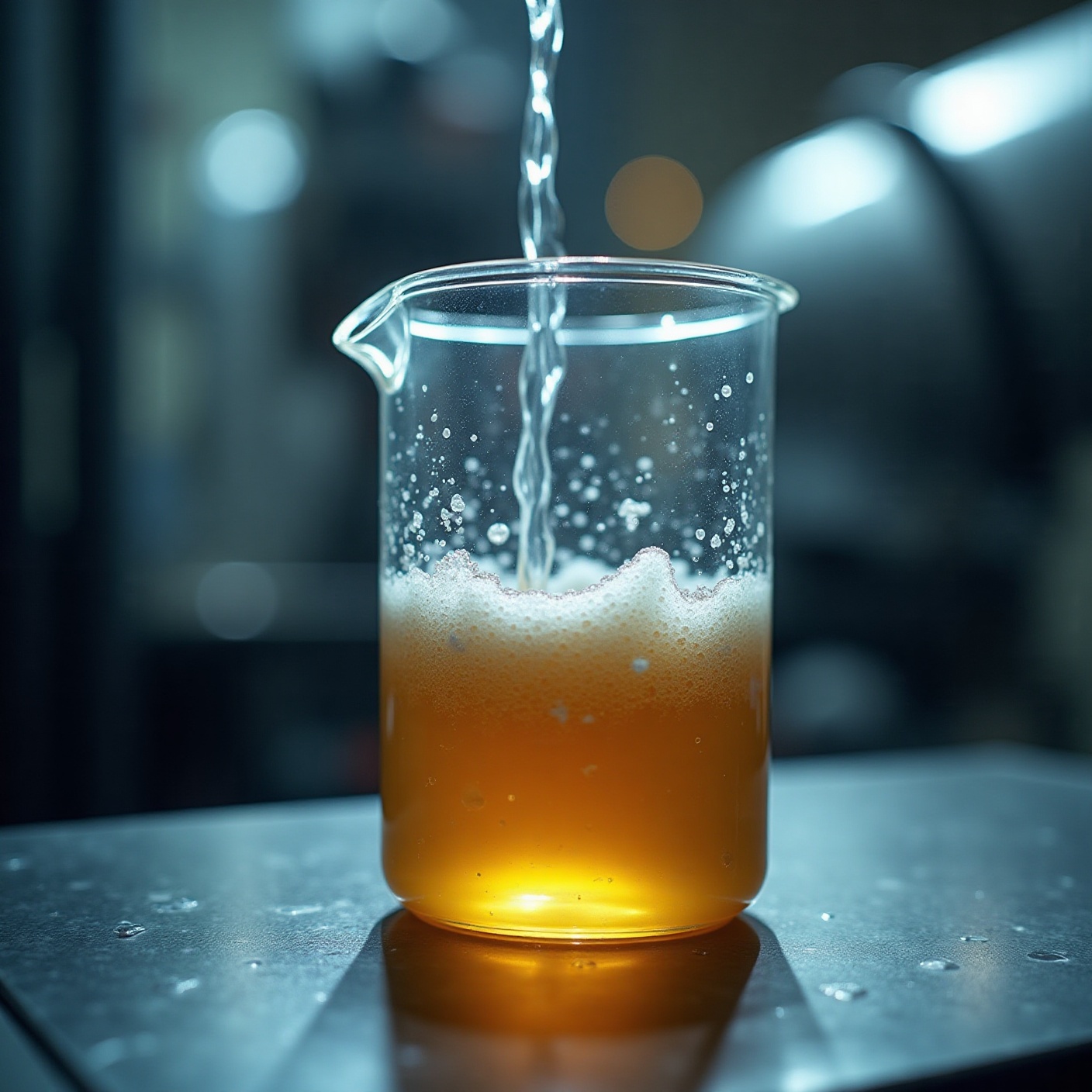
The reason comes down to what happens in the fraction of a second after ignition. Diesel fuel burns hottest at its outer edge first, and the water trapped inside each fuel droplet heats up faster than the diesel surrounding it. Water flashes to steam far below the temperature diesel needs to combust, so once it crosses that threshold, it expands instantly and violently from the inside of the droplet outward. Chemists in the field call the effect a micro-explosion, and it does exactly what the name suggests: it shatters the fuel droplet into a fine spray of even smaller ones. Smaller droplets burn more completely, faster, and with less unburned carbon left over to drift out the tailpipe as soot.
“Water-in-diesel emulsions are a practical and cost-effective way to make diesel engines cleaner,” says lead researcher Dr. Chukwuemeka Fortunatus Nnadozie. His co-author on the review, Professor Emeka Emmanuel Oguzie, framed the significance a bit differently, calling WiDE something that “can bridge the gap between conventional diesel use and a cleaner energy future.”
That word “bridge” matters. Nobody on the research team is claiming water-in-diesel replaces the shift toward electric trucks, hydrogen fuel cells, or whatever eventually takes diesel’s place at the pump for good. What they’re pointing at is the gap between now and then — the millions of diesel engines already on roads, already installed in generators and farm equipment and cargo ships, that aren’t getting swapped out next year or even next decade. For that enormous, stubborn fleet of existing machinery, a fuel additive that needs no new parts and no new training is a very different proposition than waiting for a technology that doesn’t exist yet at scale.
There are still real hurdles before WiDE shows up at a truck stop near you. Blending water into diesel reliably, at the volumes a fuel depot handles, is a different engineering problem than mixing a beaker of it in a university lab. Surfactant costs, long-term storage in extreme climates, and engine-by-engine variation across different manufacturers all need more testing outside the controlled conditions of a research paper. The Owerri review itself is a survey of lab-scale results, not a rollout plan.
Still, it’s a strange thing to sit with: one of the most polluting technologies still in daily global use might get meaningfully cleaner not through a costlier fix, but a plainer one. No new factory floor. No new engine block. Just water, doing what it has always quietly done, mixed into the fuel that runs half the world’s freight.
Would you trust a fuel that’s part tap water?