I was seventeen, alone on a black stretch of county road at midnight with a flat tire. A semi pulled over behind me. The man who climbed out did not help me. He laughed at me.
This is a thank-you letter. It’s about eleven years late, and I have no idea where to send it, so I’m sending it here.
The fall I turned seventeen I was closing four nights a week at Ruby’s, a diner off Route 9 with a pie case that hummed and a coffee burner nobody ever turned off. My car was a 1989 Honda the color of old chewing gum. My dad bought it for six hundred dollars from a guy at his church, and he loved that car more than I did, mostly because it meant he didn’t have to pick me up at eleven at night anymore.
That night I came out at 11:40 smelling like fryer grease and syrup, with forty-one dollars in tips wadded in my apron pocket, and I got about six miles down Route 9 before the steering went soft and stupid in my hands.
I remember the sound more than anything. That wet flapping slap, like somebody smacking the road with a wet towel over and over, faster than my heart was going.
I pulled onto the shoulder. Gravel, then weeds, then a fence line, then nothing but black fields all the way out to somebody’s yard light half a mile off. No streetlights on that road. There were no streetlights on any road I drove back then.
I got out. The cold came up off the asphalt and went straight through my apron. The rear passenger tire wasn’t just low, it was dead, folded under the rim like something that had given up.
My phone was a hand-me-down flip phone with a battery that held a charge for about nine minutes, and it had been dead since my break.
So I stood there in a diner apron on a dark road doing the only math available to me: walk six miles back, or walk four miles forward, or sit in a locked car until sunrise and let my father find out in the worst possible way.
That’s when I heard the air brakes.
The headlights came up behind me slow and enormous, and the whole shoulder lit up white. A semi, dry van trailer, rolling to a stop maybe forty feet back. The engine kept running. The hazards started ticking.
I want to be honest about what I felt, because it wasn’t relief. I was seventeen. Every adult in my life had told me some version of the same story about strange men and dark roads, and I had watched enough television to fill in the rest. I put my hand on the door handle of my own car and I did not let go of it.
A man came around into the light. Sixty-something. Barrel-shaped. Grey stubble, glasses catching the headlights, a canvas jacket with the name stitched over the pocket in that faded red thread: Vernon. He walked with a hitch, like one knee had quit on him years ago and he’d decided not to acknowledge it.
He stopped a good ten feet away from me. I noticed that later. At the time I didn’t notice a thing.
He looked at my car. He looked at the tire. Then he made a noise that I can only describe as a laugh with no fun in it.
“Flat tire,” said Vernon.
“Yeah,” I said.
“Bet you got no idea how to change it,” he said.
I stared at him.
“Bet you can’t even find the spare,” he said.
Reader, I want you to understand the precise flavor of what went through me at that moment. It wasn’t fear anymore. Fear had left the building. What arrived instead was the hot, ugly, absolutely magnificent rage of a seventeen-year-old girl who has just been laughed at by a stranger on the side of a road at midnight.
“I can find the spare,” I said.
“Then find it,” said Vernon.
And he crossed his arms and stood there.
I want to be clear about what happened next, because for ten years I told this story wrong at parties. He did not touch my car. Not once. Not the whole time.
I popped the trunk. There was nothing under there but a milk crate of cassette tapes and a beach towel from a lake trip that had happened three summers before. I stood looking into that trunk long enough to feel my face go red.
“Under the mat,” said Vernon, from behind me.
I pulled up the mat. And there it was, sitting in a well I had driven around on top of for a year and a half without knowing it existed. A skinny little spare tire, a scissor jack folded up like a bug, and a lug wrench.
“Huh,” I said.
“Huh,” said Vernon.
I lifted the wrench out. It was heavier than it looked. Cold, too, that dense metal cold that goes into your fingers and stays. That’s the part I still feel in my hands when I think about that night. Not his voice. The weight of that wrench.
“Now what,” I said, and I said it the way you say it when you want somebody to just do the thing for you already.
“Now nothing,” said Vernon. “Now you tell me.”
“I don’t know.”
“Then get the book out of the glovebox and read it.”
So at midnight, on the shoulder of Route 9, in a diner apron, in front of an idling semi and a stranger who wouldn’t stop watching me, I sat sideways in my own driver’s seat and read a car manual out loud by dome light.
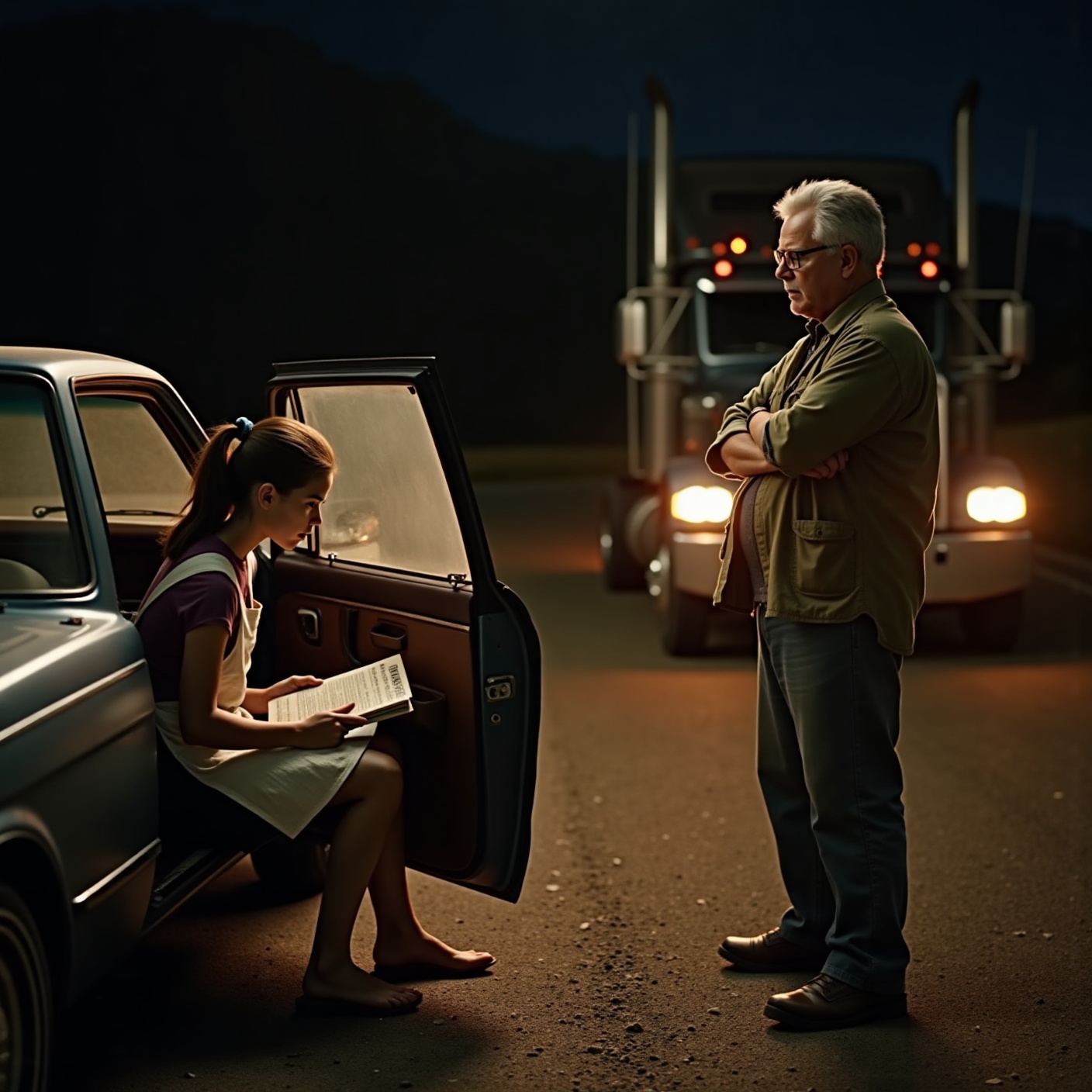
He made me do every single step. Every one.
I went to jack the car up first, because that’s what made sense to me, and he said, “Stop.”
“What,” I said.
“Break your lugs first,” said Vernon. “Loosen ’em while the tire’s still on the ground and it can’t spin. Get it up in the air first and you’ll be out here till Thursday.”
I put the wrench on the first lug nut and pulled. Nothing. I pulled harder. Nothing. The car didn’t even acknowledge me.
“They’re too tight,” I said. “I can’t.”
“You weigh what, a hundred and ten?” said Vernon. “Then quit pulling on it like it’s a rope. Get the bar level and stand on it.”
“Stand on it?”
“Stand on it,” he said.
I have never in my life felt as stupid as I felt putting one sneaker on that wrench arm and grabbing the fender for balance in front of a man who was, I was certain, going to tell this story to every trucker in three states.
The nut cracked loose with a sound like a knuckle popping.
I looked up at him. I don’t know what I wanted. I think I wanted him to say something nice.
“Four more,” said Vernon.
He walked me through the jack points, and when I set the jack under the rocker panel in the wrong spot, he didn’t move it for me, he just said, “You see that little notch stamped in the metal? That’s not decoration. Somebody put that there on purpose. Put it there.”
He made me set the parking brake. He made me chock the front tire with a rock I had to go find in the weeds with my phone flashlight, except my phone was dead, so I found it in the dark with my hands, and when I came back with a rock the size of a football he looked at it and said, “That’ll do.”
He made me spin the lug nuts off by hand and put them in my apron pocket, because “you drop one out here in that gravel, you’re driving on four and praying.”
He made me wrestle the dead tire off the studs myself. It came free all at once and knocked me flat on my back in the gravel and I said a word my mother would have skinned me for.
Vernon did not help me up. He watched me get up.
He made me tighten the nuts in a star pattern, back and forth across the wheel instead of around it, and when I asked him why he said, “Because I said so,” and then, about ten seconds later, like it cost him something, “Pulls it down even. Do it in a circle and you’ll warp your rotor and wonder why your car shakes at sixty.”
He made me lower it and then tighten them again with the weight on the ground. He made me put the dead tire and the jack back in the well and close the mat over it, “so the next time you know where it lives.”
The whole thing took forty minutes. My hands were black. My knees were bleeding through my tights. My apron pocket had five lug nuts and forty-one dollars of tips in it.
And the entire time, he complained.
Not about me. That’s the thing I missed for a decade. He wasn’t complaining about me at all.
“What kind of father,” said Vernon, somewhere around the third lug nut, mostly to the field, “hands a girl a set of keys and don’t teach her this.”
“My dad’s a good dad,” I snapped.
“Didn’t say he wasn’t,” said Vernon. “Said he’s got a hole in his head. Man puts his kid on a road at midnight and figures somebody nice’ll come along.” He shifted his weight off the bad knee. “Somebody nice come along tonight?”
I looked at him. Sixty years old, standing in the cold on a leg that clearly hurt, forty minutes into a trip that was already running on a clock, arms folded, not helping.
“No,” I said.
“Well,” said Vernon.
When it was done I put the wrench in the well and closed the trunk and stood there in the wash of his headlights, sweaty and furious and weirdly proud in a way I refused to look at directly.
“That spare’s a donut,” said Vernon. “Fifty miles an hour, no more, and you get a real tire on it tomorrow. Not next week. Tomorrow.”
“Okay.”
“Say it back.”
“Fifty. Tomorrow.” I glared at him. “Anything else?”
He looked at my car for a second. Then he looked at me.
“Nope,” said Vernon.
And he turned around and walked back to his truck with that hitch in his step, and the air brakes let go, and he pulled out around me and was gone, and I stood there on the shoulder of Route 9 with black hands and my heart going like a bird, hating him.
I got home at 1:20 in the morning. My dad was up. I told him a mean old trucker had stopped and made me change my own tire and hadn’t lifted a finger, and my dad got about as angry as I have ever seen him get, and then he got quiet, and then he didn’t say anything else about it at all.
The next morning, without being asked, he took me out to the driveway and made me do it again on the front wheel. And when I got to the star pattern before he said it, my dad went very still, and he looked down the street for a while like he’d heard something.
I told that story for years the way you tell a story about a jerk. The meanest man I ever met. Wouldn’t help a kid on the side of the road. It killed at parties.
I was twenty-seven the night I found out what it actually was.
Rain, February, a bad stretch of interstate an hour outside the city. Two in the morning. My daughter was nine months old and asleep in the back in a car seat, in that miracle sleep you do not risk waking for anything on God’s earth.
That wet flapping slap. Ten years later and my whole body knew the sound before my brain did.
I pulled onto the shoulder. And here’s what I want you to understand. I didn’t think. I didn’t panic. I didn’t stand there doing the math on how far to walk.
I got out in the rain and I set the parking brake and I popped the trunk and I pulled up the mat and I broke the lugs before I jacked it and I stood on the wrench arm with one foot and my hand on the fender for balance, and I put the nuts in my coat pocket where they couldn’t roll, and I brought it down in a star pattern, back and forth across the wheel.
My hands did all of it. They did it on their own, without me, like they’d been waiting ten years for somebody to ask.
I was sitting back in the driver’s seat, soaked to the skin, hands black, baby still asleep, when it hit me so hard I had to put my head down on the steering wheel.
He wasn’t helping me.
He could have. Forty minutes, and a man like that could have had that tire changed in six. He’d have been a hero for ten minutes and I’d have been a girl on a road who got lucky, and the next time, and there is always a next time, I’d have been a girl on a road hoping to get lucky again.
He didn’t help me. He taught me. And he made me hate him to do it, and he knew he would, and he did it anyway, and then he drove off before I could ever find out he was kind.
So. Vernon. If that was even your name and not just the jacket.
You’d be pushing eighty now, if you’re anywhere. I hope you’re somewhere with a bad knee up on a footstool and somebody bringing you coffee you didn’t ask for.
I want you to know that my hands remember you. Not your face, I’ve lost your face. Your knee, and the red thread on your jacket, and the weight of that wrench, and the sound of the first nut cracking loose.
I want you to know my daughter is eleven and she knows where her spare lives, because there is no version of this where she doesn’t.
And I want you to know that in March I passed a kid on the shoulder of the interstate, standing next to a Corolla with a flat, no coat on, phone up in the air looking for a bar of signal.
I pulled over. I got out. And I looked at that car and I heard myself, in a voice I did not choose, say:
“Bet you don’t even know where your spare is.”
She didn’t. She does now.