James was twenty-four the night the wallet disappeared, and for a long time afterward he told the story as a joke about being young and stupid. Forty dollars. A driver’s license with a photo he hated. A punch card for a sandwich place that had gone out of business two years earlier and that he kept anyway, because he was the kind of person who kept things.
And behind the license, folded flat into the billfold so the crease would never reach his father’s face, a photograph.
It was not a good photograph. His dad was squinting into the sun at a rest stop off I-70, somewhere in the flat middle of the country, holding a gas-station coffee in a styrofoam cup. One sleeve rolled to the elbow. Half a smile, the kind you give a son who says “stand there, don’t move” and then takes eleven seconds to figure out the camera. There was a semi truck in the background and a trash can with the lid gone.
It was the last picture anyone ever took of him. Six weeks later he was gone, a heart attack on an ordinary Thursday, and James was nineteen and did not cry at the funeral and cried for two years afterward at completely random times, in grocery stores, in the shower, once at a stoplight in a way that made the woman in the next car roll down her window and ask if he needed help.
His mother went through a bad year after that. She doesn’t talk about it now and James doesn’t ask. What he knows is that a lot of photographs went into garbage bags during that year, and what he had left of his father’s face was one squinting man at a rest stop, riding around in his back pocket.
Then one night in a bar on Third Street the wallet was there, and then it wasn’t.
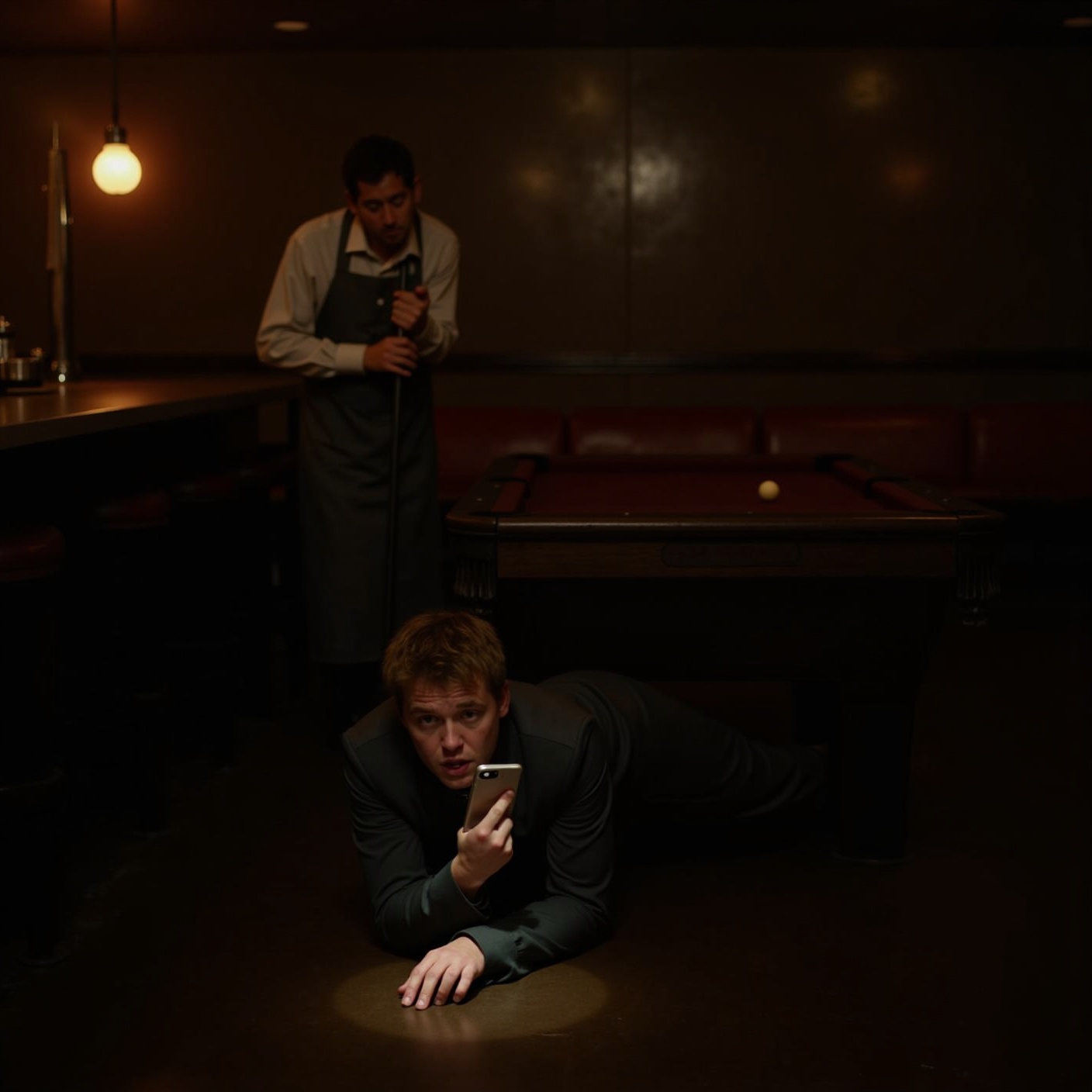
He turned that place upside down. He crawled under a pool table with a phone flashlight while the bartender watched him with an expression James still remembers, because it was not annoyance. It was pity. He came back the next morning, sober, hands not entirely steady, and asked the man mopping the floor if anything had turned up. He called twice more that week.
Then he stopped calling. Because a grown man who calls a bar three times about a lost wallet has to eventually sit with the fact that he was in that bar three nights in a row, and the nights before that, and most nights that year.
That was the week the ground gave out under him, which is a thing people say like it’s bad. He quit drinking on a Tuesday. Not dramatically. He sat down on the curb in a parking lot with his head in his hands for something like forty minutes, and then he stood up and drove home and poured out what was in the cabinet, and that was the last of it.
He went back and finished the degree he’d abandoned at twenty-two. He got a job that was beneath him and then a job that wasn’t. He learned to cook three things well. He met a woman named Dana who never met his father and only knew him through the way James’s voice changed when he talked about him, which was, she said, the way people talk about a country they left as a child.
He never got the photo back. He accepted that the way you accept weather. Some things you lose and you just carry the shape of the empty place around with you, and after a while the shape is so familiar it’s almost company.
Seven years later, on a Saturday morning in April, his phone rang. Unknown number. An area code from a town he hadn’t lived in since he was twenty-five.
“Is this James?” a man said. “You don’t know me. My name’s Kevin. I own the bar on Third now, the one that used to be Danny’s.”
James stood very still in his own kitchen.
“We’re gutting the place,” Kevin went on. “Redoing the whole floor. And today I pulled one of the booths off the wall, and there was a wallet down in the gap between the bench and the baseboard. Looked like it’d been there a while.”
“Okay,” James said. It was the only word available to him.
“Your license was still in it,” Kevin said. “Expired, obviously. Took me about an hour on the internet to find you. I hope that’s not weird.”
James asked him one question, and he asked it carefully, the way you’d carry a full cup across a room.
“Is there anything else in it?”
There was a pause on the line. James heard a saw start up somewhere and stop.
“Yeah,” Kevin said. “There’s a picture.”
The drive was two hours and forty minutes and James does not remember any of it. He remembers gripping the wheel. He remembers that he did not turn the radio on, not once, the whole way. He remembers pulling into a gravel lot behind a bar he had spent the worst year of his life inside, and thinking that the building looked smaller than it had any right to look.
Kevin was standing by the door in a T-shirt gray with drywall dust. He had the wallet in his hand already. He didn’t say hello. He held it out, and then he pulled it back an inch, and he said one thing first, quietly, like a man who had already looked and knew exactly what he was handing over.
“You should sit down before you open it.”
James sat down on the bumper of his own car, in a gravel lot, at eleven in the morning, and opened a wallet he’d last held when he was a different person.
The forty dollars was still there. The sandwich punch card was still there, four punches from a free sandwich at a restaurant that no longer existed. The leather had gone stiff and the license had curled at one corner.
And behind the license, folded flat exactly the way he’d left it, was a man squinting into the sun at a rest stop off I-70, holding a styrofoam cup of coffee, one sleeve rolled to the elbow, giving his son half a smile.
James looked at his father’s face for the first time in seven years. He was thirty-one years old. His father had been forty-eight in that photograph, and James understood, sitting on a bumper in a gravel parking lot, that he was now closer to that man’s age than he had been to his own age the night he lost him.
He didn’t say anything for a long time. Kevin stood there and let him not say anything, which was the kindest thing anyone had done for him in years.
“I almost threw it out,” Kevin admitted eventually. “It was full of dust and it smelled like a basement. And then I opened it, and I saw the picture, and I thought, somebody’s looking for this.”
Nobody was looking for it. That’s the part James still can’t get past. He had stopped looking seven years earlier. He had made his peace, built a life, told himself the story where the photo was gone and that was simply the price of the man he used to be.
And the whole time it was six inches behind a bar booth, in the dark, waiting for someone to take the wall apart.
He had it scanned that same week. It’s on his phone now, and on Dana’s phone, and printed and framed on a shelf in the hallway where you see it on the way to the kitchen. His daughter is two. She points at it and says “Papa,” which is not right, but nobody in the house is in a hurry to correct her.
James drove back down to Third Street a month later with a bottle of something good, and then remembered halfway there that he doesn’t drink and Kevin was working, so he brought coffee instead. Two gas-station coffees, in styrofoam cups.
Kevin got the joke about four seconds after he took the lid off.