
It is four and a half millimeters across. Put it on your fingertip and you would have to look twice to find it. It has no brain, no heart, and no particular ambitions.
And it does not die of old age.
The accident in the tank
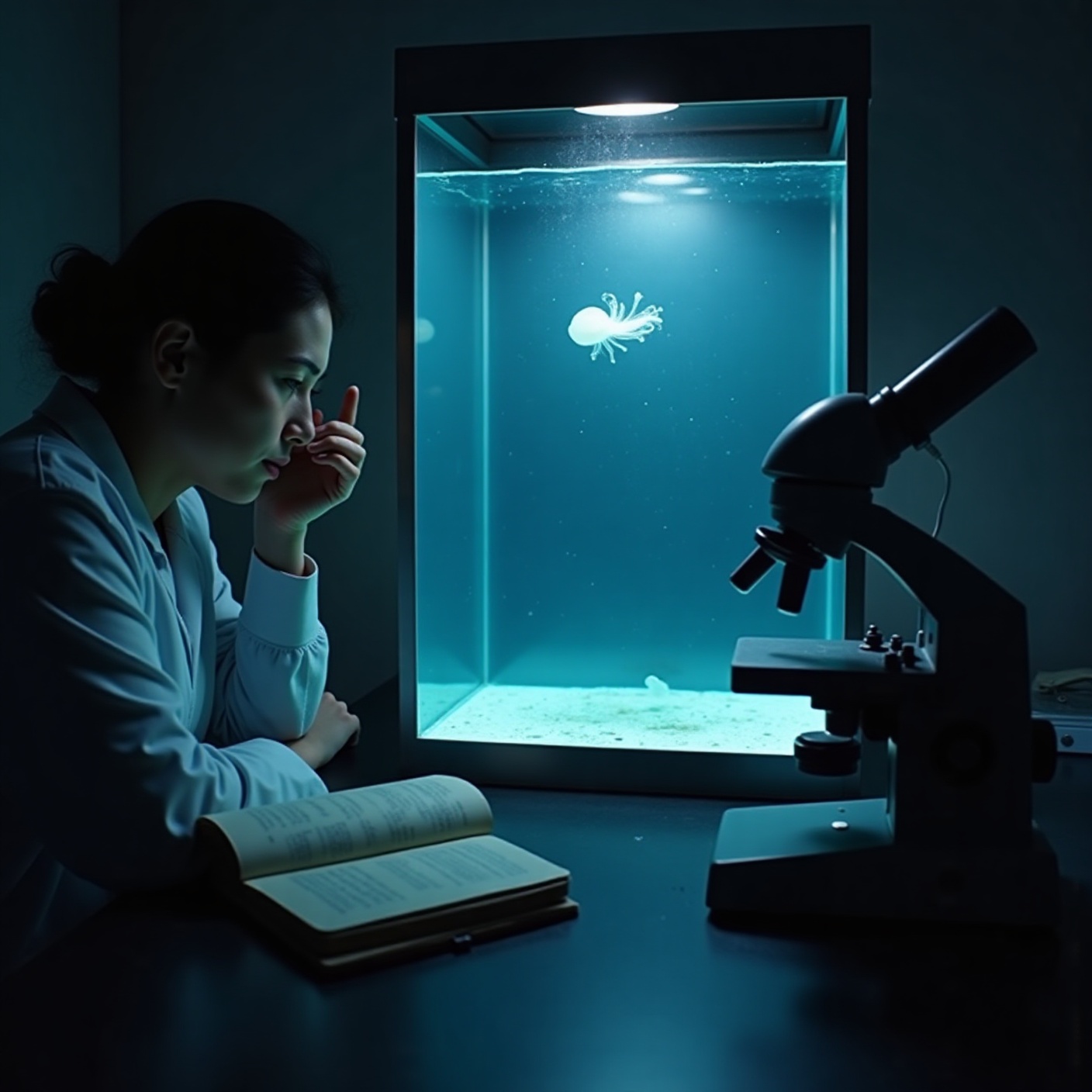
The 1980s. Two researchers, working the unglamorous end of marine biology: keeping small jellyfish alive in a laboratory tank so they can be observed through a full life cycle. Giorgio Bavestrello at the University of Genoa. Christian Sommer at Ruhr University Bochum.
The life cycle of a jellyfish is one of the tidiest arrangements in the animal kingdom, and it only runs one direction.
You begin as a polyp. That’s the stage nobody photographs: a little stalk anchored to the seafloor, unimpressive, quietly getting on with things. In time the polyp buds off a medusa, and the medusa is the jellyfish you know from the beach, the drifting translucent bell. The medusa grows, reproduces, and then it dies. That’s the deal. Every jellyfish that has ever existed has taken that deal.
The animals in that tank did not take the deal.
An adult under stress would stop swimming. It would sink to the bottom and pull itself in, its bell collapsing, its tentacles retracting, the whole elegant structure folding down into a formless little lump on the glass.
And then the lump grew back into a polyp.
Not a corpse. Not the remains of one. A polyp. The beginning of the story. A biologically juvenile animal, sitting there ready to run the entire cycle again from the top.
The name
The species is Turritopsis dohrnii, and the nickname it has picked up is the immortal jellyfish.
That word needs a fence around it, so here’s the fence: it can absolutely be killed. Something eats it. Disease takes it. Conditions turn against it. It is not invulnerable and it is not eternal in any practical sense.
What it doesn’t do is die of being old. Age, for this animal, is not a one-way arrow. That is what “biological immortality” means, and T. dohrnii is the animal biologists reach for when they need to explain it.
How it actually works
Here is the part that ought to be more famous than it is.
Your cells are committed. A muscle cell in your arm made its decision a long time ago and it will be a muscle cell until it dies. Same with a nerve cell, a skin cell, a liver cell. That commitment is the entire architecture of a complex body. It is also, in a sense, the trap: specialization is a door that locks behind you.
Turritopsis dohrnii has a key.
The process is called transdifferentiation. A fully specialized adult cell in that collapsing jellyfish does not simply die and get replaced. It de-commits. It abandons its identity and transforms into an entirely different cell type. Muscle becomes something that is no longer muscle. The body doesn’t rebuild itself from a reserve of stem cells the way you might expect. It reassigns the cells it already has.
This is not a hopeful interpretation of a blurry observation. Researchers confirmed it with electron microscopy, watching the cellular changes directly, and by studying DNA-replication patterns through the reversal. The animal is genuinely rewriting what its cells are.
The rebuilt polyp then does what polyps do: it buds off a new medusa. A new, biologically young adult, carrying no accumulated age from the previous run.
And under the right conditions, it can do this again. And again. Nobody has found the ceiling.
Why anyone cares
An animal the width of a pencil eraser has become one of the more closely watched organisms in aging research, and the reason is not sentimental.
We are aging animals whose cells are locked into their jobs. Our tissues wear out and do not come back. Everything we call growing old is, at bottom, a cellular story, and here is a creature whose cells simply decline to participate in that story.
So the labs are studying it. Not because anyone seriously expects a person to fold up and regrow as a toddler, but because T. dohrnii has demonstrated that the door is not necessarily locked. A committed adult cell can, under some circumstances, become something else. That’s not a metaphor. It happened in a tank in the 1980s, and it is happening in the Mediterranean right now, in animals too small to see.
Two scientists set out to raise a jellyfish and could not get it to finish dying.
Forty years later, we’re still trying to work out what it knows.