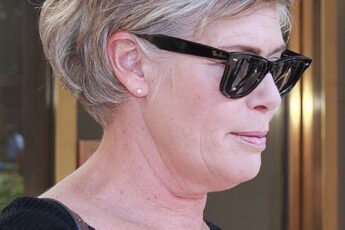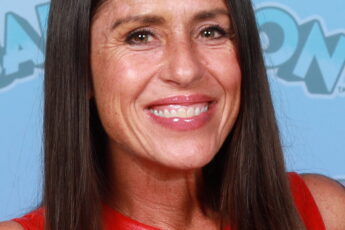
Everyone remembers the hat. Big floppy brim, a fabric flower stuck on the front, worn by a teenager who talked straight into a camcorder about her brothers, her dad, and whatever was wrecking her week.
“Blossom” showed up on NBC as a pilot preview on July 5, 1990, came back as a midseason replacement on January 3, 1991, and ran five seasons. Mayim Bialik played the title character the whole way through. The last episode aired May 22, 1995. She was in it.
That detail matters, because the story people tell about her usually starts with a walk-off that never happened. She didn’t storm out of a hit at its peak. The show reached its end, the sets came down, and a nineteen-year-old was standing in a parking lot with a famous face and a decision to make.
What she walked away from wasn’t the show. It was the career.
Because the offers were there. They always are for a kid who spent five years in living rooms across the country. The industry move is obvious: a pilot, a guest arc, something to keep the name warm while everyone decides whether you grew up right.
She had also applied to colleges. Harvard said yes. Yale said yes. She said no to both, and the reason was almost aggressively unglamorous: she didn’t want to move to the East Coast, away from her parents.
So she went to UCLA, which had held a deferred acceptance for her while she was busy being Blossom Russo.
Picture the first few weeks. Lecture halls of three hundred, and a chunk of them turning around to look at the girl from the hat show. That never fully stopped. What did stop was any advantage it gave her, because an exam does not care that you were on television.
She found the thing that got her almost immediately. “I specifically fell in love with the action potential and the electrical properties of the neuron when I was in my first semester at UCLA,” she told Brain & Life. The action potential is the spike of voltage that races down a nerve cell. It’s the smallest unit of a thought, and she fell for it in a freshman lecture.
“I love understanding the way we think and feel and communicate, and neuroscience is the science of all that,” she told the same magazine.
In 2000 she took a Bachelor of Science in neuroscience, with minors in Hebrew and Jewish studies. UCLA’s own alumni page files her under the shorthand every Bruin gets: Mayim Bialik ’00, PhD ’07.
Seven years sit between those two numbers, and she spent them in graduate school.
Here’s the part almost nobody who repeats “she has a PhD in neuroscience” can actually tell you: what the PhD was on.
Her dissertation was titled “Hypothalamic regulation in relation to maladaptive, obsessive-compulsive, affiliative and satiety behaviors in Prader-Willi syndrome.” She wrote it under Dr. James McCracken, and it earned her a doctorate in neuroscience from UCLA in 2007.
Strip the title down and it’s a story about hunger.
Prader-Willi syndrome is a genetic condition, and it’s the most common known genetic cause of life-threatening obesity in children. The hypothalamus is a structure about the size of an almond sitting deep in the brain, and among its jobs is the one nobody thinks about until it breaks: telling you that you’ve eaten enough. In kids with Prader-Willi, that signal doesn’t arrive. They finish a meal and the body reports nothing. The hunger simply keeps going, and it comes braided together with obsessive, repetitive behavior and with real difficulty around affection and social bonding.
That was her research. Adolescents, a brain structure that won’t say stop, and the tangle of behaviors that grows around it. Not a celebrity’s honorary anything. A dissertation, an advisor, a defense, and a catalog record in ProQuest with her name on it.
She was never a hermit about it. In 2005, mid-doctorate, she stepped out from behind the microscope for a bit of acting work. It didn’t derail anything. She finished.
And when she finished, she thought she knew exactly what came next. She assumed she was headed for a professorship. She taught neuroscience for roughly five years, which is the actual, boring, honorable version of what a new PhD does. Her then-husband was still working on his master’s. There were two small kids.
Then came the least cinematic plot twist in the history of Hollywood comebacks.
“The true story is I was running out of health insurance, and figured if I could even get a couple of acting jobs here and there, and if it’s enough to get you your Screen Actors Guild Aftra health insurance, we would at least have insurance,” she said on ABC’s “Popcorn With Peter Travers.”
Read that again. She didn’t go back for the lights. She went back for the coverage. A woman with a doctorate in neuroscience did the math on her family’s health insurance and concluded that the cheapest way to get her kids covered was to take a few acting jobs and hit the union’s eligibility threshold.
A few acting jobs. That was the whole plan.
What she got instead was an audition for a sitcom about physicists.
Amy Farrah Fowler walked into “The Big Bang Theory” in the season three finale, “The Lunar Excitation,” on May 24, 2010, invented by Howard and Raj as a cruel joke on Sheldon via a dating site. She was supposed to be a bit. She became a main character in season four and stayed until the show ended in 2019. Nine years.
And here is where the punchline everybody garbles finally lands correctly.
The joke is not that Bialik out-credentialed her character. She didn’t. Amy Farrah Fowler holds a PhD in neurobiology; the two of them are, on paper, colleagues. That’s the sitcom’s own little in-joke, written after Chuck Lorre found out who he’d cast.
The joke is that on a set full of actors playing brilliant scientists, exactly one person had actually done it. Bialik is the only cast member of “The Big Bang Theory” with a real doctorate. Jim Parsons won four Emmys playing a theoretical physicist. The woman beside him was the one who had genuinely sat through the qualifying exams, run the study, written the four hundred pages and defended them in front of a committee that could have said no.
And she’d turned down Harvard to do it.
The girl in the hat went and got the real thing. Then her insurance ran low, and the real thing is what got her the job.