
Here’s a thought that has no business being true. Somewhere in an Australian gum tree, wedged half-asleep into the fork of a branch, sits an animal with fingerprints so close to yours that a trained expert, staring through a microscope, could not tell them apart.
It’s the koala. And it is the only creature outside of us and our fellow primates that carries them at all.
The discovery is fairly recent. In the mid-1990s, a biological anthropologist named Maciej Henneberg, working at the University of Adelaide, took a close look at koala paws and found something he wasn’t expecting. The pads were covered in the same fine ridges we have. Loops. Whorls. Arches. The whole vocabulary of a human fingerprint, printed onto a marsupial.
He kept going, right down to the level forensic scientists call the minutiae, the tiny individual spots where a single ridge splits or comes to an end. Even there, koala prints and human prints looked the same. Not similar. The same.
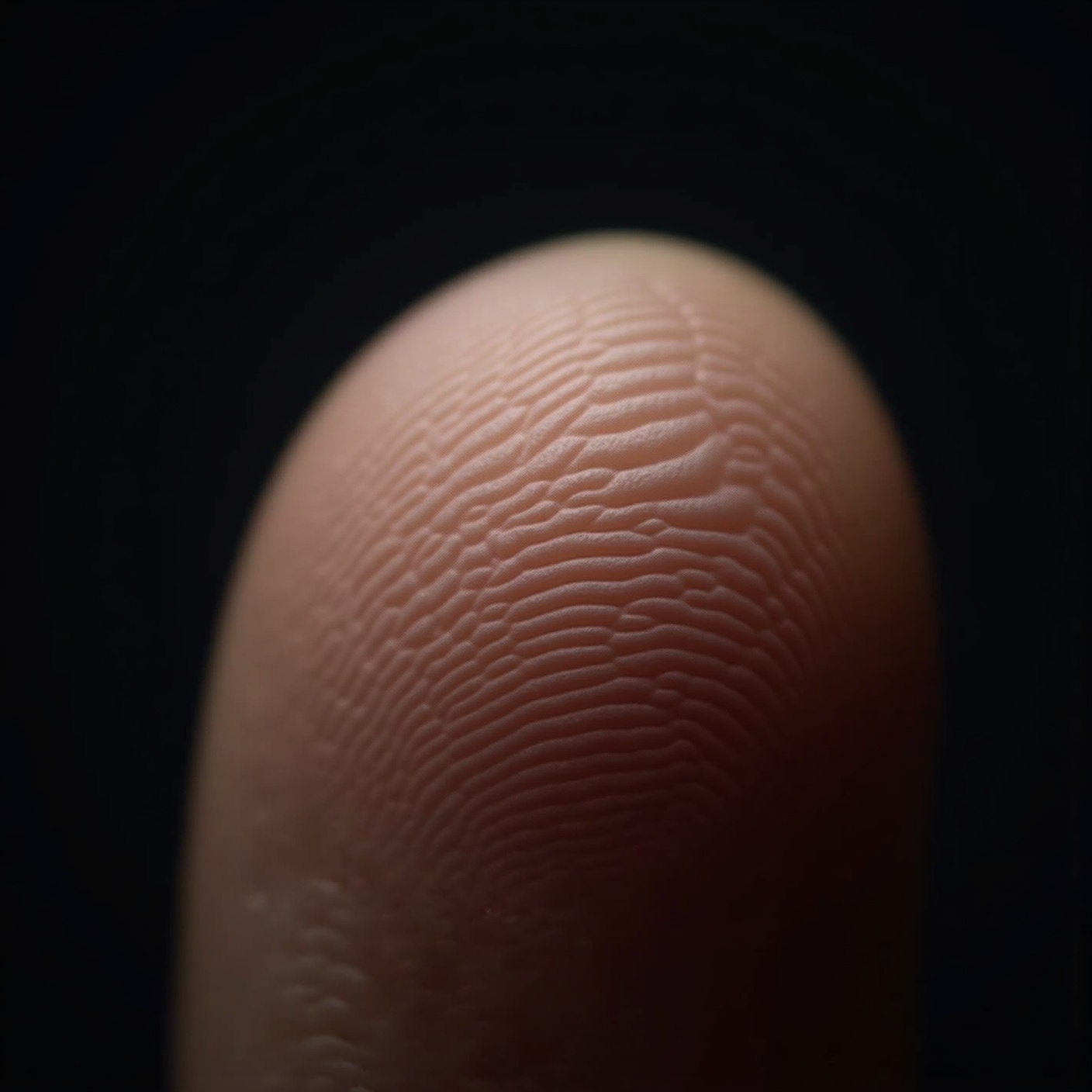
What makes it so strange is how alone the koala is in this. Its nearest relatives are the other marsupials, the wombat and the kangaroo, and they have nothing like it. Somewhere out on its own branch of the family tree, the koala grew a trait that all of its cousins skipped, and it landed on the exact same solution the primates did, tens of millions of years apart. Scientists have a name for that, convergent evolution, when two unrelated animals stumble onto the same answer to completely different questions.
So why would a sleepy leaf-eater need fingerprints in the first place?
The best guess comes back to breakfast. A koala’s whole life is a careful business of gripping. It spends its days climbing thin eucalyptus limbs and picking through them for the youngest, most tender leaves, sorting the good from the bitter by feel. Those fine ridges may be exactly what gives it that delicate, precise grip, the same way your own fingerprints help you hold a pencil or feel the raised edge on a coin. Grip and touch. That’s probably the whole reason.
And then there’s the part people love to repeat, usually with a grin.
Because koala prints are so nearly identical to ours, the idea goes, a koala could in theory throw off a crime-scene investigation, its handprint left on a windowsill and quietly fooling the fingerprint desk. Henneberg himself once raised the possibility, adding, dryly, that it was extremely unlikely a koala would ever turn up at a crime scene, but that police might as well be aware of it.
Before this hardens into a legend, it’s worth being honest about it. There is no record of it ever actually happening. No case has ever been thrown by a koala. The whole thing lives in the world of “could,” which is a fun place to visit but is not the same as true.
Still, the fact underneath it holds up just fine. The next time you press your thumb to your phone to unlock it, remember that a fuzzy, grumpy, eucalyptus-drunk marsupial on the far side of the planet is walking around with essentially the same thumb you just used.
So whose print would you rather have on file, yours or the koala’s?