
A pigeon walked up to the firefighters who gave it oxygen
It was a Wednesday evening in East Oakland, California, and the crew of Engine 29 had their hands full with a car burning down to the frame.
Anyone who has stood near a vehicle fire knows the scene. The paint blisters and peels. The tires let go with a sound like a slammed door. A tower of black smoke rolls up off the hood and drifts low across the pavement, thick enough to sting your eyes from thirty feet away. The E29 crew worked the hose, knocked the flames back, and kept an eye on the fuel line the way they’ve done a hundred times before.
Then one of them noticed something moving at the edge of the light.
A pigeon. Just an ordinary city pigeon, the kind you step around on a sidewalk without a second glance, grey with that oily green shimmer at the throat. It had come out of the smoke.
Here is the part that stopped the firefighters mid-motion. The bird did not do what a bird is supposed to do. It didn’t spook, didn’t scatter, didn’t beat its wings for the nearest rooftop. It walked. Straight toward the crew. One careful step after another across the wet asphalt, closer to the very people in helmets and heavy coats, as if it had decided that this loud, smoking, chaotic spot held the only help around.
The pigeon had breathed in the smoke too. You could see it in the way the little chest worked, quick and shallow, the beak parting for air that wasn’t coming easy.
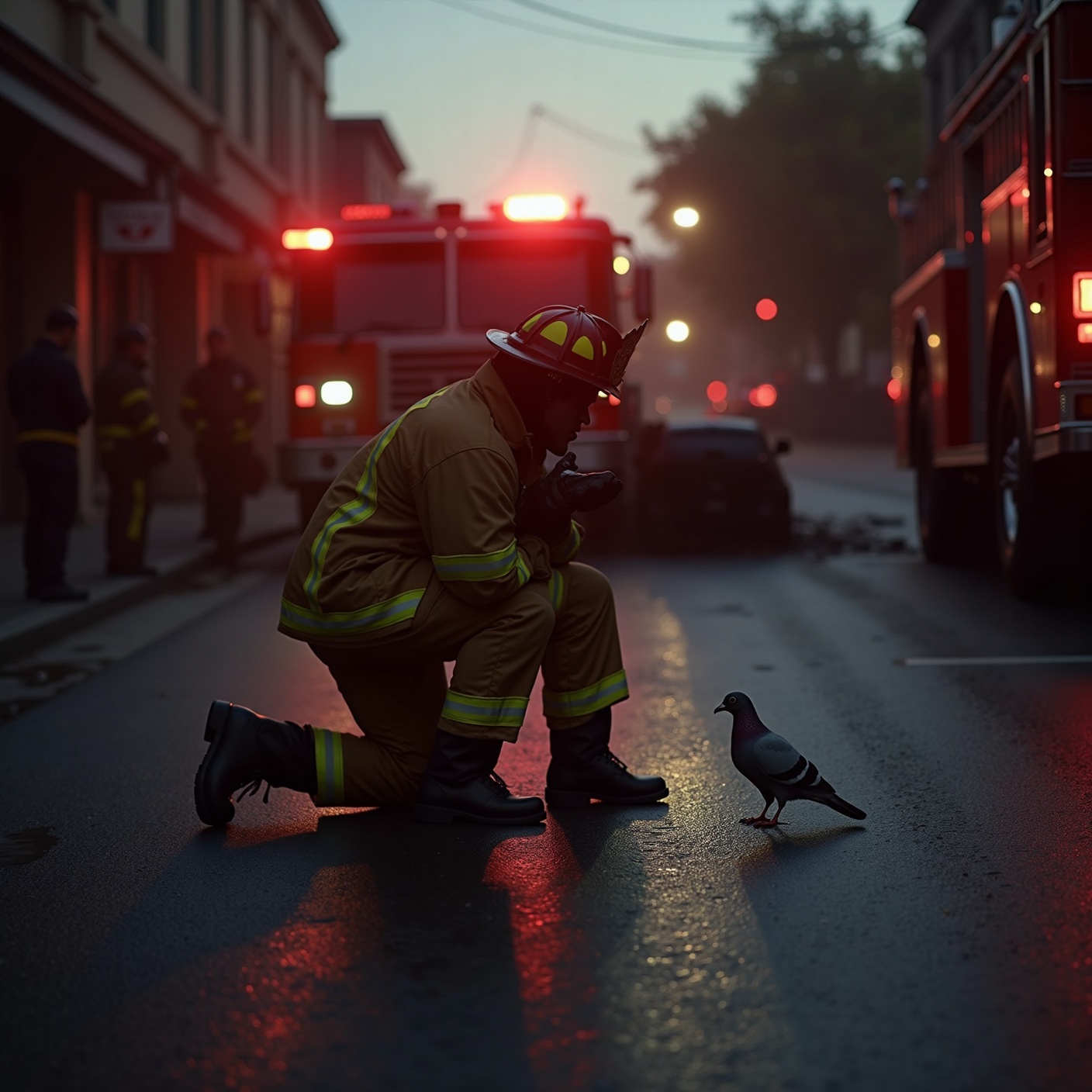
One of the firefighters knelt down on the pavement.
Fire departments all over the country now carry a small, odd-looking piece of gear for exactly this kind of moment: an animal oxygen mask. It’s a soft plastic cone, and it comes in a few sizes, made to fit over the muzzle of a dog, the face of a cat, or the beak of something no bigger than a fist. A lot of departments got theirs donated through a group called Wag’N O2 Fur Life, and most of the time the kits sit in a compartment for months without being touched.
This was the moment it was made for.
The firefighter cupped the little mask and eased fresh oxygen toward the bird, letting it breathe. And the pigeon let him. It stayed put, that trusting stillness animals sometimes find, and pulled the clean air into its lungs while the fire crew crouched around it in a loose ring, waiting.
It didn’t take long.
The bird’s breathing settled. The head came back up. And then, in front of everyone, the pigeon did the thing it hadn’t been able to do a few minutes earlier: it opened its wings, pushed off the pavement, and flew away into the evening.
“The bird soon flew away after clearing out its lungs,” the Oakland Firefighters Local 55 page wrote when they shared the story. Their account of it is plain and kind. “The crew reported, the pigeon came up to them seeking help. The bird seemed to have suffered some smoke inhalation during the East Oakland vehicle fire, so the crew administered some oxygen.”
The internet, once it got hold of the photos, did what the internet does with a story like this. But one comment cut through the rest, and it’s hard to argue with. Pigeons live closer to us than almost any wild bird, generations of them raised in the shadow of people, and maybe that’s why this one knew where to go. As the commenter put it about the firefighter and the bird in his hands: “The trust that pigeon has for him. It knows the man is a life saver.”
A crew showed up to put out a fire. They ended the night having saved something no one dispatched them to save, a common grey bird that walked out of the smoke and asked. And they stopped, and they helped, and they watched it fly.