
For six years Kayla was the only person in Daniel’s family who wasn’t in the family group chat, and the strange thing is she had stopped minding. She told herself it was logistics. They coordinated rides to his mother’s, they argued about whose turn it was to bring the ham, and she heard the important parts secondhand from Daniel in the car on the way home. That was the story she lived with. Six years is a long time to live with a story.
So the night he finally added her, she actually teared up a little over a pot of pasta water. He did it at the kitchen table without any ceremony, thumbs moving, not looking up. “There,” he said. “You’re in. Six years late, but you’re in.” Then he gave her that quick, real smile of his, and something under her ribs she hadn’t known was clenched came loose.
The welcomes landed while she was draining the noodles. His sister Paige sent a row of hearts. His aunt sent a thumbs up. Her phone felt warm in her hand, like it had been let into something.
She opened the chat to say thank you. And she noticed, the way you notice a step that isn’t where you expected it to be, that the conversation didn’t start with her welcome. It scrolled up. And up. She put the colander down.
Across the table Daniel’s phone buzzed. He glanced at it, and she watched his face do something she had never once seen it do in six years. It went white and still all at once, the way skin goes when a person stands up too fast. “Kayla,” he said, and his voice had changed. “Kayla, wait, that’s the—”
But she was already scrolling, and she did not stop, and she did not say a word.
The chat was called “Family.” Just that. It was six years old. The first message was dated four days after the wedding, it was from his mother, Linda, and it was about her. So was the one under it. So were, she would come to understand over the next hour, most of the four hundred that followed.
She read the way you read something you already know is going to hurt and can’t put down anyway. “Did anyone else think the dress was a little much for a second marriage?” That was message one. Kayla has never been married before, and Linda knew that. Message forty was about how she’d “let Daniel” repaint the hallway. Message ninety was a photo of a casserole she’d carried to Easter, captioned, “I didn’t have the heart to tell her.” There was a note about her job. A note about her laugh. Six years of a woman deciding, out loud, patiently, in front of everyone, that her son had married beneath himself.
And everyone was in the room for it. Paige. The aunt. Linda’s sister up in Erie. Daniel. Her husband’s name, sitting in that chat, for six years.
She looked at the top of her screen. There were two chats there now. The one she was reading, “Family.” And a brand-new one, “Family ❤️,” with a little red heart, created that same afternoon at 3:47. She understood it the way you understand bad news the half-second before someone actually says it. The one with the heart was hers. It had been built that day so she could finally be “in the family chat” and never, ever see this one. He’d meant to add her to that one. His thumb had slipped by a single line.
“Give me the phone,” Daniel said, and he wasn’t ordering her, he was begging, his hand open across the table between the salt and the bread. “Please. Let me be the one to explain it. It’s not what—”
“I’m reading,” she said. That was all. She carried her plate and her phone into the bedroom and shut the door, and she read four years back before she came out. By the time she did, everyone in that chat had gone silent, because they’d worked out what had happened too.
Here is what she did not do. She did not scream. She did not screenshot a single message, though her thumb hovered over the button for a long minute. She did not post six years of grievances to her own page. She did not call her mother. She didn’t even cry the way you’d think.
What she did was stop going to Sunday dinner.
The first Sunday she said she had a headache, which was true. The second Sunday she said she had a deadline, which was not. The third Sunday she said nothing at all. She stayed home and repotted a fern and let Daniel drive to his mother’s by himself, and when he asked, carefully, whether she was coming, she told him, “Not this week,” in a voice so pleasant it scared him more than yelling ever could have.
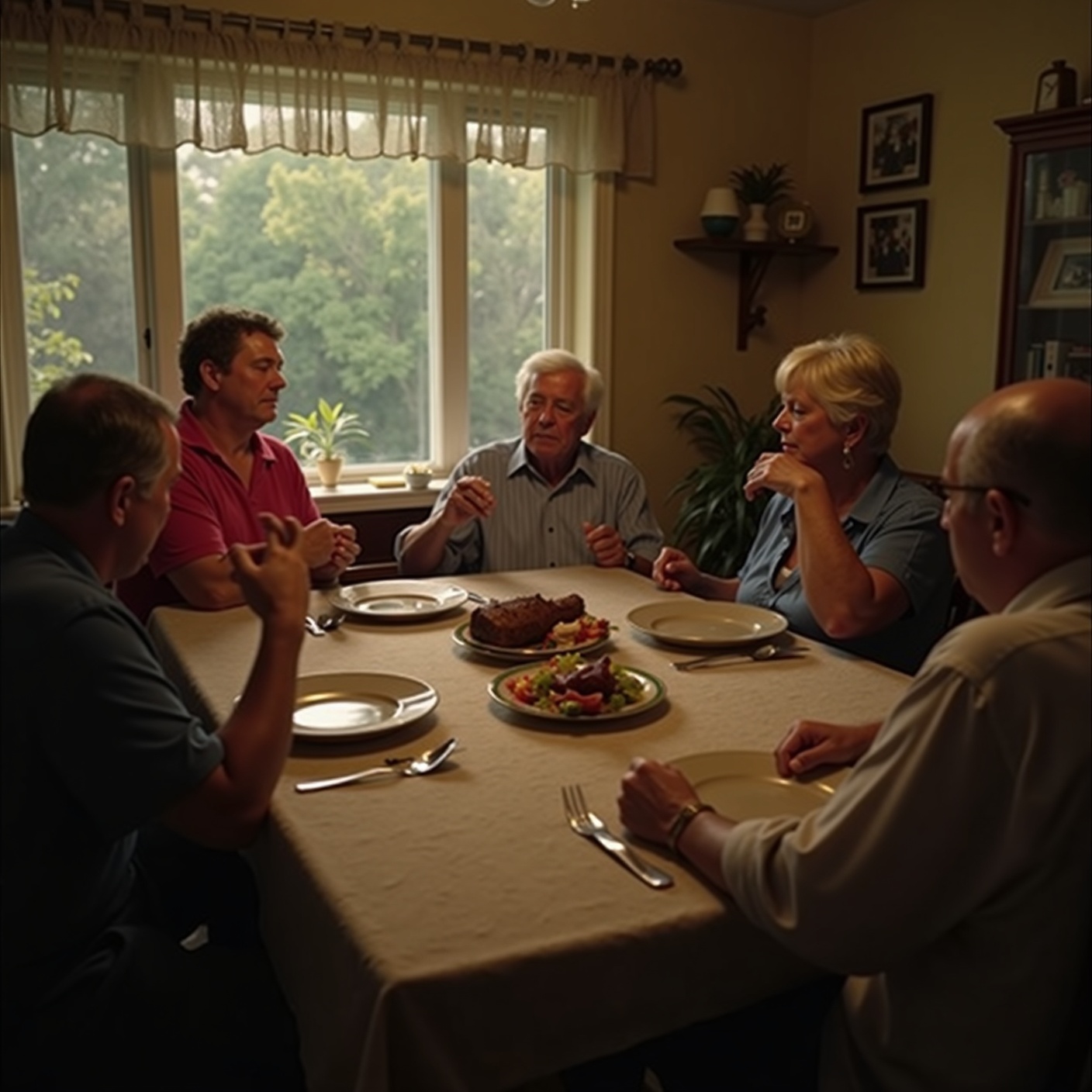
It took Linda about a month to panic. The casseroles started coming the other direction. Paige texted, “Is everything okay?? We miss you at the table.” Linda called the house phone, the one nobody uses, and left a message asking whether she had “done something.” Kayla was unfailingly warm to every one of them and gave them absolutely nothing, and nothing, it turns out, is the loudest thing you can hand a family that has spent six years talking about you behind a wall.
Daniel came apart slowly. He didn’t know how much she’d actually read. He’d watch her set the table, open his mouth, close it again. He stopped sleeping right. Twice she woke at midnight to find him out on the porch, typing.
It was a Tuesday, five weeks in, when he finally sat down across from her at that same kitchen table and set his phone face-down between them like a man laying down a weapon. “I have to show you something,” he said, “and after you see it you can walk out the door if you want. But I’m not going one more day letting you think I sat in that room for six years and said nothing.”
He turned the phone over and started to scroll, slowly, from the very beginning. And he read them out loud to her. Not his mother’s lines. His.
Because under nearly every one of them, there was an answer. She had missed it the first night. She’d read that chat at one in the morning with her whole body shaking, and she’d seen his name and assumed the single worst thing a person can assume, that he had sat there and let it happen. She read it wounded. She never read it right.
“The dress was perfect and you know it, Mom.” That one was the fourth day of the marriage. “Do not send me pictures of her food again.” “She got that promotion because she is good at what she does. Say that back to me.” “You will not talk about my wife like this in front of the family. I mean it, and I won’t say it nicely next time.” The first couple of years he’d been quieter, a word here and there, keeping a peace she never knew was being broken over her head. And then somewhere around year three the quiet just stops on the screen, and it turns into him, every single time, week after week, four years of a man planted in a doorway his wife was never supposed to walk through, refusing to let anyone past.
“I couldn’t make her stop,” he said, and his voice cracked on the word. “So I made sure she was never once alone in there with it. That was the only thing I knew how to do. And I figured if I ever told you, all you’d hear was that I stayed. I didn’t know how to turn it into a good thing. It isn’t a good thing.” He laid his hand flat on the table. “I should have left that chat and burned the whole thing down for you six years ago. I know that. I just kept telling myself I could win it.”
She looked at the two chats stacked at the top of her screen. “Family,” where her husband had been quietly at war on her behalf for four years. And “Family ❤️,” the pretty, empty room he’d built in an afternoon so she would never have to know about the war or the reason there was one. He’d wanted to hand her the heart and carry the rest alone. His thumb had slipped by one line, and it had handed her the whole of it.
She still doesn’t go to Sunday dinner. That’s a separate conversation, one she and Linda are having very slowly now, in person, with the phones face-down on the table. But she did read that chat one more time, all of it, start to finish, in daylight, with Daniel sitting next to her. It reads differently when you aren’t bleeding. Four hundred messages. Her name is in almost every one of them, in two different hands, and only one of those hands ever meant it as a wound.