
The first thing Ellen remembers is a hand closing over hers, and a voice telling her she was not going anywhere.
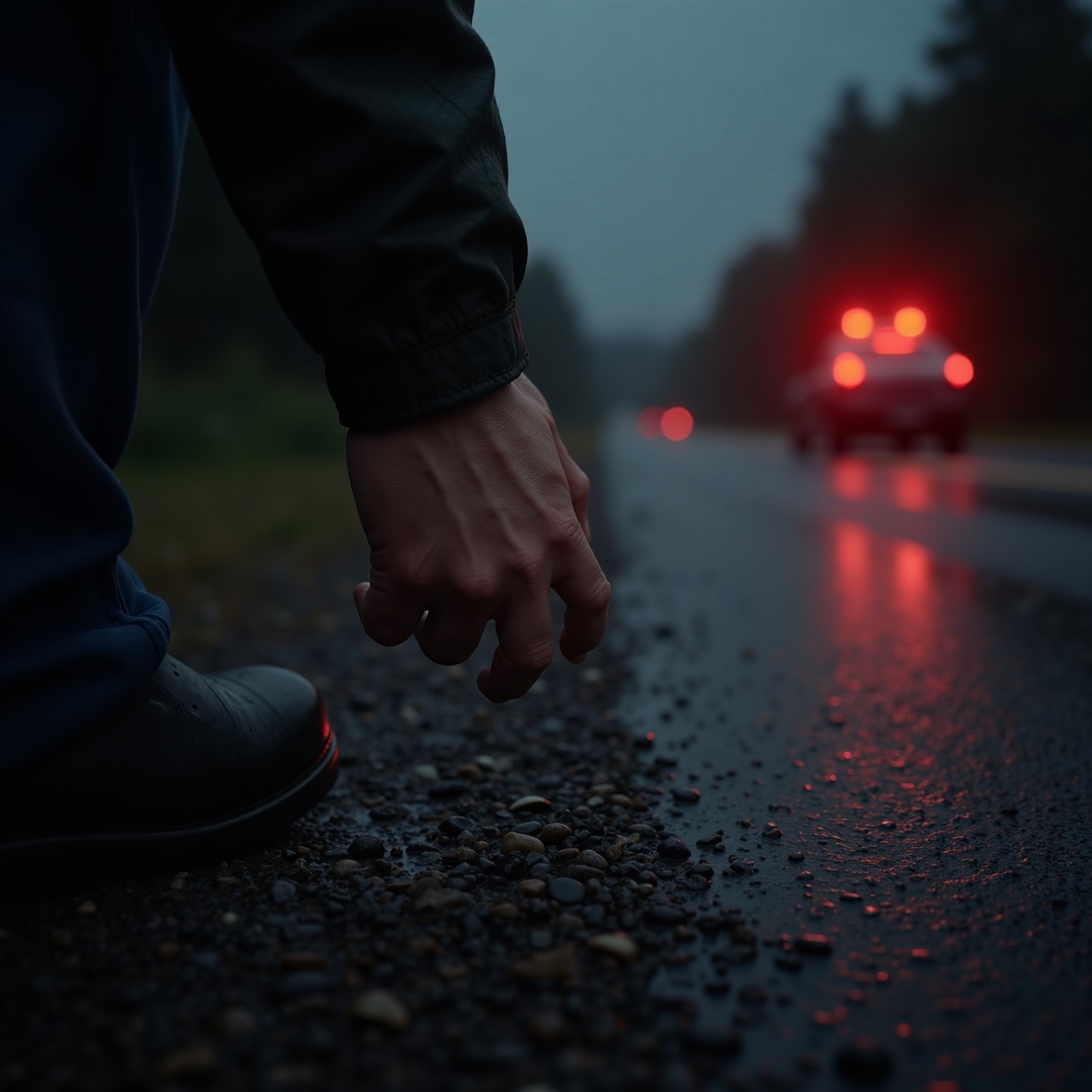
She was seventeen. It was a wet Thursday night on the county highway, the kind of dark two-lane road where the trees come right up to the shoulder, and her car had left it.
She doesn’t talk about the rest of that night, even now. What she keeps, what she has always kept, is the part that came after. Metal, then a strange quiet, then a stranger on his knees in the wet gravel beside her, reaching in, taking her hand.
“Look at me,” he said. “You hear me? You’re not going anywhere. Help is coming. Just keep looking at me.”
So she did. She looked at him. She couldn’t have told you his height or his coat or the car he’d climbed out of. But she could have drawn his eyes for you thirty-five years later, and in a way she did, a hundred times, in the dark behind her own eyelids.
He stayed. That’s the thing she never got over. He didn’t call it in and drive off. He knelt in the cold on the side of a road for a girl he’d never met and he talked to her the whole time, steady and low, about nothing, about anything, until the red lights came sweeping around the bend.
And then the night filled up with people. Uniforms, a stretcher, a paramedic asking her name. Somebody eased her hand out of his so they could work. And in the noise and the moving and the doors slamming shut, the man simply stepped back into the dark and was gone.
She never got his name. Nobody had it. In all the reports and all the forms, there was no passerby, no witness who stayed. The medics had been focused on her. For a long time she half wondered if she’d invented him, the way a person going under invents a hand to hold.
But you don’t invent eyes like that. She knew he’d been real. She just had no way on earth to find him or to thank him.
You can’t live through a night like that and come out the same. Ellen came out of it pointed in one clear direction. She trained as a nurse. She turned out to be good at the part nobody teaches, the sitting-with, the holding-on, the being there when someone is frightened and the machines are beeping.
In her forties she took over a small care home on the edge of town. Twenty-some residents, most of them near the end, a lot of them scared in the same way that girl on the highway had been scared. Ellen made it her whole life to be the person in the room who says, “You’re not going anywhere alone. I’ve got you.”
She never once connected the dots out loud. It was just who she’d become. She spent thirty-five years quietly paying back a debt to a man she was certain she’d never see again.
It was an ordinary Tuesday in the spring when they wheeled the new resident through the front doors.
An elderly man, frail, thin as a coat on a hook, a blanket over his knees. His daughter walked beside the chair with a folder of paperwork and that apologetic, exhausted look families get. Ellen came around the desk to greet them the way she greets everyone, warm, unhurried, a hand already out.
And then the old man lifted his head and looked at her.
She stopped where she stood.
She knew those eyes. She had known them for thirty-five years. Older now, cloudier, folded into a face full of lines she’d never seen. But unmistakably, impossibly, the same eyes that had held her to the earth on the worst night of her life.
It couldn’t be. She told herself it couldn’t be. Do you have any idea how many pairs of eyes a person passes in fifty-two years?
But her hands had gone cold, and her heart was doing the thing it hadn’t done since she was seventeen.
She looked down at the folder on the desk. A first name she had never known. Walter. And an address out on the far side of the county, the same side her road had been on all those years ago.
She crouched down beside his chair, the way she does with the frightened ones, and she made herself ask it plainly.
“This is going to sound strange,” she said. “A long time ago, a very long time, there was a girl in a car wreck out on the county highway. A man stopped and stayed with her until the ambulance came. He held her hand the whole time.” Her voice wasn’t quite working. “Was that you? Please. Was that ever you?”
The old man studied her face for a long moment. Something moved behind those eyes, a light coming up in a window at the far end of a hall.
“Raining that night,” he said slowly. “She was so scared. I kept telling her to look at me.”
Ellen put her hand over her mouth.
“I always wondered what became of that girl,” Walter said. “They took her away and I never knew. I’ve thought about her for years.”
“She’s fine,” Ellen said, and now she was crying and laughing at the same time, the way you do when thirty-five years lets go of you all at once. “She’s right here. She grew up. She’s been looking for you her whole life.”
She took his hand the way he’d once taken hers.
“You’re not going anywhere alone,” she told him. “You hear me? I’ve got you now.”
Walter spent his last two years in Ellen’s care home. She sat with him in the evenings when the place went quiet and the hallways dimmed. She was in the room, holding his hand, when it was finally his turn to be the frightened one.
She never did get to repay him, not really. You can’t. But for two years, the girl he’d saved on the side of a dark road got to be the one who stayed. And when people ask her why she does the work she does, she tells them the truth, which sounds like a made-up story and isn’t.
A stranger once refused to leave her in the dark. She’s been paying it forward her whole life. And one Tuesday in spring, life let her pay it back to the exact man himself.