
Ray Delgado had walked the same three miles of Route 12 for fourteen years, and in that time he’d learned to read a street the way some people read a face.
He knew which porch lights burned out and stayed out. He knew the Hendersons packed up for the lake every Fourth of July and the Nawabi twins raced him to the box for their comic books. And he knew, better than he knew his own phone number, that the woman at 214 Sycamore took her mail in the same day it came. Every day. Rain, heat, holidays, didn’t matter.
Eleanor Whitfield was eighty-two and sharp as a tack. Most summer afternoons she was already out on the porch when Ray came up the walk, a sweating glass of lemonade set on the rail for him whether he had time to drink it or not.
“You look thin, Raymond,” she’d say. She was the only person alive who called him Raymond. “You’re not eating right.”
“I eat plenty, Miss Eleanor,” Ray would answer, and she’d wave a hand like she’d heard that particular lie a hundred times before.
So on Monday, when he found Saturday’s mail still folded in the box, he only frowned a little. People visit. Her daughter Karen lived out in Denver, and every so often Eleanor flew out to spoil the grandkids for a week. Ray tucked the new envelopes in behind the old ones and kept walking.
Tuesday, the mail was still there. And now there was more of it, and a rolled newspaper lying yellowed on the front walk where the paperboy had thrown it.
That one sat wrong with him the whole rest of the route. Eleanor didn’t even take a paper on Tuesdays.
Wednesday morning, Ray stood at the box at 214 Sycamore and did not put the mail in.
Three days of it now. Saturday, Monday, Tuesday, packed in tight, and two papers gone soft on the walk. The curtains in the front window were drawn shut. And behind them, in the full light of a July morning, a lamp was burning.
He could have kept going. He had two hundred more boxes ahead of him and a supervisor who timed the route with a stopwatch in his head. A younger carrier might have shrugged, figured the old lady was napping or off visiting, and moved on down the block.
Ray set his bag down on the step.
“Miss Eleanor?” He knocked. Waited. Knocked again, harder, until his knuckles stung. “Eleanor, it’s Ray. It’s the mail.”
Nothing came back. Just the hum of a window unit and, somewhere deep in the house, a television turned down low.
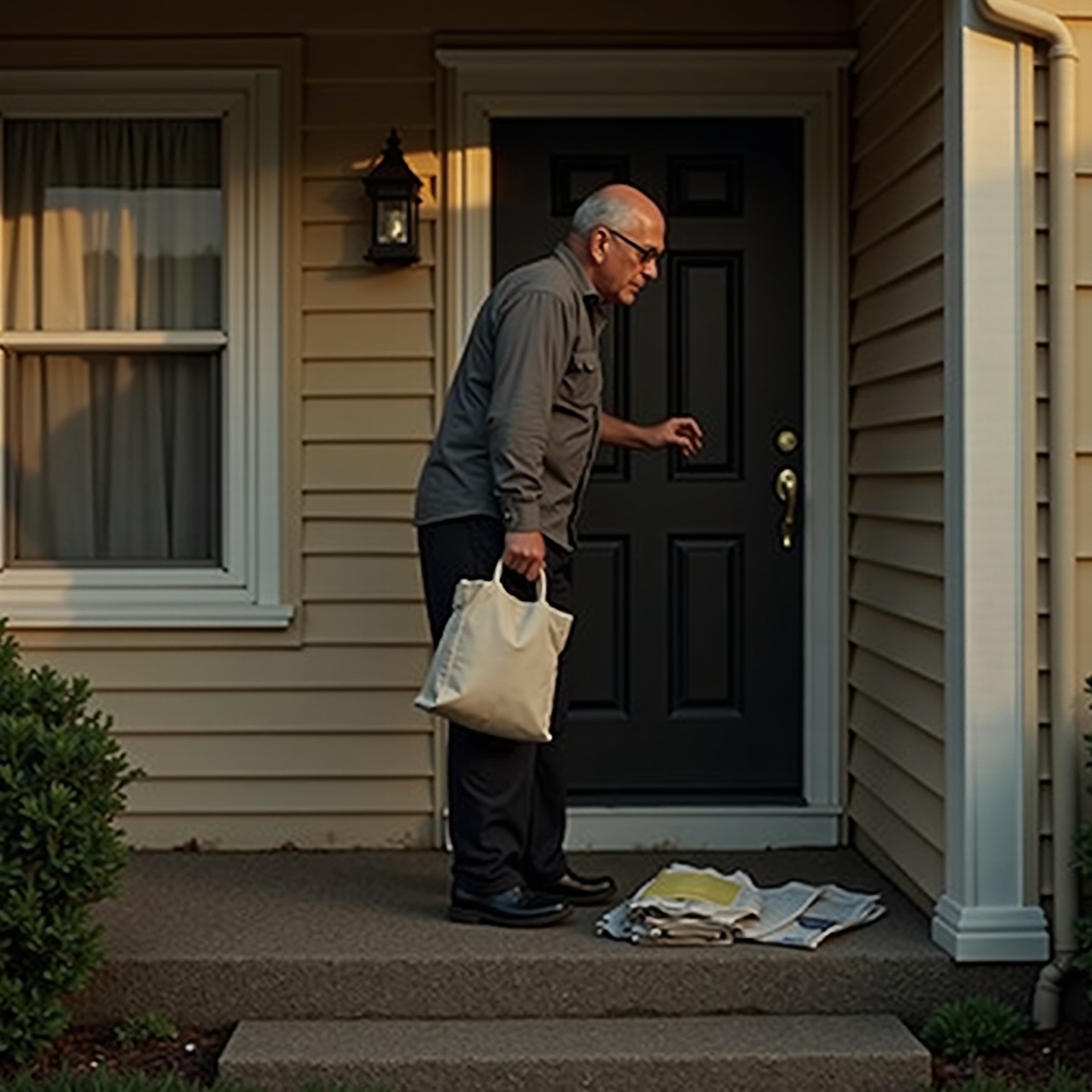
He went around the side, boots in her marigolds, and cupped his hands against the kitchen window. It took his eyes a second to cut through the glare off the glass. Then his stomach dropped.
She was on the floor. Down between the table and the stove, one arm flung out, not moving.
“Eleanor!” He slapped the glass with the flat of his hand. She didn’t stir. But then, faint, the fingers of that outstretched hand curled in on themselves. Just barely. She was alive.
Ray had his phone out before he’d finished the thought.
“Nine-one-one, what’s your emergency?”
“I’ve got a woman down inside her house, she’s elderly, she’s not answering me but I can see her moving a little,” Ray said, already jogging back around to the front. “214 Sycamore. Every door’s locked. She’s on the kitchen floor, I can see her through the window. Please, you’ve got to send somebody quick.”
“Sir, units are on the way. I need you to stay on the line with me.”
He stayed. He knelt down at the window and talked to her through the glass the whole time, loud and even, the way you’d talk to somebody you were trying to keep from slipping under.
“Help’s coming, Miss Eleanor. You hang on for me, you hear? You still owe me a lemonade.”
It felt like an hour. It was six minutes. The ambulance rolled up Sycamore with the siren already cut so it wouldn’t frighten her, and two paramedics were over the side gate and working the back door before Ray could so much as point.
What they found inside told the rest of it. Eleanor had gone down sometime Monday, they figured. A stroke had taken her legs right out from under her, and she’d been on that kitchen floor the better part of two days. Couldn’t reach the phone on the counter. Couldn’t call loud enough for anyone to hear over the rattle of the AC. Just her and the linoleum and the mail stacking up in a box out front like the one clock left in the world that was still keeping time.
One of the paramedics, a broad-shouldered kid named Tovar, stopped beside Ray on the way back to the rig.
“You the mailman?” Tovar asked.
“I am.”
“You’re the one noticed the mail.” It wasn’t quite a question.
“Three days of it,” Ray said. “She always takes it in the same day.”
Tovar looked at him for a beat, then back at the stretcher they were loading. “Another day on that floor and you and me aren’t having this conversation. You get what I’m telling you?”
Ray got it. He didn’t trust his own voice, so he just nodded and bent down and picked his bag back up off the step.
He finished the route that afternoon. Slower than usual. His supervisor never did hear about the eleven minutes he lost at 214 Sycamore, and Ray never once brought it up.
Eleanor spent three weeks in the hospital and a month after that in rehab, teaching her left side to trust her again. Karen flew in from Denver the first night and didn’t leave until her mother could walk her to the door.
It was nearly autumn before Ray came up the walk at 214 and found her back out on the porch. Thinner now, a cane hooked over the rail beside her chair, and a sweating glass of lemonade set out on the top step, waiting.
Taped to the glass was a note in a shaky hand he had to read twice.
“For the man who counts the days. — E.W.”
Ray drank the whole thing standing right there, in no hurry at all, while Eleanor watched him from her chair and pretended she wasn’t crying.
“You still look thin, Raymond,” she said.
“I know it, Miss Eleanor,” he said. “I’m working on it.”