There was a stretch in the early ’90s when you could not walk past a movie poster, a magazine rack, or a video store shelf without seeing her face. Big dark eyes, a pixie of dark hair, that half-smile that looked like she knew something you didn’t. Winona Ryder was maybe nineteen and already had “Beetlejuice,” “Heathers,” and “Edward Scissorhands” behind her. Kids taped her photo inside their lockers. Grown critics ran out of nice things to say.
She wasn’t just pretty on a poster, either. She could act. “The Age of Innocence” earned her a Golden Globe and an Oscar nomination. “Little Women” brought another one. “Girl, Interrupted” she helped get made herself, then quietly handed the showiest role to a newcomer named Angelina Jolie, who walked off with the Oscar. Winona didn’t seem to mind. She was the one who’d fought for the whole movie to exist.
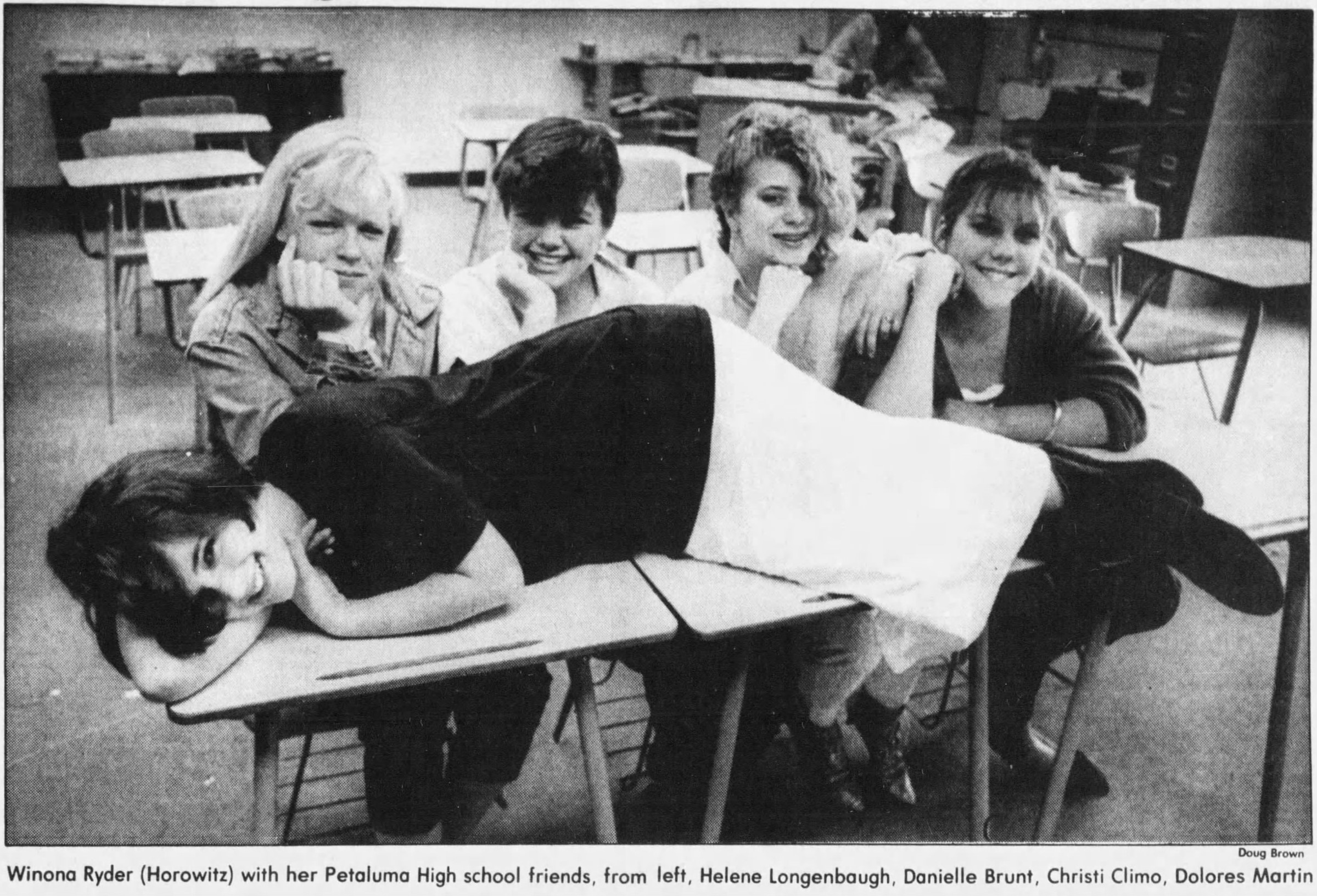
For a while it looked like the decade belonged to her. And then, almost as fast, the story turned.
On a December afternoon in 2001, she was stopped leaving a Saks Fifth Avenue in Beverly Hills with about $5,500 in designer clothes she hadn’t paid for. What followed wasn’t a quiet legal matter. It was a full-blown circus: photographers on the courthouse steps, late-night monologues, her mug shot on the front of every tabloid in the country. She was convicted of felony grand theft and vandalism, and given probation and community service.
Years later she still sounded a little stunned by how big it all became. The whole thing was “so surreal,” she told Esquire. She had been quietly struggling — depressed, overwhelmed, on painkillers prescribed for a broken arm. “I checked out,” she said. “I think I just checked out.” To Porter magazine she put it another way: “Psychologically, I must have been at a place where I just wanted to stop. It wasn’t what people think. And it wasn’t like the crime of the century.”
Here’s the part that gets forgotten, though. She didn’t spiral in public. She didn’t crash. She just… stepped back. The offers thinned out, and instead of clawing to stay famous, she let the quiet come. She read. She got interested in linguistics. She turned up for the odd small role and then went home. For most of a decade, one of the most recognizable young faces in America was mostly, deliberately, out of frame.
She’s talked since about how strange fame felt even at its peak — how it could be “incredibly isolating, dangerously so,” and how a big part of her only ever wanted to do good work without all the noise. “I don’t have any interest in being a movie star,” she said. Looking back in 2024, she admitted the scandal “definitely had a giant effect” on her career. She said it plainly, without a trace of self-pity.
Then, in 2016, a small show on Netflix asked her to play a frantic small-town mother whose son had vanished. Joyce Byers — flannel shirts, string of Christmas lights taped to the wall, a woman the whole town thought had lost her mind. “Stranger Things” became a phenomenon, and a generation of teenagers who’d never seen “Heathers” fell for the trembling, fierce mom at its center. Older viewers felt something else entirely: relief. There she was again.
The role brought her a Golden Globe nomination and, more than that, a way back that fit who she’d become. “I’m finally getting to play my own age,” she told Time, “and it’s liberating.” No longer the untouchable teenage it-girl. Just a very good actor, playing a real woman, on a show she carried for nine years, right through to its final season.
She never did chase movie-stardom again. It seems she didn’t have to. The quiet years gave her something the spotlight never had, and when the work came looking for her, it found someone steadier waiting. Some comebacks are loud. Hers was the opposite — she simply, finally, came home to it.