
The stroller rode around in the trunk of the Corolla for six days before Megan finally took it back.
It was a floor model, marked down twice, two hundred dollars even. The canopy snapped shut one-handed, which sounds like nothing until you have four-year-old twins. For four years she’d been pushing a hand-me-down double from a woman at church whose left front wheel shuddered so hard on pavement she steered the thing with her hip.
She brought it up on a Tuesday, in the careful voice she saves for money.
“Two hundred dollars,” Daniel said, thumbing through something on his phone. “For a stroller. Meg, we are stretched thin as it is.”
“They’re four,” she said. “That old one is going to dump them both in the street one of these days.”
“Then we tighten up somewhere else,” he said, and set the phone face down, which was how she always knew a conversation had ended.
So she tightened. Groceries were already a hundred and eighty a week for four people, which meant rice, store brand everything, and a running list on the fridge in her handwriting. Back in March she sold her own laptop, a five-year-old machine she’d bought with her own money in the years when she had her own money, for three hundred and ten dollars to a college kid in a Wendy’s parking lot. The three hundred and ten went into the furnace repair. She didn’t even resent it at the time, and that’s the part she’s had trouble forgiving. Not the money. The not resenting.
She’s thirty-three. Four years ago she was a benefits coordinator making fifty-two thousand a year, with her own chair, her own mug, a badge that opened the side door. Then the twins came six weeks early, daycare for two cost more than she cleared, and everyone agreed it made sense. Everyone meant Daniel, and Daniel’s mother Ruth, who said it at the hospital before Megan was out of the paper gown.
“You’ll want to be home with them anyway, sweetheart,” Ruth said, patting the blanket smooth over her knee. “A mother doesn’t get these years back.”
The customer service desk gave her the two hundred in cash. She folded it into the grocery envelope and pushed the shuddering stroller back out through the automatic doors, and one of the twins laughed at the sound the bad wheel made, and she laughed too, because what else.
The envelope came the following Thursday, between a seed catalog and a coupon flyer.
A bank envelope. Not their bank. She was sorting mail at the kitchen counter with a child hanging off each leg, and she’d already dropped it into Daniel’s pile before the return address caught up with her.
It was a 1099-INT. Interest income, reported to the IRS, on a savings account she had never heard of, at a branch thirty minutes north, in Daniel’s name and no one else’s. The interest alone for one year was five times what she got for her laptop.
She read it three times. The refrigerator hummed. Behind her a plastic dinosaur clattered off the table, and she heard herself say, “In a minute, baby,” in a voice that came out perfectly normal.
She said nothing that night. She said nothing the next night either.
Three days. She used all three.
On Friday she called her sister Kim from the driveway with the engine running, because she couldn’t trust her own voice inside the house.
“Forty-five what,” Kim said.
“I don’t have a number yet,” Megan said. “I have a tax form.”
“Get a number. Then get a lawyer, and I mean Monday, Meg, not eventually.”
“I’m not doing anything Monday,” she said. “I’m going to read every page of it first.”
Saturday morning, while the twins were down for their nap, she went out to the garage and opened the gray file tote under the Christmas bins, the one Daniel calls the paperwork tote and handles the way other men handle a toolbox. Third folder from the back. Paper statements, held together with a black binder clip, going back to March of 2021.
Six hundred dollars on the fifteenth of every month, moved over on payday. Every tax refund since 2021. Both of his bonuses. Four years of it, stacked, unbroken, not one skipped month, not through the furnace, not through the year they carried the pediatric dental bill on a credit card at nineteen percent.
Forty-five thousand, one hundred and change.
She drove to the library and printed the whole run at ten cents a page. Nine dollars and forty cents. She paid it out of the grocery envelope, and she caught herself noticing that, and something in her chest went very quiet and very level.
Saturday night she put the twins to bed, poured two coffees, and laid the statements out on the kitchen table in four rows by year. Then she sat down and waited.
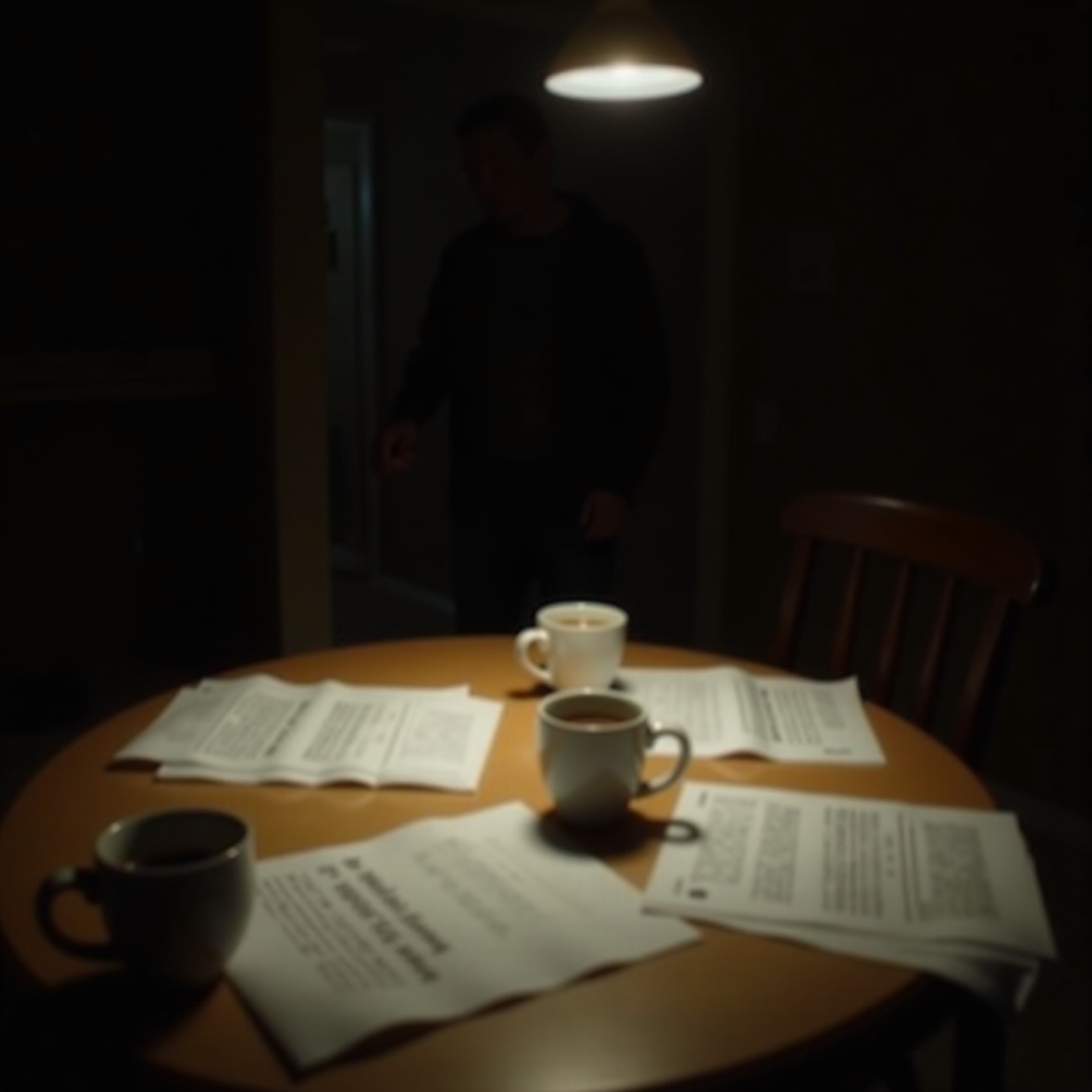
Daniel came in at ten past nine, keys in hand, and stopped in the doorway.
“What is this,” he said. It didn’t come out as a question.
“March 2021,” she said. “Two weeks after I came home from the hospital. That’s the first deposit.”
He didn’t sit. He looked at the table the way a man looks at a dog that’s gotten into something.
“You went through my things,” he said.
“You have a savings account with forty-five thousand dollars in it,” she said, “and I sold my laptop in a parking lot.”
“That’s not the same thing.”
“Explain to me how it isn’t.” Her hands were flat on the table. “I want to hear you say it out loud.”
And he said it. He said it the way you say a thing you’ve rehearsed so many times in your head that it comes out smooth.
“It’s not ‘our’ money, Megan. You haven’t brought home a paycheck in four years. I wanted one thing in this house that was mine.”
She didn’t answer him. She didn’t cry and she didn’t throw the coffee. She stood up and walked out to the garage, and to this day she can’t tell you why.
The tote was still open on the concrete where she’d left it.
Under the folder of statements was a manila envelope, soft at the corners, and inside it were letters. Ruth’s handwriting, the big looping kind they taught in the fifties. Nine of them, spanning years, all addressed to Daniel, none of them ever mailed. Ruth hands you an envelope at the door and watches you put it in your coat.
The one dated April 2021 was a single page.
“Danny. She has stopped working and she will not go back, they never do. Open something at another bank in your name only. Six hundred a month, off the top, before she sees the number. She will never miss what she never learns to count. A man needs one thing in that house that is his.”
She sat down on an overturned bucket and read it twice.
Under the letters was a shoebox, one of three Ruth dropped off in 2023 when she moved to the condo. Important documents, she called them. Under a stack of expired insurance cards was a passbook savings book from a bank that hasn’t existed since 1998. Opened April 1994. Ruth’s name. Seventy-five dollars a month, in ink, in her hand, month after month, for eleven years.
Folded into the back cover was a letter to her sister Dot, same looping hand, never sent.
“Walt will never know and it is not his business. A woman needs one thing in this house that is hers.”
The same sentence. The exact same sentence, thirty-two years apart, out of two different people’s mouths.
She carried the whole thing inside and set it on the kitchen table on top of the bank statements. The letters. The passbook. The one to Dot, unfolded, facing him.
Then she went upstairs and shut the bedroom door, and she did not say a single word.
She heard him down there a long time. No footsteps. No chair scraping. Just the sound of paper being picked up and set down, picked up and set down.
He came up sometime after one and sat on the edge of the bed in the dark with his shoes still on.
“I was four,” Daniel said. “In 1994. I was four years old.”
She didn’t move.
“She used to tell me Dad was careless with money,” he said. “My whole life. She said it so many times I never once asked her how she knew.”
She still didn’t answer him. Some things a person has to arrive at without help, or they never really arrive.
She never called a lawyer. People assume she did, and she lets them, because the truth takes longer to explain. She wasn’t married to a thief. She was married to a man who’d been handed a script at four years old and had never once seen the cover page.
He went to the bank on Monday and put her name on the account, and he did it without being asked, which mattered to her more than the forty-five thousand did.
Ruth called on Wednesday, the way she does every Wednesday. Megan said hello, said the twins were fine, and held the phone out across the table.
Daniel took it. He was quiet for a second, the way you’re quiet before stepping off something.
“Hi, Mom,” he said. “I want to talk to you about 1994.”