Doreen showed up on discharge day with a car seat she’d bought herself, which should have told Kayla something.
She’d had a C-section four days earlier. Theo was jaundiced and small and finally cleared to go home, and she was moving like a woman made of glass. So when Doreen said, “Let me carry him down, you concentrate on walking,” she said thank you.
Doreen carried him through the lobby. She carried him across the parking garage. She got in the back seat with him, and at the apartment she went straight to the good chair by the window and sat down with him against her shoulder.
At one o’clock Kayla asked for him. “He’s finally settled,” Doreen said, without looking up.
At two-thirty she asked again, and her husband put his hand on her arm.
“She’s just excited,” Brett said quietly, in the kitchen. “It’s her first grandson. Let her have an hour.”
She got her son back at five in the afternoon, because she finally said the words “give him to me” out loud in her own living room, in front of her husband and his father, in the flattest voice she has ever used.
Nobody spoke on the way to the door. That night Wesley called to say she’d upset his wife.
Then came the album. Doreen made a leather one for Theo’s first year and brought it to Christmas dinner, and everybody passed it around going oh look, oh look. Twenty-two photographs. Kayla is in four of them. In one you can see her shoulder and her hair. In one she is the back of a head. In one she’s turned toward the window with her face gone. The fourth is her hands holding a bottle, cut off at the wrist.
She brought it up once, at the sink, drying a casserole dish.
“You’re too sensitive, Kayla,” Doreen said. “Nobody’s doing anything to you.”
So she stopped bringing it up, and built the version of her mother-in-law she could live with. Cold woman. Doesn’t like her. Never will. It’s a tidy thing to carry and it explains everything, which should have been the first clue.
Two years after that, Wesley stopped knowing which house he was in, and they moved him into memory care out on Ridgeline. Doreen took a one-bedroom ten minutes from him. And the house on Coldbrook Road, four bedrooms and a bad roof, came to Brett and Kayla.
She handed over the keys on a ring with a strip of masking tape wrapped around it. On the tape, in ballpoint, a list. Front door sticks, lift while you turn. Don’t plug in the garage refrigerator. And the last one, underlined twice. The hall closet stays shut.
“It’s not even a closet,” Brett said, when she asked. “It’s painted shut. It’s been painted shut my whole life. There’s nothing behind it, Kayla, it’s a wall.”
The second week, she was stripping wallpaper upstairs because they were repainting the hall. Three layers, going back to a fern print from the seventies. Under the third layer, running floor to ceiling, there was a seam. Then a hinge, buried under about nine coats of paint. Then, four feet up, a round lump where a doorknob had been papered straight over.
It took her two hours with a utility knife and a putty knife and a hair dryer.
The air that came out of that room was cold and had a smell she can only describe as closed.
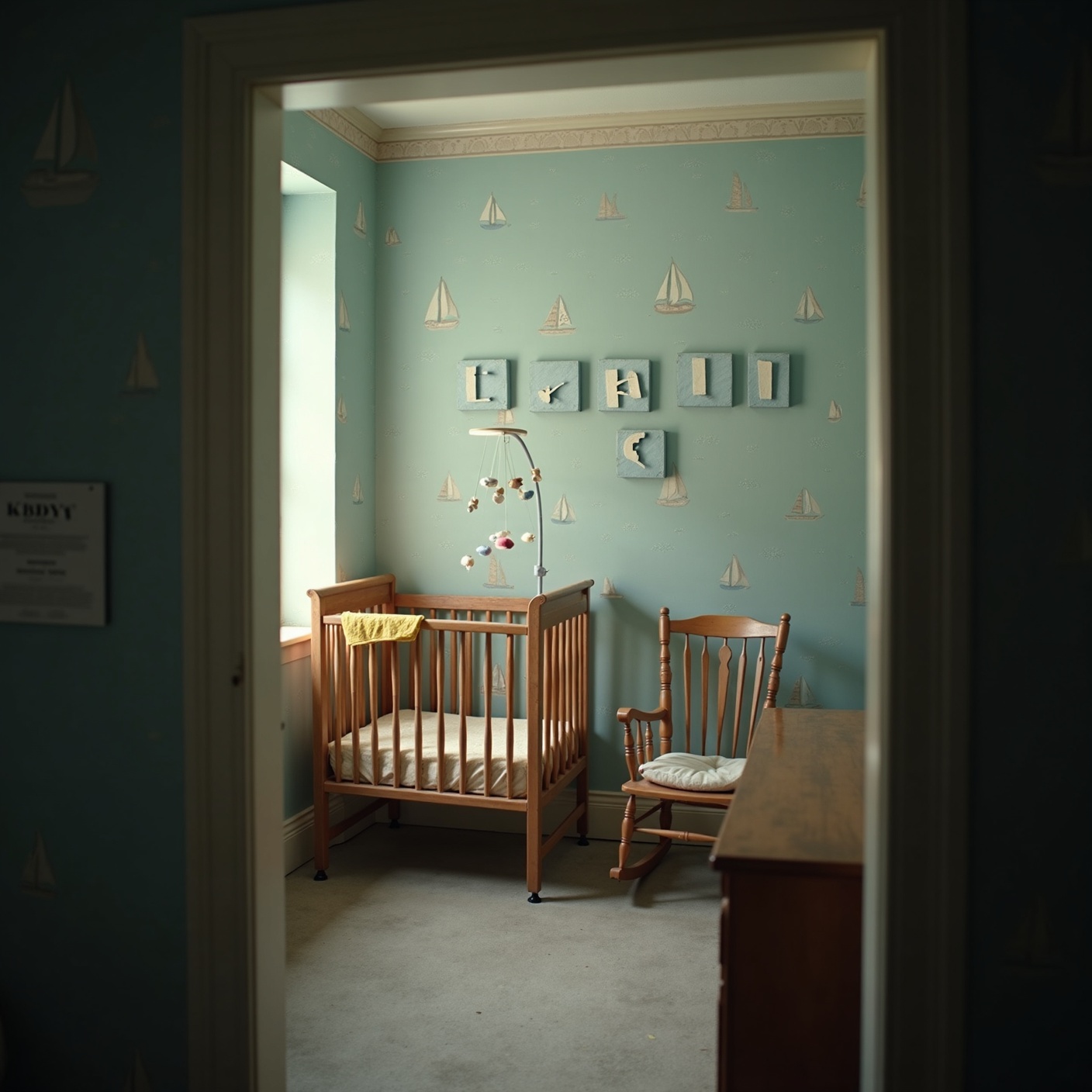
Sailboat wallpaper, faded blue on the sunny wall and still bright on the other. A crib against the far wall, made up, a yellow blanket folded over the rail. A wooden mobile of little painted fish, gone still. A rocking chair with a cushion tied to it. Everything under a gray coat of dust and everything, every single thing, put away neat.
And over the crib, screwed into the wall, five cut-out wooden letters painted pale blue. MICAH.
Brett came up the stairs two at a time when she called him. He stopped in the doorway with his hand still on the frame.
“Whose room is this,” he said. It didn’t come out as a question.
“You tell me.”
“I don’t know a Micah,” Brett said. “I have never in my life heard that name in this house.”
The dresser drawers were full of baby clothes, folded, sorted by size, the little snap-front shirts they made in the early nineties. In the bottom drawer, under a stack of receiving blankets, there was a manila folder held shut with a rubber band that had gone hard and snapped at a touch.
Two plastic hospital bracelets, the tiny kind. Two birth records from Mercy General, same night, eleven minutes apart. Brett Wesley, six pounds four ounces. And Baby Boy B, five pounds nine ounces. Behind those, a form with a state seal on it, signed by Doreen and by Wesley in his old firm handwriting, dated eleven days after they were born.
Brett sat down on the floor with his back against the crib and didn’t say anything for a long time.
Kayla went downstairs and got the photo albums out of the sideboard, the old ones, and found the 1992 pages. Every photograph from that fall has a clean scissors line down one side. Every single one. Somebody sat at a table thirty years ago and cut a picture in half, over and over, and kept the half she was allowed to keep.
She drove to Doreen’s apartment the next morning by herself. Doreen opened the door in her cardigan with her reading glasses pushed up in her hair, and she looked at Kayla’s face for about two seconds.
“You went in the closet,” Doreen said.
She made tea she didn’t drink. Wesley’s plant closed in November of 1991. She was thirty-six with a mortgage, no insurance, and twins that came six weeks early, and the smaller one spent nine weeks in the hospital before anybody would say the word home. The couple who took him were from two counties over. She kept that room exactly as it was for four years, and then one night Wesley papered the door, because she wouldn’t stop going in there and sitting in the dark.
“I haven’t opened that door since 1996,” Doreen said.
Kayla asked her about the six hours. She asked her flat out, sitting at the little table, and Doreen didn’t dress it up.
“I have handed a baby to somebody one time in my life and watched them walk out a door with him,” she said. “You’re asking me why I couldn’t do it again in an afternoon. I’ve known for thirty years what it does. I’m not able.”
Then she asked about the album, and Doreen laughed, which was the last thing she expected.
“I don’t cut you out, Kayla. I cut everything down to the baby. I’ve been doing it since 1992. It’s the only way I know how to look at a photograph.”
She got up, took the folder out of Kayla’s bag before it was offered, and put it back in her hands with both of hers on top.
“You’re the only one who ever asked me a second time,” Doreen said. “Everybody in this family lets me say I’m fine. So you do it. Find him. I can’t, and Brett will forgive me, and that’s worse than if he didn’t.”
She opened the folder again in the car in the parking lot, and there was one thing in it she hadn’t seen the night before, tucked flat behind the state form. A Christmas card from 1998. No note inside, no signature, just a photograph of a boy about six on a bike in somebody’s driveway, squinting, with the exact same widow’s peak her husband has.
Doreen had been given one picture in thirty years and she kept it in with the paperwork, where nobody would find it by accident.
They took the wallpaper off the upstairs hall and painted it a color called oat. They left the letters on the wall. Theo naps in that room now, under the sailboats, and Kayla has written four letters to an address two counties over, and mailed three.