
Hannah had been on her feet since a quarter past six that morning. It was almost two in the afternoon and she hadn’t sat down once, not even to eat the half a grilled cheese going cold on the shelf by the dish pit with her name written on the plate in ketchup, which is the closest thing to a love letter you get in a diner kitchen.
She’s twenty-two. She has worked at the Bluebird for eight months. She takes the early doubles nobody else wants because she’s putting herself through the community college two towns over, one three-credit class at a time, and every shift is another textbook she doesn’t have to put on a card.
That Tuesday they were short. Brittany called out at five in the morning with a sick kid, which nobody blamed her for, but it meant Hannah had the whole floor by herself through the lunch rush. Sixteen tables. The AC unit over the front booth had been dripping into a bus tub since June. Gary, the manager, kept saying he’d call somebody about it.
So when the man at nine asked for Gary, her stomach did the thing. That cold drop, like missing a stair in the dark.
She ran the whole morning back in her head in about two seconds flat. Had she been slow? They’d waited a while for their food, she knew that. The kitchen was buried. Had she gotten the order wrong? Was it the check? Did she forget to bring the little one more chocolate milk, the way she said she would and then got pulled to the eight-top by the window who wanted separate everything?
Table nine was a family. Mom, dad, and a boy about six with a cowlick that would not lie down no matter how many times his mother licked her thumb and went after it. Nice people. Quiet. The kind that stack their own plates at the edge of the table to make your life easier, and you love them a little for it.
When they first sat down, the mom had leaned across the table and lowered her voice the way parents do when it’s serious.
“I have to tell you,” she said. “Eli has a peanut allergy. A bad one. We carry an EpiPen, but I get nervous eating out. I’m sorry to be that mom.”
“You’re not that mom,” Hannah told her. “You’re the right mom. Give me two minutes.”
And she meant it. Her little cousin Dylan has the same thing, and she has watched her aunt read the back of a granola bar box like it owed her money. She knows what that fear looks like from the inside.
So she went back to the line and did the thing you’re supposed to do and that almost nobody has time to do on a rush.
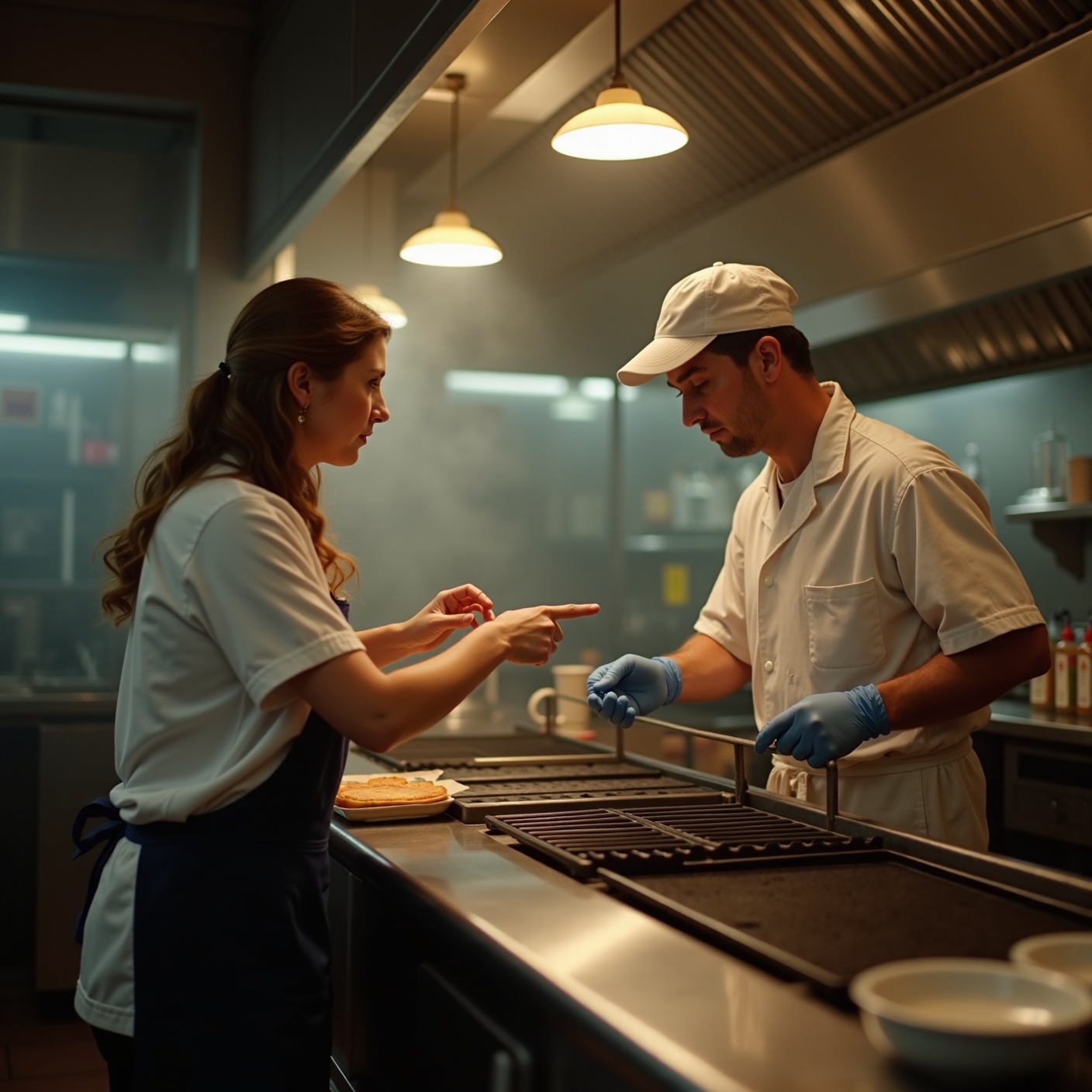
“Marcus,” she said to the cook, “table nine, the kid. Peanut allergy, the real kind. I need a clean pan, fresh gloves, and I need to know what’s in the pancake batter and whether the fryer oil’s ever touched anything with nuts.”
Marcus didn’t sigh at her. He changed his gloves right there, wiped down a section of the flat-top, and pulled the batter tub so she could read the label herself. They went through the boy’s whole order together. The pancakes were clear. The bacon was clear. She made them fresh anyway, on their own corner of the griddle, away from everything.
She carried that plate out like it was made of glass. She watched the boy take the first bite and didn’t fully breathe until he was halfway through and grinning with syrup on his chin.
That was forty minutes ago. And now the dad was asking for the manager, and all she could think was that she’d done something wrong she couldn’t even see.
She found Gary in the back office doing the liquor count. “Table nine wants to talk to you,” she said, and heard her own voice go thin. “I don’t know what it’s about. They waited kind of long for their food. I’m sorry.”
Gary gave her a look she couldn’t read and put down his clipboard.
She did not want to follow him out there. She did it anyway, hanging back by the pie case, close enough to hear, far enough to pretend she was refilling the napkin dispensers if it went bad.
Gary reached the table. “Folks. Everything all right? I understand you wanted to see me.”
And the mom, Stephanie, turned in the booth so she could see Hannah too. She reached out and put her hand flat on the table, next to the dad’s, and she looked up at Gary, and here is what she said.
“I wanted to see you,” she said, “so I could tell you about her.”
She nodded toward Hannah, whose face went hot.
“My son has a severe peanut allergy,” Stephanie said. “We almost didn’t come in. Do you know what most places do when I tell them? They nod. They say ‘should be fine.’ They rush off. And I spend the whole meal watching my boy’s face for a rash.”
Gary glanced back. Hannah stared very hard at the napkins.
“She didn’t do that,” Stephanie went on. “She went back to your kitchen and she checked everything. The batter. The oil. She had your cook change his gloves in front of us — we could see it through the window. She cooked his food separate. She treated my son like he mattered more than the rush she was clearly drowning in, and she was doing this whole room alone, I watched her, she never once let it show.”
Her voice did something on the last part. Caught.
“So I don’t have a complaint,” Stephanie said. “I have the opposite. Whatever you pay her, it isn’t enough. This girl is worth every penny and then some. Give her a raise. I mean that.”
The dad reached under the saltshaker and slid something across to Gary. Then he corrected himself, took it back, and held it out to Hannah instead.
It was five twenties, folded in half, with a receipt where he’d written across the bottom: “For Eli’s waitress. Thank you for keeping our boy safe. — The people at table nine.”
Their check was thirty-one dollars.
She would like to be able to say she said something graceful. She didn’t. She stood there in her ketchup-stained apron with her feet screaming and her eyes filling up and said, “You didn’t have to do that,” which is the dumbest possible thing to say, and Stephanie stood up and hugged her anyway, right there between the pie case and the booth, and whispered, “Yes, I did.”
Gary walked them to the door. When he came back he stood next to her for a second and didn’t say anything, and then he said, quietly, “Come see me before you clock out.”
She has thought about that whole afternoon a lot since. About how she spent two full minutes braced for the worst, sure she was about to get chewed out, when the truth was the exact reverse of everything she feared.
And she keeps thinking about how close she came to being too busy to do it right. Sixteen tables. One of her. It would have been so easy to nod and say “should be fine” and rush off, like all those other places Stephanie mentioned.
What Gary told her in that office before she clocked out — and what she did with those hundred dollars that same week — is the part she still can’t tell without her throat going tight.