
Sit down at a chessboard. Thirty-two pieces lined up in two neat rows, sixty-four light-and-dark squares, a set of rules simple enough that most people pick them up in an afternoon. It looks small. It looks knowable. It fits on a coffee table.
Now hold that image in your mind, because we’re about to compare it to the entire universe — and the board is going to win.
The number that started it all
In March 1950, an American mathematician named Claude Shannon published a paper with a plain title: “Programming a Computer for Playing Chess.” At the time no computer had ever actually played a game. Shannon was sketching, on paper, how one someday might. To do that, he first needed to know what a machine would be up against. How many different games of chess are even possible?
His method was simple enough to follow at the kitchen table. On any given turn, a player usually has somewhere around 30 legal moves to choose from. The opponent then replies with roughly 30 of their own. So a single round — one move by White, one move by Black — branches into about 30 times 30, which is close to a thousand different continuations. A typical full game lasts around 40 of these rounds before someone wins, loses, or agrees to a draw.
String it together and the arithmetic is almost insulting in how quick it is: a thousand possibilities, multiplied by itself 40 times. That comes out to 10 to the 120th power — a 1 with 120 zeros trailing behind it. Shannon was careful to call this a conservative lower bound, not an exact count. The real figure is almost certainly larger. Even so, this floor became famous under its own name: the Shannon number.
Write it out longhand and the zeros run past the edge of the page. There isn’t a common word for a number that size. It’s beyond a trillion, beyond a trillion trillion, beyond anything the human day-to-day ever needs to name.
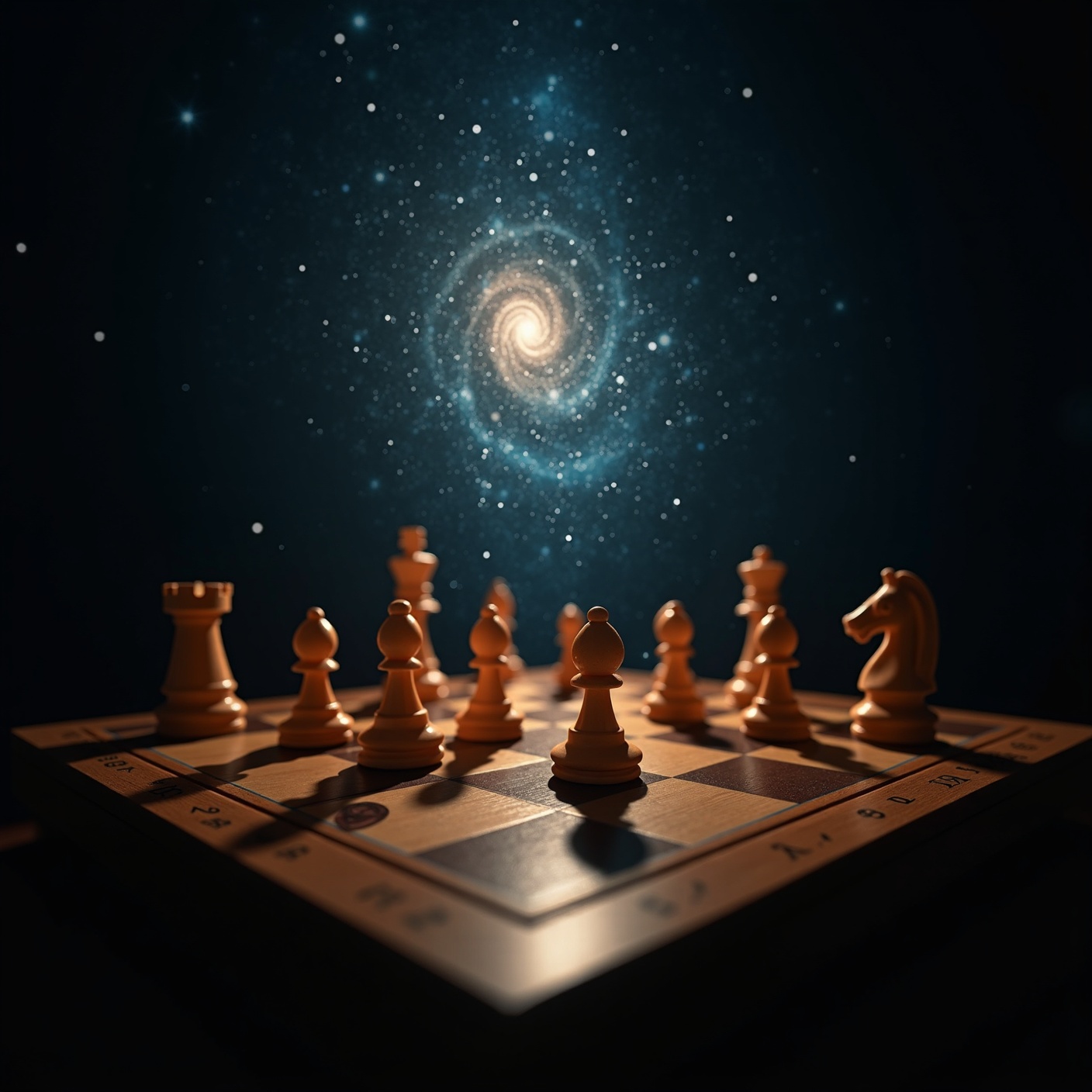
Now let’s count the universe
A number that big is hard to feel. So let’s give it something to stand next to — the biggest thing anyone can point at.
Astronomers who study the observable universe — the whole sphere of space we can actually detect, stretching billions of light-years in every direction — put the number of atoms in it at roughly 10 to the 80th power. That’s every atom in every star. Every planet, moon, and comet. Every mountain, every ocean, every cloud, every living thing, every grain of dust drifting between galaxies. Add it all up, across a span so wide light itself takes billions of years to cross it, and you get about a 1 with 80 zeros.
Set the two numbers side by side and something strange happens.
Chess: 10 to the 120th. The universe: 10 to the 80th.
The difference isn’t small. It’s 40 zeros. And in this kind of math, every single zero means ten times bigger. Forty zeros means the game outnumbers the atoms not by double, not by a thousandfold, but by a factor of 10 followed by 39 more zeros.
Try to picture the gap
Here’s one way to feel the size of it. Imagine you could take every atom in the observable universe and hand each one its very own universe — a full copy, another 10 to the 80th atoms apiece. You’d now be holding a truly absurd pile of atoms: about 10 to the 160th of them.
And the chess games would still fit inside it with room to spare — because 10 to the 120th is smaller than that. Flip it the other way and the point lands harder: the games of chess outnumber the atoms in our one universe so completely that you’d need something like a trillion trillion trillion universes’ worth of atoms just to catch up.
All of that possibility is folded into a wooden box you could carry under one arm.
A board, not a warehouse
This is the part that tends to short-circuit people, so it’s worth saying slowly. The chessboard isn’t big. It isn’t hiding a warehouse of pieces. There are only ever 32 of them at most, usually fewer as the game goes on. There are only 64 squares. Nothing about the physical object suggests infinity.
The vastness doesn’t live in the pieces. It lives in the branching. Every choice opens new choices, and each of those opens more, and the tree of “what could happen next” doubles and redoubles until it dwarfs the physical cosmos. Complexity, it turns out, isn’t the same thing as size. A small set of simple rules, allowed to interact freely, can generate more outcomes than there is matter to record them.
It’s worth separating two different questions here, because people often blur them. One is “how many different games can be played?” — that’s the Shannon number, the 10 to the 120th figure. The other is “how many legal arrangements of pieces can exist on the board at once?” That’s a smaller question, and mathematicians John Tromp and Peter Österlund pinned it down with real rigor: about 4.8 times 10 to the 44th distinct legal positions. Smaller than the number of games, but still monstrously larger than anything you’ll meet in ordinary life. Either way, the board is deeper than it has any right to be.
Why it matters beyond the trivia
There’s a reason this comparison keeps circling back around, beyond its shock value. It explains why chess has never been “solved” the way tic-tac-toe has. You could sit a computer down and ask it to simply check every possible game and pick the perfect one — and it would never finish, not if it ran until the actual stars burned out, because there aren’t enough atoms in reality to even write all the games down.
And yet, here’s the twist that makes the whole thing land. Modern chess engines don’t need to see every game. They’ve learned to navigate that unthinkable ocean by intuition and clever pruning, cutting away the hopeless branches and steering through the rest — well enough that no human grandmaster who has ever lived can beat the best of them anymore. We built machines that sail a space larger than the universe, on a board that fits on a kitchen table.
So the next time someone shrugs and calls chess “just a board game,” you have a quiet answer ready. Ask them to imagine every atom in existence. Then tell them the little wooden box holds more than that — and it isn’t even close.